
As a food writer and broadcaster I’d usually steer clear of any meal that could be described as slop. Online, however, people looking for recipes are increasingly being served exactly that.
Social media is how Gen Z get their recipes. They want their fill of hypnotic, algorithm-led food porn. Some 72 per cent of 18 to 27-year-olds say they plan and make their meals based on what they see online, mostly on TikTok and Instagram, according to a recent study by the consumer-focused consultancy Publicis Commerce. Some of it is zeitgeisty, such as the viral two-ingredient “cheat’s” cheesecake (biscuits plus Greek yoghurt, in the fridge overnight). Or the endless shots of hot honey protein bowls. Or those fiddly looking blanket dumplings. And some of it is fake.
AI slop is that hollow stuff produced by large language models such as ChatGPT and Gemini. At first glance it looks like substantial information but on closer inspection makes very little sense. In the world of food this means AI-generated recipes delivered in their thousands on social media: they’re short videos in which everything from the visuals to the voiceover and the recipe itself are created by our future machine overlords.
Watch a few of these videos and you’ll get the gist. Something is always a bit off, with uncanny movements, textures that don’t look right, chopping that requires no pressure and processes any home cook could tell you wouldn’t work.
The biggest tell is how bizarre the recipes are, often featuring revolting mixtures and insane preparations. One involves making a cake of boiled cabbage, putting the mixture into a large plastic bottle then chopping into the bottle with a knife to portion the mixture before frying it. “Now Grandma Cooks Cabbage the Same Way! New Idea for an Old Recipe,” the caption reads. Grandmas everywhere are weeping.
Another involves cooking snapped spaghetti in soy sauce, milk and butter with peppers, cabbage and chicken breast. My Italian grandma is weeping.
Often the voiceovers don’t sound right. “This preparation stands out for its practicality,” begins one video. I watch as an omelette is made, except that it contains slices of bread. The whole thing is then covered with cheese as the narrator declares meaninglessly: “You will get a golden snack so flavourful it solves any quick meal.”
The recipes seem to have been created by an alien that has just arrived on Earth. It wants to fit in with its new human companions but doesn’t quite know how.
Nevertheless, in the interests of giving modern tech a fair shot, I decide to test a recipe. I see one Instagram foodie account with millions of followers and select a recipe resembling a basket made of meat. “This is the only way to cook minced meat,” the caption declares. A meat basket is the only way? What about slow-cooked in an umami ragu, blipped away until it’s sweet and rich? A family-favourite chilli con carne? Burgers? Meatballs? A good old shepherd’s pie?
Food newsletter
Restaurant reviews, insider insights and recipes from the best chefs in the business.
Sign up with one click
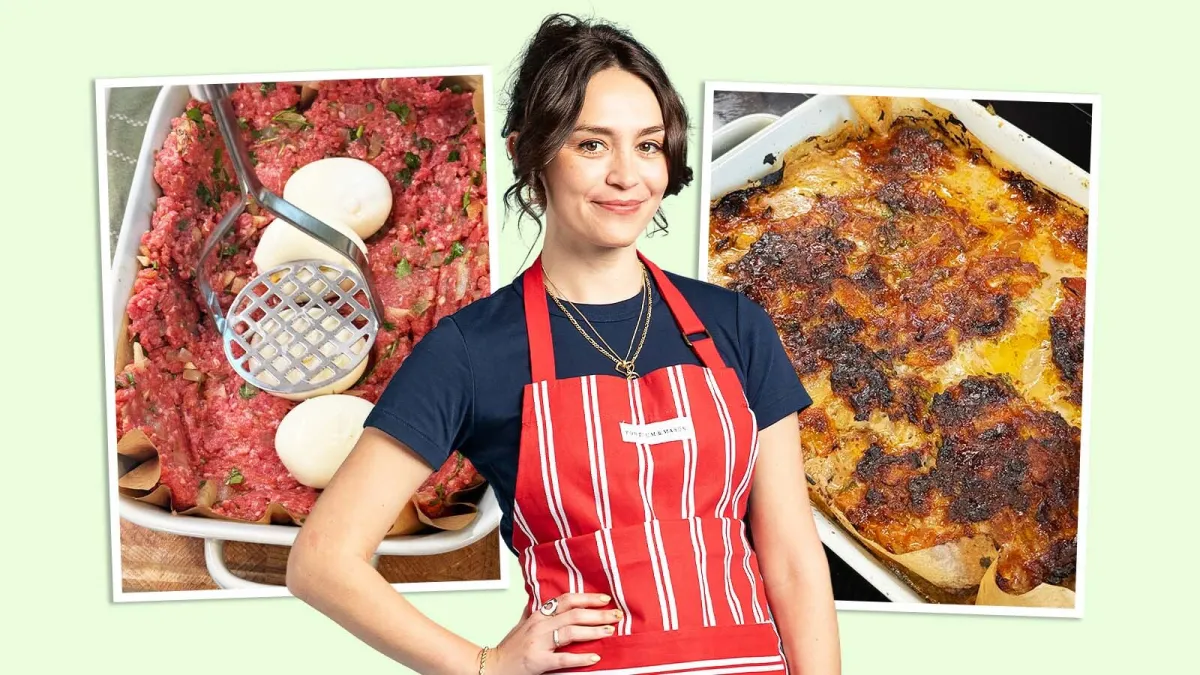
The video starts with a weirdly rigid case made entirely of raw meat. This is filled with four boiled eggs, mashed directly into their pink surroundings, creating a neat layer of bits. Then sautéed spinach, mushrooms and grated cheese are added before a solid pink meat lid goes on. Finally the whole thing is brushed with a glaze of ketchup, soy sauce, mustard and honey and baked for 45 minutes. Out it comes, its sticky condiment coating leaving it reddish and gleaming. A knife effortlessly slides through the creation, revealing perfect but unappetising layers of mashed egg, spinach, mushroom and cheese surrounded by a mass of pale meat.
The video is 29 seconds long and contains scant instructions. In the caption there’s a list of ingredients (how much is “15g of garlic”? What does “two pieces of egg” mean?) but no guidance at all on how to make the meat case. In my kitchen, unlike in the realm of AI, it doesn’t just magically appear.
I mix the meat with chopped parsley, garlic, fried onion and two eggs until I have a sticky mixture. This is basically how you make burgers or meatballs — but unsurprisingly it won’t hold up in the playdough-like structure I see on screen. I reach for scaffolding in the form of a pie dish, pushing the meat mixture up around the sides. It feels more like plastering than cooking.
I pop in four boiled eggs and retrieve my masher from the drawer. I push down on the first one, feeling considerable resistance. The masher isn’t sharp enough to cut effortlessly through the egg to produce perfectly uniform squares, as per the video. Instead the eggs burst and I am left with a mess.
I press on, layering up the other ingredients before tackling the meat lid. In the video it’s an independent entity, already fashioned and structurally sound. I have a ball of meat mix. I try my best to spread it on top then stick it around the edges with my hands. It’s not enjoyable work, and cheese and bits of mushroom are left poking through the top. I measure out the glaze — of which there’s far too much — and paint it on.
In she goes! Closing the oven door I feel relieved that my ordeal is nearly over. I sit at my kitchen table and wonder whether the point of these AI recipes is to be as weird and provocative as possible to catch and retain our attention.
Then again I know many people who find AI helpful in the kitchen. Several of my friends will input the ingredients they have in their fridge and ChatGPT will tell them what to make. I’ve used it myself to ask culinary questions or to troubleshoot (“Is my kefir OK?”). I’ve asked it to calculate the ratio of salt I need to make homemade sauerkraut. I’m aware there are dedicated AIs for the purpose of coming up with recipes, including ChefGPT and DishGen. But in terms of creativity I don’t rate it. Sure, AI systems can scrape the internet for recipes written by cooks, but they end up producing a mishmash of several recipes: quantities can be off, instructions confusing. Crucially, the final result hasn’t been tested by a tastebud-owning human being.
Maybe this sounds pretentious, but for me recipes are a way of connecting to another person: the recipe writer. They’re a portal to their point of view and a snapshot of a time and place. That’s what I love about them.
Ding! Forty-five minutes is up and my culinary Frankenstein’s monster comes out of the oven. The smell that fills my kitchen is heavy and dank, with a gross sweetness like rotting fruit. My creation looks nothing like the one online. The top isn’t a uniform reddish-orange — instead it is nearly burnt in parts, with the most unpleasant pools of milky liquid sitting in craters on the surface.
I’m an adventurous eater but even I wish I didn’t have to try it. As I push in the knife the meat crumbles and falls apart, revealing clumps of egg huddled at the bottom. There are no discernible layers. It looks as though someone has dropped a large amount of dog food.
Gingerly I try a little of the caramelised meat at the top. This doesn’t taste bad, but when I scoop up some spinach, mushroom and egg with the plain mince I’m not thrilled. It’s a bunch of bland things thrown together carelessly. My husband refuses to try it. When I later show a photo to a friend they say simply: “It’s so brown.”
Even if AI recipes get better — and they surely will — can they replicate a recipe written by a living, tasting, thinking human with a lifetime of experiences, influences and memories? I don’t think so. A recipe is a reflection of someone’s personality and AI famously has none. You can’t manufacture good taste — especially from an algorithm that cannot eat.
I think the public weariness of AI will snowball, pushing everyone to appreciate things that have an obvious human touch: idiosyncratic, artisanal, handmade. Food is a language that all humans understand and that AI, by its very nature, cannot.
The slop is not taking over. We’re already losing our appetite.