

Maro Itoje is on the seventh floor of the Clara Grant School in Tower Hamlets, east London. Through one window, an image of wealth. The gleaming glass financial hub of Canary Wharf stands incongruously over the inner-city estates. Through another, the tower block in which most of the children live, often in disadvantaged and overcrowded conditions.
Twenty young boys and girls from the primary school greet Itoje with a moving performance of World in Union, a song first recorded for the 1991 Rugby World Cup in England, before sitting in a circle to each ask him a question. How did you become England captain? What did you want to be when you grew up? What was your funniest moment on the field?
Itoje had begun his day around the corner at St Paul’s Way primary school, where 43 per cent of pupils qualify for free school meals. When Sir Keir Starmer paid them a visit, the first question posed to him was: how much do you earn? Itoje avoided that one, although he would have been well prepared. Itoje and the prime minister spent time at a recent state banquet for the president of Nigeria discussing how to deal with scrutiny.
 Itoje rubbed shoulders with the prime minister at the Nigerian state banquet at Windsor Castle earlier this month
At the Windsor Castle dinner, Itoje talked rugby with Princess Anne, who had taken great delight in handing the Calcutta Cup to Scotland after England’s defeat at Murrayfield, he had a “brief interaction with the King” about the Six Nations and talked politics and the media with Starmer.
“He had Iran and the cost of living at the forefront of his mind. We had a great conversation around all those topics and what he’s hoping to do with the country,” Itoje says. “Over the last six weeks, the England team and I have had our fair share of criticism. He has to live in that state 24-7. How does one keep to the task at hand?”
State dinners and state schools, from one extreme to another for the England captain. Itoje is here in Tower Hamlets to meet children who receive weekly tuition sessions funded by his foundation, the Pearl Fund. He is finding it an important, confronting experience.
Many of these pupils arrive into primary school without fine motor skills because they have grown up staring at tablets. That is not necessarily a criticism of parents; many of whom are out working, trying to make ends meet for their families.
 Itoje meets some of the children who receive regular tuition sessions funded by his foundation, the Pearl FundPaul Ifeneziuche
Either way, the children at both schools we visit crave the knowledge and the dedicated adult interaction provided by volunteers from Action Tutoring. School attendance on tuition days goes up. Skills improve. Confidence and communication grow.
“I’m looking behind you now,” Itoje says. “This council estate is where the majority of the kids from this school live. Maybe it’s a two-bedroom flat with three, four, five children. It’s a highly congested space. This is a densely populated area with no green space.
“We wanted to pick the most disadvantaged borough and help the kids who are the most vulnerable, who have the biggest risk. You can watch it on TV, you can read about it, but it doesn’t ram home the importance until you see it in front of you.
“If you don’t see an alternative path for yourself, if you see no hope in school or no hope in your education, then you’re much more likely to go into doing untoward behaviour.”
Itoje’s contribution is part of a wider mission to close the attainment gap — the difference in academic performance between disadvantaged and privileged children — which has been growing since Covid. As a former pupil of Harrow School, raised in a wealthy family that prioritised education, Itoje acknowledges his good fortune and the “lottery of birth”.
The last question of the session comes from Rubel Aloum, the head of school at Clara Grant. He asks Itoje to explain to the children the importance of resilience, of not giving up when they struggle with a maths problem and to keep working at their English when finishing the sentence feels hard.
 The England captain, 31, wants to help close the attainment gap — the difference in academic performance between disadvantaged and privileged children — through his foundationTimes Photographer Marc Aspland
As Itoje answers, he could just as easily be talking about England’s Six Nations campaign, which derailed alarmingly with defeats by Scotland, Ireland and Italy before a more promising performance against France in Paris. With four defeats, this was England’s worst Six Nations campaign. Resilience is needed in spades.
“Life isn’t always fun. It isn’t always sunshine and rainbows,” he says to the pupils. “When things are hard, persevere and eventually you will come out the other side. Once you do, you will look back and go, ‘Oh, I thought that was hard but now I have done it.’ Life is a series of those moments over and over again. When you have homework or a test that is a little bit hard, if you stick to it you will overcome.”
The children file off back to class, some with Itoje’s autograph on their school uniform, and we take a seat. I want to dig deeper into that advice and his belief that consistency in approach and effort will ultimately prevail.
The RFU is conducting a review of England’s campaign. Some changes, whether in management personnel, style or structure, appear inevitable. Steve Borthwick, the head coach, is expected to get the Nations Championship Tests against South Africa, Fiji and Argentina in July to prove that he can lead England out the other side. Itoje has spoken to Bill Sweeney, the RFU chief executive, and told him that responsibility rests with the players.
“You can go searching and looking for, ‘This drastically needs to change, that drastically needs to change.’ Honestly, I don’t believe that’s the case,” he says. “So much of life is about persevering. We all have a plan that you want life to look like. Particularly in a sporting context, you want to win.
 Itoje is confident that England will learn lessons from their difficult Six Nationstimes photographer Marc Aspland
“Unfortunately life doesn’t work like that all the time. You have a decision to make, whether or not you’re going to roll with the punches, whether you’re going to decide to knuckle down, do the work, persevere. I think so much good comes from those who persevere. So much good comes from those who are able to navigate their own disappointments, setbacks, and respond.
“That’s the opportunity for me as an individual, and that’s the opportunity for us as an England rugby team at the moment. We’ve obviously had a disappointing Six Nations. But I do think in a couple of years we’ll look back and be like, ‘We learnt from that experience.’”
Leadership within the squad was affected by a few senior individuals managing personal challenges and not playing well, which in turn made it harder to drive standards. Itoje came into the Six Nations having barely played for three months as he recovered from a knee injury and dealt with the death of his mother.
When he joined up with England, having attended her funeral in Nigeria, Itoje was laid low with food poisoning. “There are a number of things we can do as players, senior players and myself to align more quickly,” he says.
The RFU review aims to understand why England played at times as if in a tactical straitjacket. England’s struggles stemmed from poor discipline — operating shorthanded for more than a full Test during the Six Nations — and their inability to convert pressure into points.
 Itoje says that the players must shoulder a large portion of the responsibility for England’s disappointing performances during the Six Nations, not just the head coach BorthwickDavid Rogers/Getty Images
Again, Itoje insists that was on the players, not Borthwick. “Steve didn’t want us to play the way we were playing,” he says. “That wasn’t part of the plan. That wasn’t part of how he coached throughout the week. But we unfortunately couldn’t handle it. We spent way too much of the games with a man in the bin. And we weren’t executing.
“We were getting into the opposition 22 but we weren’t converting. We weren’t giving that extra pass. We weren’t offloading like we did throughout 2025 [and 12 straight Test wins]. Looseness around the breakdown when we were in control. All of those things we didn’t do as well as we should have done.”
So what or who triggered the positive shift in attacking intent for the France game? Itoje returns here to the theme of his conversation with Starmer and his advice to the children: in times of adversity, persevere and keep to the task at hand.
“Steve showed us so many images that week of us moving the ball and playing on top of teams,” Itoje says. “He had wanted us to do it earlier but given the situation we were in, it was really emphasised that week.
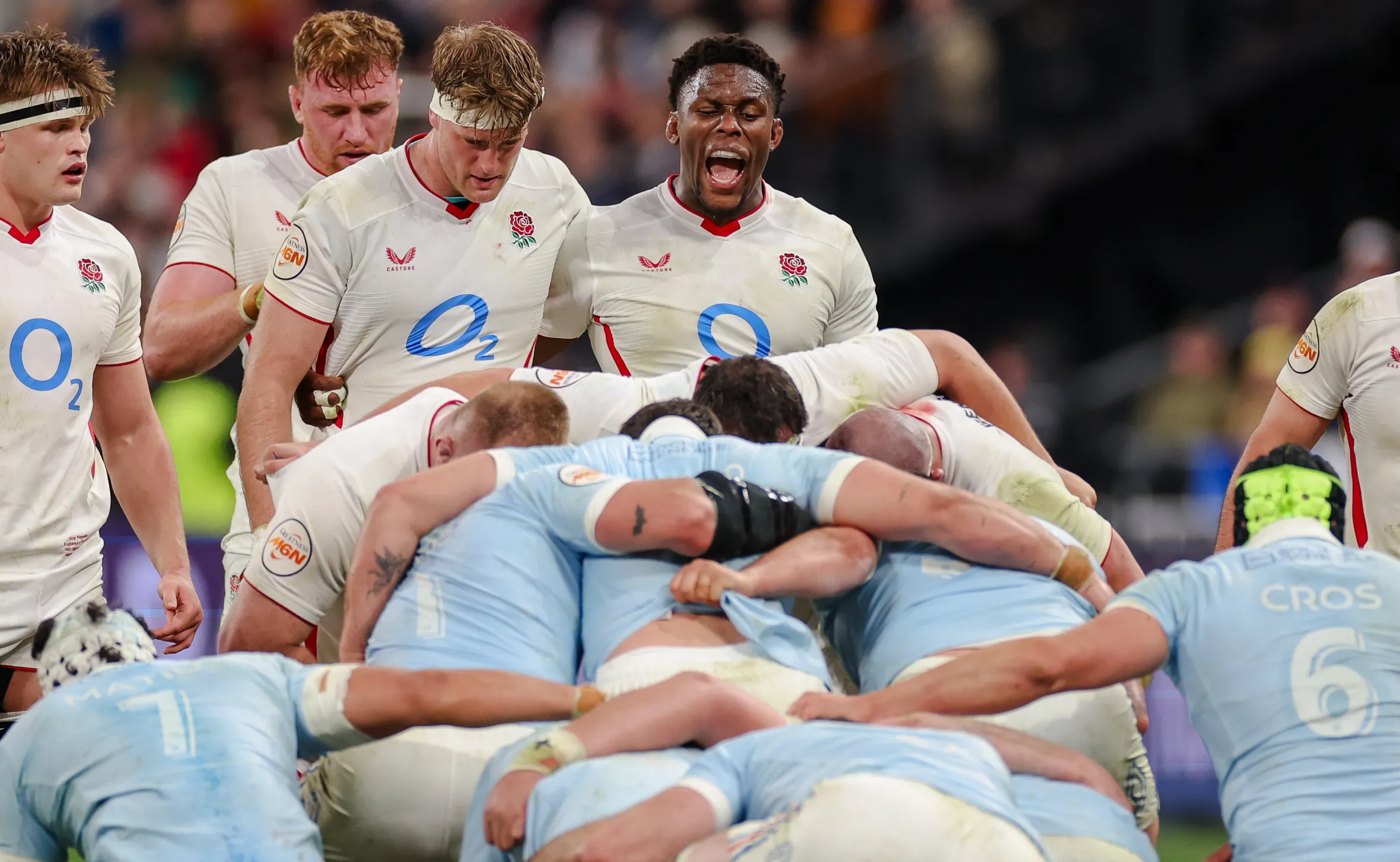 England’s performance against France was much improved — and Itoje says that was in large part down to Borthwick telling his players not to “play safe” and instead be the team that “attacks the game”Times Photographer Marc Aspland
“He said, ‘This is the team that I think you are. This is the team that I want you to be. I don’t want you to play safe. I don’t want you to just play within yourself, even if it’s just a little bit. I want you to be this team that attacks the game.’
“That France game was a reminder that if we do our stuff, if we play the way we want to play, we can beat anyone. That’s how we want to play. That’s how Steve wants us to play. That’s how the coaches want us to play. So we just need to make sure we deliver on that.
“I take responsibility alongside the senior players. We need to make sure that the team is ready to go. There is truly no need for a revolution.”