
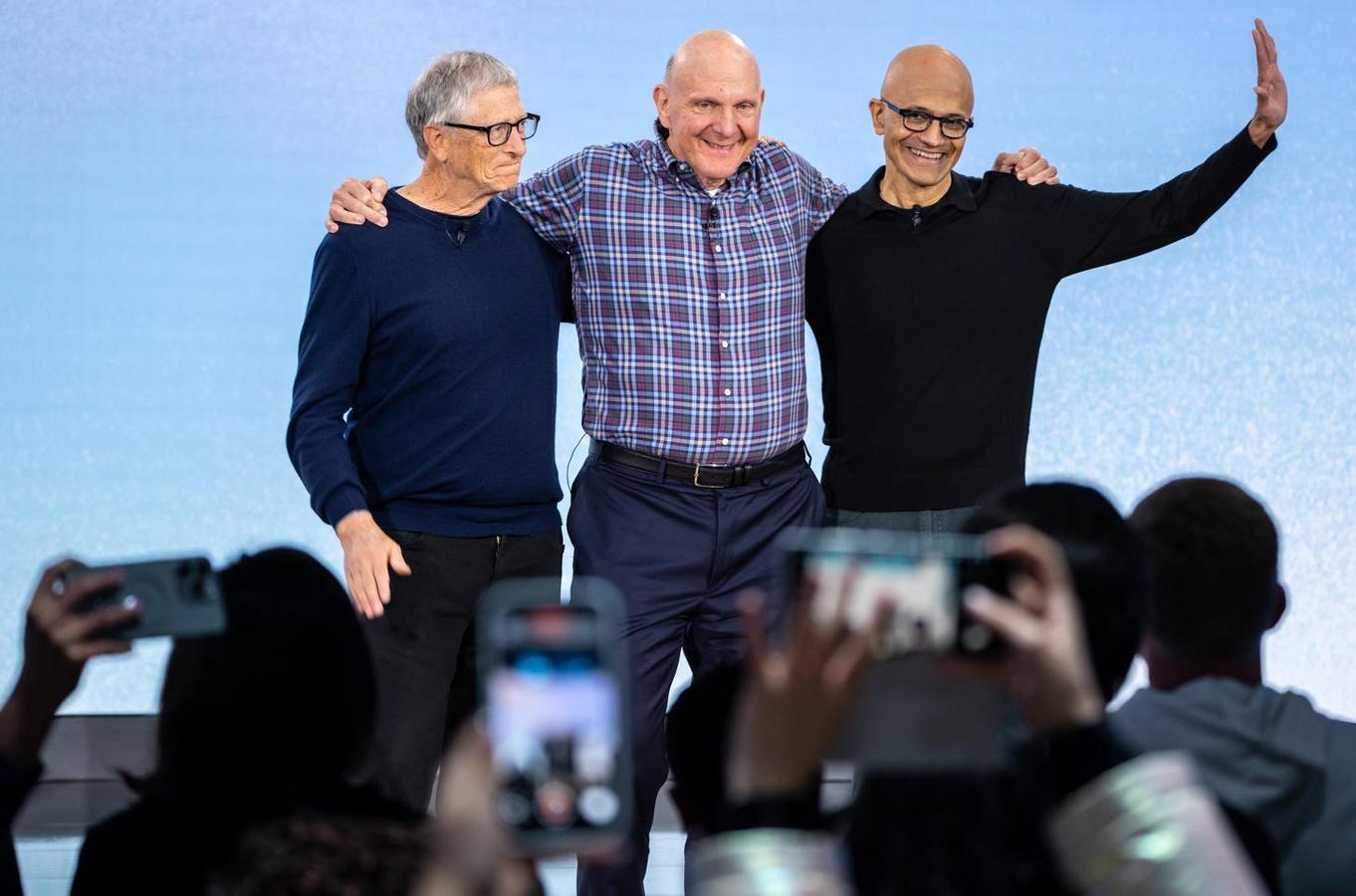

REDMOND, WASHINGTON – APRIL 4: Former Microsoft CEOs Bill Gates, left, and Steve Ballmer, center, pose for photos with CEO Satya Nadella during an event celebrating the 50th Anniversary of Microsoft on April 4, 2025 in Redmond, Washington. Microsoft also highlighted updates in Copilot, the company’s AI tool. (Photo by Stephen Brashear/Getty Images)
Getty Images
Microsoft stock has fallen 36% from its October 2025 all-time high. And 2026’s first quarter could be the worst since 2008 at the peak of the financial crisis, when the software giant’s shares fell 27%, according to Bloomberg.
Microsoft’s share decline reflects the company’s inability to disprove two prevailing narratives:
Hyperscalers are doubling down on capital expenditures without generating faster growth.AI agents from OpenAI and Anthropic may push down Microsoft’s software prices and margins.
Microsoft sees itself as uniquely qualified to earn a return in invested capital by providing software that lowers customers’ total cost of ownership.
“We have to manage a capital-intensive business, by using all of the levers that software gives us in managing TCO, managing utilization, optimizing the kernels by workload, ensuring that there’s a diverse class of customers,” Microsoft CEO Satya Nadella told Morgan Stanley Research U.S. Software Managing Director Keith Weiss. “Those are all the things that I think will generate great ROIC, and this is probably unique,” Nadella added.
While Wall Street sees as much as 57% upside, I am skeptical about Microsoft stock. Sadly, I see Nadella now doing some of what his predecessor, Steve Ballmer, did: trying to lock in customers to as many Microsoft services as possible.
ForbesCulture Is The Most Surprising Reason Microsoft Stock Will Keep RisingBy Peter Cohan
When it comes to AI chatbots, Nadella seems to be trying the same approach while failing to deliver end users a better product for their money than what rivals deliver.
Moreover, I question whether Microsoft will catch up to and ultimately overtake Anthropic’s Claude, which is setting the pace in making AI agents useful for end users.
How Microsoft Lost Its Early AI Lead
Microsoft — which invested $13 billion into OpenAI — has been spending $30 billion per quarter on CapEx to build out its AI infrastructure.
What’s more, analysts saw a big payoff coming from AI chatbots. In 2023 Credit Suisse forecast Copilot would generate $40 billion in new revenue by 2028.
The reality falls far short. While Microsoft does not disclose the number, analysts estimate annual 2025 M365 Copilot revenue was between $1.4 billion and $3.2 billion. That low number stems from a tiny proportion — around 2% to 3.3% — of Microsoft 365’s 450 million commercial users paying a $30-per-user, per-month premium to roll out Copilot companywide.
Most companies do not see the return on investment. Simply put, the time saved or value generated by Copilot does not justify doubling their standard software licensing costs.
The reason? Microsoft took a shortcut to huge revenue growth by blanketing its entire service line — from Bing to Windows to Office — with a generalized chatbot.
Unfortunately, Copilot lacked basic organizational features — such as pinning threads, easily recalling context for long-term projects or performing multistep tasks — to do complex work.
Here’s an extreme example. An accountant said he goes home and, in his downtime, uses Claude or ChatGPT to rewrite all the things that he has to do in work inside Microsoft’s Copilot system, and then emails it to his work address because his accounting firm prohibits employees from using tools that are outside of Copilot.
Personally, I asked for Copilot to be disabled from my system because it was intrusive and — unlike Claude — did not help me do anything useful.
Why Claude Gives Users More For Their Money
Microsoft implicitly agrees with me. By relying on Claude’s models to make Copilot perform high-end tasks — through the recent introduction of Copilot Cowork — Microsoft is recognizing Anthropic as the superior intelligence provider while putting its investment in OpenAI at risk.
Unlike Microsoft, which sought to win the AI narrative through distribution, Anthropic succeeds on capability and trust. Those strengths have enabled Anthropic’s enterprise market share to grow from 18% to 40% in under two years — enabling the company to land contracts with highly regulated companies like Goldman Sachs and Allianz.
Unlike ChatGPT, Claude does not require constant user hand-holding — it can do hours of autonomous work without breaking. Because of its more than 200,000-token context window, it can ingest a 600-page document, and it cuts the average time to completed 1.4-hour tasks by an average of 80%.
Claude earns enterprise trust through several features — most notably its strict zero-retention policy. This means enterprise data never trains models and is wiped after each session.
For industries that cannot risk leakage of intellectual property — such as health care, finance and managed service providers — Claude’s data policy opens up valuable market opportunities.
Of course, offering more capabilities for users is half the value equation — the other is the AI chatbot’s return on investment, as measured by how long it takes cost savings from the tool to earn back its TCO.
By that measure, Claude prevails over Copilot. To be sure, Microsoft’s sticker price is half Claude’s typical $60 per user per month; however, Copilot only works with premium Microsoft 365 E3 or E5 licenses, which go for an additional $36 to $57 per user per month.
What’s more, Microsoft charges the same amount regardless of how much each employee uses Copilot. If a company buys 1,000 Copilot licenses ($360,000/year) but only 5% of employees actually use it daily – a common adoption hurdle in early pilot programs – the effective cost for Copilot’s actual users increases to $600 per active user per month.
Claude also saves enough money to pay back its customers’ investment by reducing coding costs. For example, Claude Opus models achieve a 72.5% success rate, and they boost team coding productivity by 55%.
If a Claude enterprise customer pays $1,000 per month for application programming interfaces, the 55% productivity increase on an engineer costing $150,000 per year more than offsets the monthly API fee.
By contrast, Copilot cuts time for simple tasks but is less successful than Claude at time-consuming autonomous ones. Microsoft cites time reductions of 30% to 90% for generating an Excel chart or a Word doc.
However, Copilot’s success rate on autonomous coding benchmarks is between 45% and 55%. Moreover, Copilot generally cannot hold context for longer than 30 to 60 minutes and generally requires frequent human prompting and correction.
To be fair, Microsoft is trying to move forward with agentic AI; however, the momentum favors Claude.
Between mid-2025 and January 2026, Copilot subscribers who use the product as their primary AI option fell from 18.8% to 11.5%. What’s more, a 2026 survey concluded that at 46%, Claude Code is the most-loved AI developer tool — far more than GitHub Copilot’s 9%.
What Analysts Are Saying
Despite Microsoft’s competitive challenges in delivering a tangible return on investment to enterprise AI chatbot customers, Wall Street remains very bullish on the stock. More specifically, 67 analysts set an average price target of $592 for Microsoft — suggesting 66% upside, according to Bloomberg, which is the highest “implied return on record” going back to 2009.
Not every Wall Street analyst shares this general bullish sentiment.
One bearish analyst needs convincing that AI chatbots won’t eat Microsoft’s software lunch. “There is this concern that rather than paying Microsoft, we’ll see more customers go directly to AI vendors, which could disrupt the core business, or at least pressure pricing and margins,” Janus Henderson Investors portfolio manager Jonathan Cofsky told Bloomberg.
He also questions whether the company’s CapEx will pay off. “Microsoft has become a lot more capital intensive,” Cofsky added. “For the shares to perform better going forward, we need to become more comfortable that software growth won’t materially decelerate.”
Microsoft’s CapEx growth is indeed significant. Between fiscal 2025 and fiscal 2028, the company’s capital expenditures are anticipated to rise at a 29.5% average annual rate from $88 billion to $191 billion, noted Bloomberg,
To be fair, another analyst is a long-term bull. “I think the stock has a lot of long-term value,” Allspring Global Investments portfolio manager Jake Seltz told Bloomberg.
“Its AI strategy will ultimately be vindicated, and I think it is largely insulated from the biggest AI disruption fears. In the meantime, those concerns are creating an opportunity, especially if you’re willing to have some patience,” he added.
But a gnawing concern remains. Microsoft 365 has not seen revenue growth accelerate from Copilot as expected, according to research from analysts at UBS who have not seen a big “usage ramp.”
Unless Microsoft can free itself from the need to lock in its 450 million commercial users to the company’s full product set, Anthropic’s will keep gobbling up more agentic AI market share.