
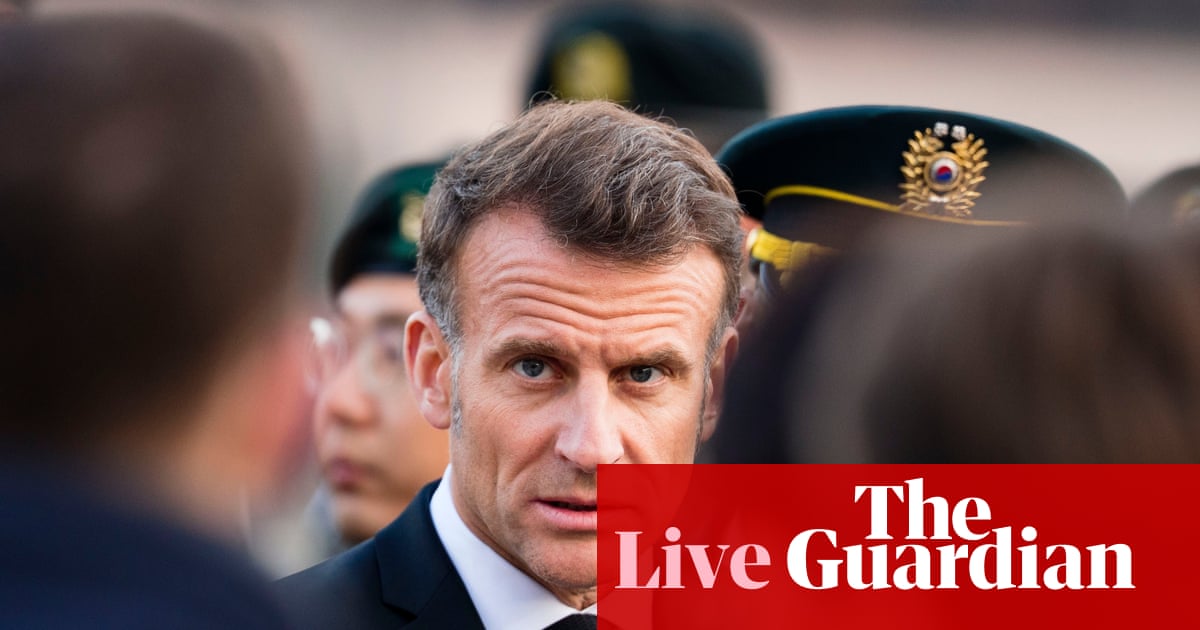
Macron criticises Trump, says ‘unrealistic’ to reopen strait of Hormuz by force
The French president, Emmanuel Macron, has hit out at Donald Trump, saying he was undermining Nato by creating “daily doubt about his commitment” to the alliance.
The US president, in interviews to various media yesterday, made disparaging comments about Nato, calling it a “paper tiger” and threatening to pull the US out of it. Trump has been especially critical of the alliance for refusing to heed his demands to secure the strait of Hormuz by force, provoking the ire of European leaders.
Macron warned that Trump’s comments questioning the US commitment to the alliance “erode its very substance” as he urged leaders to “be serious”.
“I believe that organisations and alliances like Nato are defined by what is left unsaid – that is, the trust that underpins them, and that has often been the case, incidentally, with military and strategic matters,” he said durinng a state visit to Seoul in South Korea.
“If you cast doubt on your commitment every day, you erode its very substance.”
He continued: “We need to be serious, and if you want to be serious, you don’t go around saying the opposite of what you said the day before.
“I think there is too much talk.”
Macron said it “unrealistic” to reopen the Hormuz strait by force, telling reporters that it would expose navies to Iranian attacks. He said securing the strait could only be done “in coordination with Iran” after a ceasefire.
For the latest European reactions to the war in the Middle East and all the other news from across the continent, follow our Europe live blog here:
Updated at 08.09 EDT
Key events
Show key events only
Please turn on JavaScript to use this feature
 Graeme Wearden
Now for some more on the market reaction. rent crude is now ‘only’ up 5% today at $106.40 a barrel, following reports that Iran and Oman are working on a protocol to cover travel through the strait of Hormuz.
That’s down from its earlier high of $109.74 a barrel, but still higher than the $99 at which it started the session.
ShareReport: Iran is drafting a protocol with Oman to monitor traffic in the strait of HormuzGraeme Wearden
Iran is drafting a protocol with Oman to monitor traffic in the strait of Hormuz, the official IRNA news agency cited deputy foreign minister Kezem Gharibabadi as saying this afternoon.
Iranian deputy foreign minister Kazem Gharibabadi has apparently told Sputnik, the Russian government-owned news agency, that Iran has nearly completed its draft protocol, which would establish a new navigation regime in the strait of Hormuz.
Gharibabadi told Sputnik:
double quotation markThe draft of this protocol is currently in the final stages of preparation. Once we have it ready, we will begin negotiations with Oman so that we can draft a joint protocol.
Gharibabadi then explained that the protocol would mean that, in peacetime, all vessels that pass through the strait must have all the necessary agreements with the coastal states – Iran and Oman, and obtain the necessary permits and licenses in advance.
Updated at 11.45 EDT
Polish prosecutors have opened an investigation into a bomb attack that wounded a Polish soldier who was part of a UN peacekeeping patrol in Lebanon, the District Prosecutor’s Office in Warsaw said on Thursday.
The 29 March bombing was carried out in Bint Jubayl by an unidentified person using an improvised explosive device on the route of the Polish convoy, prosecutors said in a statement, Reuters reported.
The statement said the bomb attack failed due to the HMMWV, or Humvee, vehicle’s security measures.
The wounded soldier suffered injuries to his face and head, the office said. The UN Interim Force in Lebanon, or UNIFIL, was first deployed in 1978 and has remained through successive conflicts, including a 2024 war during which its positions came under fire repeatedly.
US-Israeli strikes hit a bridge near Tehran on Thursday, which had already been hit around an hour earlier, Iranian state TV reported.
“A few minutes ago, the American-Zionist enemy once again targeted the B1 bridge in Karaj,” a city west of Tehran, state TV said, adding that the first strike had caused two civilian casualties.
It said the later attack took place as emergency teams were deployed to the site to help victims of the first strike.
Argentina’s government declared Iran’s charge d’affaires, Mohsen Tehrani, “persona non grata” and expelled him from the country, Argentina’s foreign minister said in a statement on Thursday.
The measure orders Tehrani to leave the country within 48 hours.
The decision comes in response to a statement released on Wednesday by Iran’s Ministry of Foreign Affairs, which accused Argentina’s president, Javier Milei – an ally of the US president, Donald Trump – and his foreign minister, Pablo Quirno, of being complicit in military attacks on its territory.
Argentina’s foreign minister said Iran’s claims “contain false, offensive, and unfounded accusations against the Argentine republic and its highest authorities”.
Updated at 10.51 EDT
UN chief Antonio Guterres warned that the Middle East conflict risked spiralling into a wider war, as he called for an immediate halt to US-Israeli strikes on Iran and Iranian attacks on its neighbours.
“We are on the edge of a wider war that would engulf the Middle East with dramatic impacts around the globe,” the secretary-general told reporters in New York.
Share Helena Horton
The closure of the strait of Hormuz, the crucial oil and gas shipping route that has been blocked by Iran since the US-Israeli attacks began, is having ripple effects around the world, with most industries already grappling with rising energy costs.
If the strait is not reopened, transport blockages across the Middle East could cause significant shocks to food and medicine supplies.
No one knows how long the wider conflict will last, but governments are panicking about the implications.
Yvette Cooper, the UK foreign secretary, is hosting a meeting with 35 other countries on Thursday to discuss reopening the strait.
Here is what could happen in the UK if the blockade drags on:
The Lebanese prime minister, Nawaf Salam, said there was no end in sight to the war that has killed hundreds of people and left a million more displaced.
Marking one month since Lebanon was dragged into the Middle East war, with the Israeli military fighting Iran-backed Hezbollah militants along the southern Lebanese border, Salam said his country was committed to “employing all available means to stop the war”.
Speaking at a press conference, he said: “Lebanon has become a victim of a war whose outcomes or end date no one can predict with certainty.”
The Israel Defense Forces (IDF) has issued unprecedented evacuation orders for swathes of the Lebanese south, which it claims to be a Hezbollah stronghold. With troops advancing further into Lebanese territory, Israel said it will occupy and destroy the homes along the border to prevent the return of about 600,000 residents.
A man stands atop the rubble from a building destroyed in an Israeli airstrike in Dahiyeh, Beirut’s southern suburbs. Photograph: Hassan Ammar/APYoung boys sit at the entrance of a tent at an unofficial camp for displaced people on Beirut’s waterfront area. Photograph: Joseph Eid/AFP/Getty Images
Since the start of attacks, 1,318 people have been killed in Lebanon and 3,935 injured, according to the country’s health ministry. More than 1.1 million people have been displaced, including hundreds of thousands of children, the UN said.
“We are called upon to continue our work in strengthening our capacities, obtaining greater support for sheltering the displaced, responding to their needs, ensuring their good hosting—indeed, their embrace—and safeguarding their security as well as the security of their hosts among the citizens throughout all of Lebanon,” said Sawaf.
“For these displaced persons are the first and greatest victims of a war in whose waging they had no say or decision.”
Share‘Everyone is thinking about oil prices’: is Iran using the war to hide a surge in executions? Sarah Johnson
It has been almost three months since Peyvand Naimi, 30, was arrested in connection with the mass street protests that spread across Iran in January before being brutally suppressed. Since then, he has been detained for more than a month in solitary confinement, appeared in a televised forced confession, and has undergone two mock hangings, beatings, interrogation, psychological torture and starvation.
He has been accused of involvement in the deaths of security agents during the protests and of celebrating the death of Iran’s former supreme leader, Ali Khamenei, but his family insist he has done nothing wrong and that no formal charges have been made. He has been denied access to a lawyer; his relatives fear he now faces execution.
“My whole body was shaking when I heard about the torture he has endured,” says Zahra Hosseini*, a close relative. “It’s unbelievable. I am very worried.”
Naimi’s uncertain fate comes amid concerns that a surge in executions is taking place in Iran and has been “overshadowed” by the US-Israeli war on Iran. At least 145 people are confirmed to have been killed in 2026 so far, with an additional 400-plus executions reported but not verified, according to Iran Human Rights.
Read the full report here:
Updated at 09.19 EDT
Israeli defence minister Israel Katz has warned that Hezbollah chief Naim Qassem would pay an “extraordinarily heavy price” for escalating attacks during the ongoing Jewish holidays.
“I have a clear message for Naim Qassem… you and your associates will pay an extraordinarily heavy price for the intensified rocket fire directed at Israeli citizens as they gathered to celebrate Passover Seder,” Katz said in a video statement.
Austria has rejected US requests for military overflights of its territory since the start of the conflict in the Middle East in line with its policy of neutrality, a defence ministry spokesman told AFP on Thursday.
“There have indeed been requests and they were refused from the outset,” Colonel Michael Bauer said, adding that every time a similar request “involves a country at war, it is refused”.
Austria has been a neutral country since 1955. It is surrounded to the north, south, and east by Nato members, with neutral Switzerland to the west.
Germany and China both want to restore the freedom of navigation in the strait of Hormuz and agree that individual states must not control sea lanes or levy tolls for passage, the foreign ministry in Berlin said on social media platform X on Thursday.
China can exert its influence on Iran to bring about a negotiated solution and an end to hostilities against the Gulf states, added the ministry.
Updated at 08.39 EDT
Iran’s two largest steel plants have been forced out of action by several waves of US and Israeli attacks, the companies have said.
“Our initial estimate is that restarting these units will take at least six months and up to one year,” Mehran Pakbin, deputy head of operations at the Khuzestan Steel Company, was quoted as saying by the Mizan Online website on Thursday.
Mobarakeh Steel Company in the central province of Isfahan said that its “production lines have completely shut down following the high volume of attacks”.
Both plants have suffered repeated strikes since last week.
ShareYvette Cooper condemns ‘Iranian recklessness’ over global economic security
The UK foreign secretary, Yvette Cooper, is chairing a meeting of almost three dozen nations to discuss measures to help reopen the strait of Hormuz.
She condemned “Iranian recklessness” for “hitting global economic security”, adding that the UK is seeking to lead a diplomatic initiative to restore access to the maritime route being targeted by Iran in retaliation for the US-Israeli campaign against it.
She said there were more than 25 attacks on vessels in the strait and 20,000 seafarers trapped on 2,000 ships.
UK foreign secretary Yvette Cooper speaks during a virtual summit. Photograph: Leon Neal/Reuters
“Iranian recklessness towards countries who were never involved in this conflict… is not just hitting mortgage rates and petrol prices and the cost of living here in the UK and in many different countries across the world, it is hitting our global economic security,” she said.
Speaking ahead of the virtual meeting, she said military planners are being convened to look at how to de-mine the strait as past of efforts to secure the vital sea passage, the Press Association news agency reported.
“Alongside today’s discussions, we are also convening military planners to look at how we marshal our collective defensive military capabilities, including looking at issues such as de-mining or reassurance once the conflict eases,” she said.
For more UK reaction to the Middle East war and other news, you can follow our UK politics blog here:
The Philippines said Iran has pledged to allow safe passage of oil shipments through the strait of Hormuz.
Officials said a “productive phone conversation” between the Philippine foreign secretary, Theresa Lazaro, and her Iranian counterpart, Abbas Araghchi, had opened the door to crucial oil shipments.
“The Iranian foreign minister assured the secretary that Iran will allow the safe, unhindered, and expeditious passage through the strait of Hormuz of Philippine-flagged vessels, energy sources, and all Filipino seafarers,” the Philippine foreign affairs department said in a statement.
The Philippine president, Ferdinand Marcos, declared a state of “national energy emergency” last week as a result of the Middle East war, which his administration said posed “an imminent danger of a critically low energy supply”.
ShareMacron criticises Trump, says ‘unrealistic’ to reopen strait of Hormuz by force
The French president, Emmanuel Macron, has hit out at Donald Trump, saying he was undermining Nato by creating “daily doubt about his commitment” to the alliance.
The US president, in interviews to various media yesterday, made disparaging comments about Nato, calling it a “paper tiger” and threatening to pull the US out of it. Trump has been especially critical of the alliance for refusing to heed his demands to secure the strait of Hormuz by force, provoking the ire of European leaders.
Macron warned that Trump’s comments questioning the US commitment to the alliance “erode its very substance” as he urged leaders to “be serious”.
“I believe that organisations and alliances like Nato are defined by what is left unsaid – that is, the trust that underpins them, and that has often been the case, incidentally, with military and strategic matters,” he said durinng a state visit to Seoul in South Korea.
“If you cast doubt on your commitment every day, you erode its very substance.”
He continued: “We need to be serious, and if you want to be serious, you don’t go around saying the opposite of what you said the day before.
“I think there is too much talk.”
Macron said it “unrealistic” to reopen the Hormuz strait by force, telling reporters that it would expose navies to Iranian attacks. He said securing the strait could only be done “in coordination with Iran” after a ceasefire.
For the latest European reactions to the war in the Middle East and all the other news from across the continent, follow our Europe live blog here:
Updated at 08.09 EDT
Here are some of the latest images on the newswires as conflict deepens across the Middle East:
First responders search for survivors at the site of an overnight Israeli airstrike that targeted a house in the southern Lebanese village of Zibdine. Photograph: Abbas Fakih/AFP/Getty ImagesPeople queue up to buy gas in Noida in India’s northern state of Uttar Pradesh amid ongoing oil and gas import disruptions caused by the Middle East war. Photograph: Arun Sankar/AFP/Getty ImagesPeople inspect the damage at a McDonald’s as a result of a projectile fired from Lebanon, in the Gan Hatzafon area in Kiryat Shmona, Israel. Photograph: Atef Safadi/EPAMembers from the Popular Mobilisation Forces attend a funeral of fighters who were killed in a US airstrike in Tal Afar, Nineveh province, north of Baghdad, Iraq. Photograph: Hadi Mizban/APUS president Donald Trump delivers a national addresss from the White House. Photograph: Getty ImagesShare