
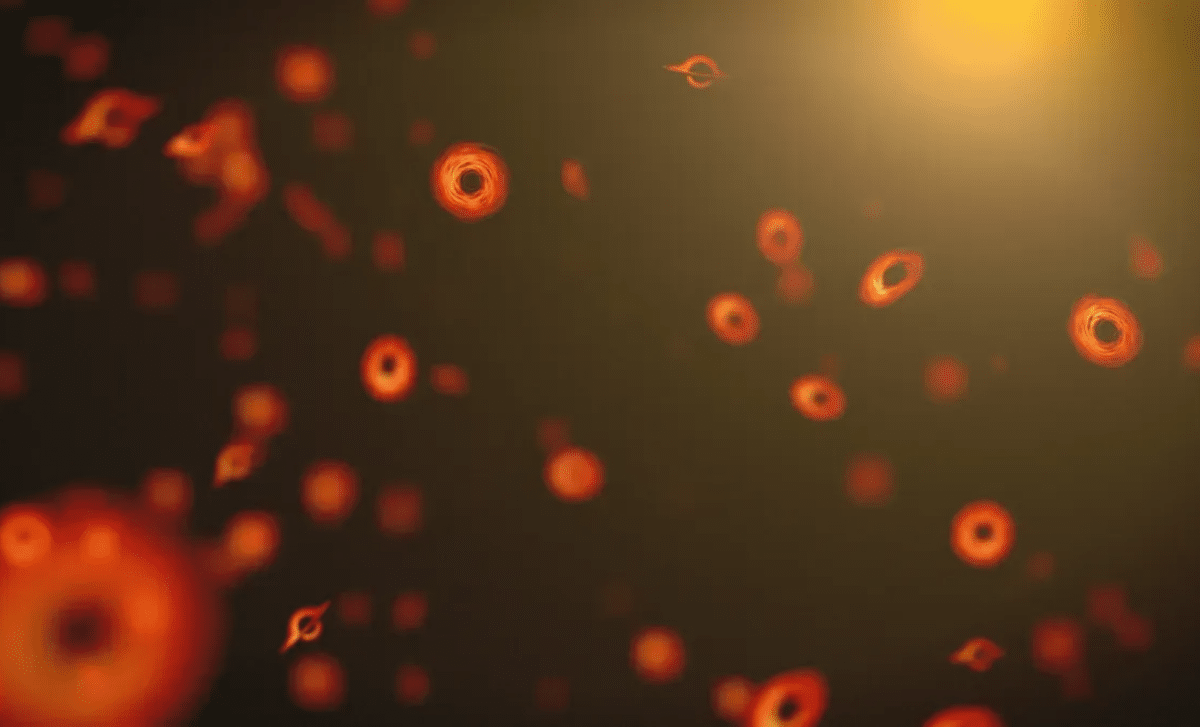
esearchers may have detected the first direct evidence of primordial black holes, potentially reshaping our understanding of dark matter. The gravitational wave signal, captured by LIGO in November 2025, has sparked a revolutionary hypothesis: the collision that produced the signal might not have involved conventional stellar black holes, but rather black holes formed in the earliest moments of the universe. This study, led by researchers at the University of Miami and available on arXiv, suggests that primordial black holes could account for a significant portion of the mysterious dark matter that pervades the cosmos.
The Strange Gravitational Wave Collision
In November 2025, LIGO’s detectors captured an unusual gravitational wave signal, S251112cm, that left scientists perplexed. The collision, unlike anything observed before, involved two objects far lighter than the typical stellar black holes or neutron stars that have been the usual suspects in such cosmic events. The masses of these objects were surprisingly small, ranging between 10 to 87 percent of the mass of our Sun. This finding immediately raised eyebrows in the astrophysical community. Traditional black holes, which are the result of supernova explosions, typically have a minimum mass of around 1.4 solar masses, but these objects defied that expectation.
The peculiar characteristics of the signal pushed researchers to explore radical theories. One possibility that emerged was that the detected objects were primordial black holes, hypothetical black holes that could have formed in the universe’s infancy, shortly after the Big Bang. Unlike their stellar counterparts, primordial black holes could be significantly lighter, with masses much lower than that of the Sun.
A Revolutionary Hypothesis
According to the research, available on arXiv, this gravitational wave signal could represent the first-ever evidence of primordial black holes colliding.
“The research suggests that the most plausible explanation for the LIGO signal, which lacks any conventional astrophysical explanation, is the detection of a primordial black hole,” said senior author Nico Cappelluti, an associate professor at the University of Miami. He went on to emphasize the potential significance of this discovery, stating that “these primordial black holes could account for a significant portion, if not all, of dark matter.”
Dark matter, a mysterious and invisible substance that makes up about 27% of the universe’s mass, has long been one of the greatest puzzles in modern physics. If primordial black holes are indeed the key to dark matter, it would not only solve one of the most pressing problems in cosmology but could also open the door to new areas of research and discovery.
Primordial Black Holes and the Early Universe
The concept of primordial black holes dates back to the earliest days of the universe. These objects are theorized to have formed in the extremely dense conditions just moments after the Big Bang, when the universe was a hot, dense soup of particles. Unlike stellar black holes, which are the remnants of massive stars, primordial black holes would have formed from the fluctuations in the density of matter during the first few moments of cosmic history.
What makes primordial black holes so intriguing is their potential to explain dark matter. Since they don’t emit light or interact with regular matter in detectable ways, they are incredibly difficult to observe directly. Their detection, if confirmed, would offer a compelling solution to the dark matter conundrum. Furthermore, primordial black holes could also shed light on the early universe, providing insights into conditions shortly after the Big Bang that we are currently unable to replicate in labs.
The Dark Matter Connection
The idea that primordial black holes could make up dark matter is not entirely new. Scientists have long speculated that small black holes, formed in the extreme conditions of the early universe, might be a key component of dark matter. However, the discovery of a gravitational wave signal that might be attributed to these very objects could provide the first tangible evidence to support this theory.
Alberto Magaraggia, lead author of the study and a graduate researcher at the University of Miami, elaborated on this by saying,
“We attempted to estimate how many primordial black holes may exist in the universe and how many of them LIGO should be able to detect. And our results are encouraging. We predict that subsolar black holes like the one LIGO may have observed should indeed be rare, consistent with how infrequently such events have been seen so far.”
This statement highlights the rarity of these events, but also the possibility that LIGO might be able to detect more such collisions as its sensitivity increases over time. If further observations confirm the existence of primordial black holes, this could mark the dawn of a new era in the study of dark matter.