

A new mission concept from Delft University aims to survive on Venus far longer than any spacecraft in history, opening the door to sustained geological and atmospheric science on Earth’s hostile neighbor.
No spacecraft has ever survived more than two hours on the surface of Venus. The Soviet Venera 13 lander set that record in March 1982, enduring 127 minutes before succumbing to temperatures exceeding 460 degrees Celsius and atmospheric pressures roughly 92 times greater than those at sea level on Earth. More than four decades later, the Venusian surface remains one of the least explored environments in the solar system, not for lack of interest, but for lack of engineering solutions capable of surviving it.
A team at Delft University of Technology in the Netherlands believes it may have found a path forward. According to research presented at the 57th Lunar and Planetary Science Conference, the team has proposed KYTHERA, a lander mission concept designed to operate on Venus’s surface for up to 200 Earth days, a duration that would represent an extraordinary leap beyond anything previously achieved.
An Engineering Challenge Unlike Any Other
The core problem with landing on Venus is straightforward: the planet destroys spacecraft quickly. Average surface temperatures sit around 464 degrees Celsius, and the crushing atmospheric pressure is comparable to diving nearly a kilometer beneath Earth’s oceans. Every previous lander, all built during the Soviet space program between 1970 and 1985, was essentially racing against the environment from the moment it touched down.
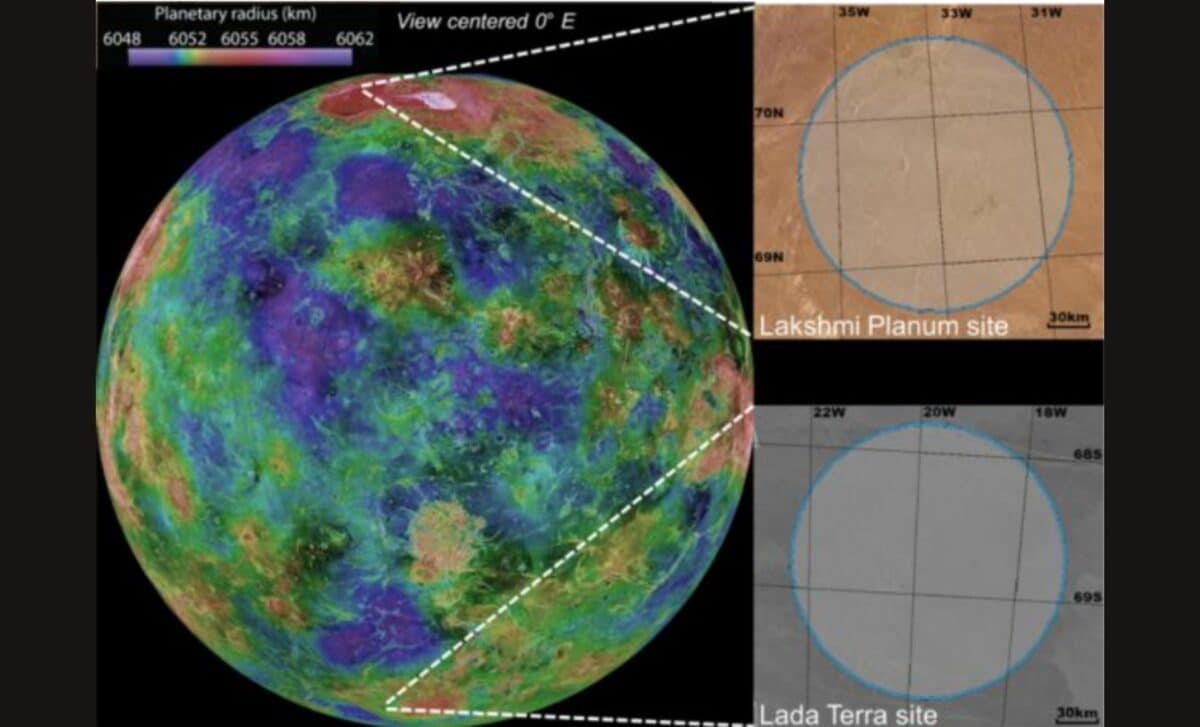 Overview of proposed landing sites ©57th LPSC (2026)
KYTHERA’s proposed solution centers on a hot-cold box architecture combined with Stirling radioisotope generators that would provide both electrical power and active cooling. The cold box is designed to house temperature-sensitive instruments at stable operating conditions, while the overall structural design draws on the proven Venera-style configurations that, despite their limitations, successfully reached the surface on multiple occasions. Radioisotope power systems are well-established technology, having been used on missions ranging from the Voyager probes to NASA’s Curiosity and Perseverance rovers on Mars.
The lander would also carry a deployable seismometer arm, designed to make direct contact with the ground for optimal coupling, along with a Venus Mass Spectrometer suite adapted from instruments developed for NASA’s forthcoming DAVINCI mission. A Raman LIBS spectroscopy system would allow geological analysis of surface rocks at distances of several meters, with the mission targeting at least 20 individual rock analyses to characterize mineralogical diversity across the landing site.
Choosing Where to Land
According to the research, two candidate landing sites were evaluated: Lakshmi Planum, a high plateau in Venus’s northern hemisphere, and Lada Terra, a large highland region in the southern hemisphere. The two sites represent a classic tension in planetary exploration between engineering safety and scientific ambition.
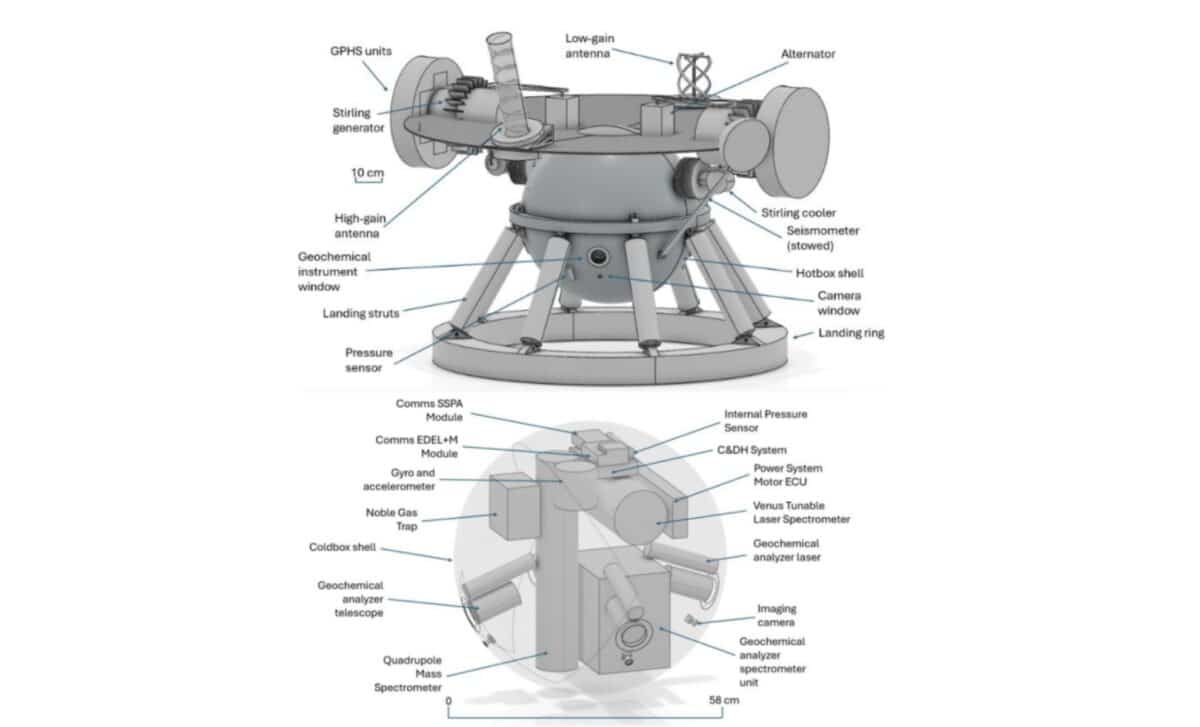 Lander and cold box design ©57th LPSC (2026)
Lakshmi Planum offers somewhat lower pressure and temperature conditions, providing greater engineering margins for the lander’s thermal systems. Lada Terra, by contrast, presents a more demanding environment but is scientifically compelling, the region features potentially active coronae and is considered a promising target for detecting seismic activity and recent volcanism. The team provisionally selected Lakshmi Planum pending more detailed analysis, with a proposed launch window between 2035 and 2037.
Science operations would begin before the lander even touches down. The Venus Mass Spectrometer would conduct atmospheric sampling roughly every 200 meters during descent, building a vertical chemical profile of the atmosphere. After landing, continuous seismic and environmental monitoring would run for the full mission duration, with atmospheric composition measurements taken approximately every 12 hours.
The researchers are candid about what remains unresolved. According to the study, additional work is needed on instrument performance and materials durability under Venus’s surface conditions, work that will be pursued through a newly established high-pressure, high-temperature laboratory for planetary materials at Delft. Whether KYTHERA ultimately evolves into a funded mission will depend on results from that facility, as well as broader decisions within international Venus exploration programs.
For now, the concept joins a growing body of renewed scientific interest in Venus, as agencies including NASA, the European Space Agency, and India’s ISRO develop a new generation of missions. None of those currently planned involve surface operations, which is precisely why a proposal like KYTHERA, however preliminary, matters to researchers hoping to finally understand what lies beneath those impenetrable clouds.