
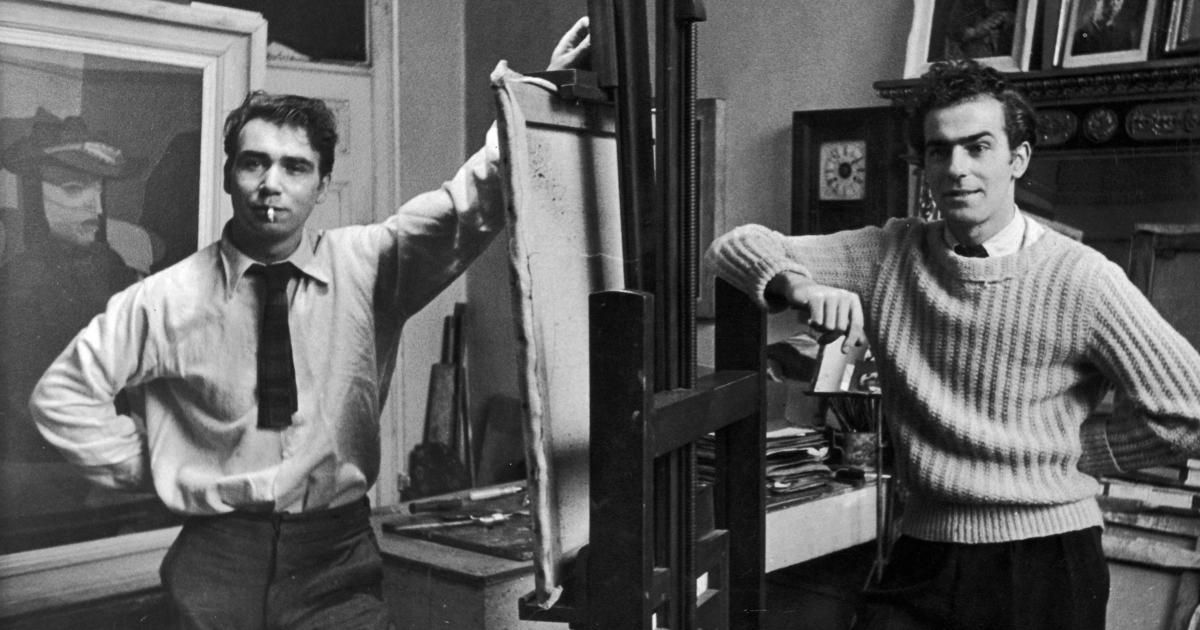
The Dick Institute in Kilmarnock will be playing host to the forthcoming exhibition, which will feature around 50 paintings from their time living in working in Scotland, England and across Europe.
Read more:
The show will recall how the pair took London’s bohemian art scene by storm, befriended the likes of Francis Bacon, Lucian Freud and Dylan Thomas, were photographed by Vogue, and enjoyed huge success in the 1940s and 1950s before “slipping into obscurity”.
They both died penniless within four years of each other in the 1960s after struggling with alcohol addiction and mounting debts.
Fleming, Ian; The Two Roberts: Colquhoun and MacBryde; The Glasgow School of Art; http://www.artuk.org/artworks/the-two-roberts-colquhoun-and-macbryde-138219 (Image: Glasgow School of Art)
The Two Roberts were described as “relatively little known” by the National Galleries of Scotland just over a decade ago when it staged the first major retrospective of their work to coincided with the centenary of the birth of both artists.
Barr worked on the exhibition while he was writing a novel on MacBryde and Colquhoun, which was billed as “one of the strongest and most passionate love stories of modern British art”.
Robert Colquhoun’s painting ‘Woman with a Goat’. (Image: Victoria Gallery & Museum, University of Liverpool.)
The exhibition – Robert MacBryde and Robert Colquhoun: Lovers, Artists, Outsiders – is currently running at the Charleston cultural centre in Lewes, in Sussex. It will transfer to Nottingham next month before opening in Kilmarnock in September.
The exhibition, which will run at the Dick Institute until January, is said to “rescue The Two Roberts from the footnotes of history”.
Barr told The Herald: “As far as I know there has never been an exhibition devoted to The Two Roberts in Ayrshire before.
“It felt really important to me to bring them home. I really wanted that to happen and I very glad that the Dick Institute said yes to the exhibition. It will be a real homecoming for the pair of them back to where it all started.
“The show which is currently on in Lewes is the first exhibition of their work in England since 1962.
“There is a lot of work in it that has never actually been seen before. I’ve very grateful to some amazing private lenders who have agreed to share this work.”
Publicity material for the exhibition states: “It foregrounds their shared creative practice, grounded in radical queer love, and celebrates an alternative tradition of modernist art by two queer, working-class Scottish artists.
“It features paintings, drawings, lithographs, monoprints and archival objects, including school records and photographs, which trace and place their personal and artistic lives at the centre of an extraordinary creative landscape in a rapidly changing world.”
Colquhoun, who was born in Kilmarnock, started working as an apprentice in an engineering works when he left school before studying at Glasgow School of Art in 1933. He died suddenly after suffering heart failure in London in 1962.
Born in Maybole in Ayrshire in 1913, MacBryde worked in a shoe factory for several years before he started at the art school in 1932. He died in 1966 after being struck by a car outside a pub in Dublin.
The pair, who were known as “The Two Roberts” to their fellow students and tutors in Glasgow, set off on a travelling scholarship to France and Italy in 1938 before the start of the Second World War forced them to return to Britain, with the pair moving to London.
Barr said: “During and after the Second World War, the Two Roberts were the stars of the London art scene and feted by names we now remember, Bacon, Freud and co.
“They died penniless and young and have been relegated to the footnotes of art history. This is unjust.
“As a fellow gay working-class Scottish artist, I feel a strong connection to them that’s beyond the biographical.
“Their work and their world shed so much light on the dark days of now and their practice offers joy and inspiration.
“This exhibition is long overdue and makes vital connections, just as I hope my novel about them also does.”