

You already knew that octopuses were bizarre creatures — masters of disguise, formidable escape artists and possessors of what amount to several “mini brains” distributed among their eight arms.
But wait until you hear about their sex lives.
According to a new study from Harvard University, the male octopus courts not with a glance but with a probing arm that can, quite literally, taste a potential partner. The same appendage is then used to transfer an envelope of sperm.
This specialised limb, known as the hectocotylus, has long been recognised as a reproductive tool.
Until now, however, researchers had not appreciated that it is also a sensory organ in its own right, capable of identifying a suitable mate in the dark by her chemical signature.
In plain terms, a male will reach out, feel around, and detect the female’s hormones to confirm he has found the right partner. He then uses his hectocotylus to deliver a parcel of sperm, known as a spermatophore, into her mantle cavity — the bulbous, sac-like part of the octopus that lies behind the eyes.
Inside, the hectocotylus guides the spermatophore to the female’s oviduct where fertilisation can take place. The male can do this without ever seeing the female — a blind date, by any definition.
The new study, published in Science, began when Pablo Villar, a researcher at the Bellono Lab at Harvard University, was intrigued to find that the hectocotylus was dotted with sensors similar to those seen on the other arms.
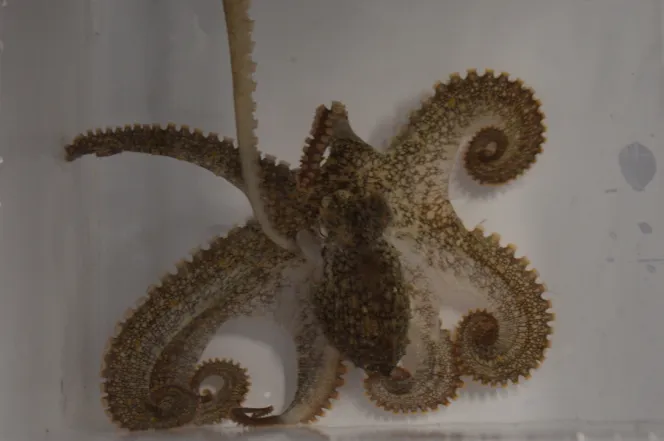 The male’s specialised arm Anik Grearson
“That was surprising, because the males generally don’t use the hectocotylus for exploring or finding food,” he said.
“They keep it close to their body, coiled up, and don’t really use it for sampling the sea floor.”
Villar and his colleagues carried out experiments to explore what the sensors were used for. In one, male and female octopuses were separated by an opaque barrier with small openings, meaning they could not see each other.
The male extended his specialised arm through the gap, located the female and proceeded with mating.
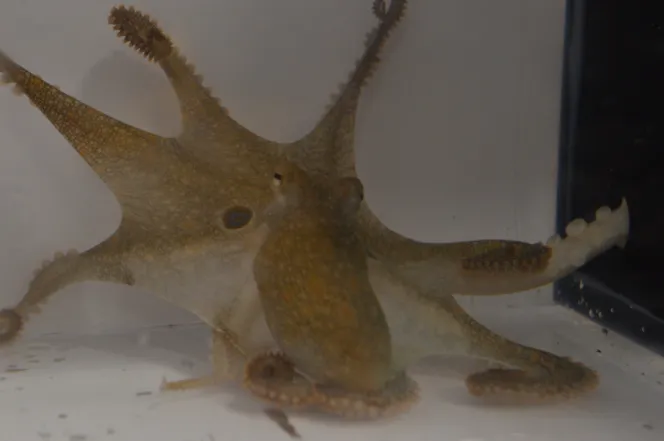 A female California two-spot octopus mates through a barrier with a maleAnik Grearson
When paired with another male, however, the behaviour stopped. Something — more exactly, some special set of molecules — was missing.
The key substance turned out to be progesterone, a hormone known in humans for its role in pregnancy. Female octopuses produce it in their reproductive organs; the male’s hectocotylus, the researchers discovered, is exquisitely tuned to detect it.
When Villar and his colleagues coated artificial tubes with progesterone, males enthusiastically investigated them, treating them much like a receptive partner.
The study suggests this chemical sensing also helps octopuses distinguish their own species from closely related ones.
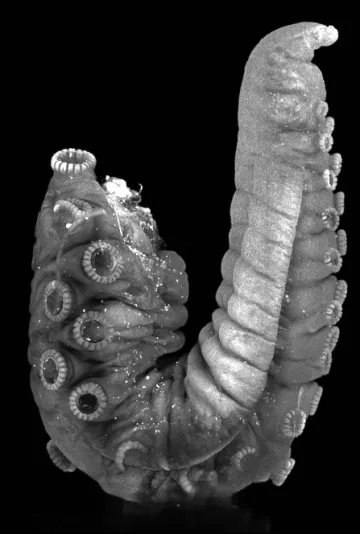 The hectocotylus of a wild-caught California two-spot octopusPablo Villar/Douglas Richardson
Their method of mating may reflect the animals’ lifestyles. Octopuses are solitary creatures that rarely encounter one another in the wild, which means there is little room for error when trysts do occur.
By merging sensing and mating into a single appendage, the chance of mistaken identities and wasted effort is reduced.
Octopus arms are semi-autonomous. Collectively, they are packed with more neurons, or nerve cells, than are found in the central brain, allowing them to act with a degree of independence from it. This includes the hectocotylus. In laboratory tests, even severed arms responded vigorously to progesterone, writhing as if still engaged in the act of courtship. It is, in a sense, a limb with a mind of its own.
At the molecular level, the team identified a specific receptor on the surface of the hectocotylus, known as CRT1, that binds to progesterone. Intriguingly, this receptor appears to have evolved from ones originally used to detect chemicals associated with prey.
In other words, the same sensory machinery that allows an octopus to find dinner has been repurposed for its love life.