
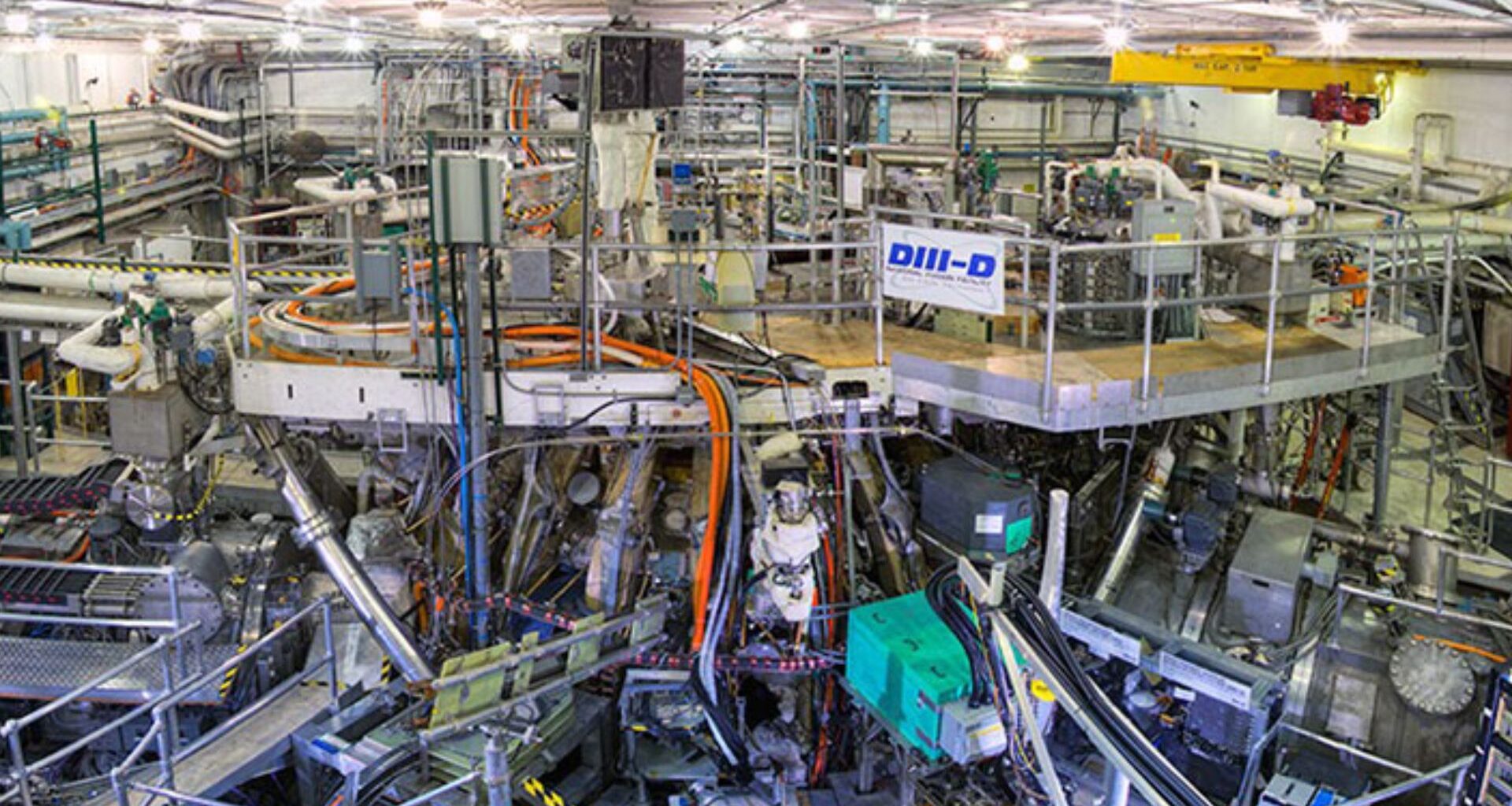
New research at the Princeton Plasma Physics Laboratory (PPPL) has indicated that the rotation of the plasma core is a primary factor in how particles are distributed within a fusion reactor’s exhaust system.
The study identifies why plasma particles consistently hit certain parts of the reactor more than others.
This finding allows computer simulations to match experimental results, which provides a tool for designing future fusion power plants.
In a tokamak, magnetic fields hold plasma in a doughnut-shaped configuration. Some particles eventually escape this magnetic core and move toward the divertor, which serves as the machine’s exhaust system.
“There, plasma particles strike metal plates, cool down and bounce back. (The returning atoms help fuel the fusion reaction.)” said PPPL in a press release.
“But experiments consistently show that far more particles hit the inner divertor target than the outer one.”
Challenges in modeling asymmetrical heat loads
This uneven distribution remained unexplained because existing models could not replicate the degree of the asymmetry seen in physical tests.
Understanding this distribution is necessary for the engineering of future fusion systems. It will help in knowing exactly where exhaust particles will land to ensure the divertor can manage the heat without sustaining structural damage.
“The leading explanation centered on what’s known as cross-field drifts within the divertor itself, the sideways movement of particles across magnetic field lines,” explained the press release.
“However, computer simulations that included only this kind of drift couldn’t reproduce the uneven striking pattern in experiments, making it difficult to trust that simulations could reliably guide divertor design for future machines.”
Integrating core rotation into predictive simulations
To resolve this, a team led by Eric Emdee at PPPL used the modeling code SOLPS-ITER. They analyzed data from the DIII-D tokamak located in California.
The researchers tested four specific scenarios to isolate the cause of the particle patterns: models with and without cross-field drifts, and models with and without plasma rotation.
The simulations matched the experimental data only when the team included the measured core rotation of 88.4 kilometers per second.
This toroidal rotation—the movement of particles around the tokamak—creates a parallel flow along the magnetic field lines.
Emdee noted that while cross-field flow was previously considered the primary driver of asymmetry, this study shows that parallel flow driven by the rotating core is just as significant.
“A lot of people said cross-field flow was what created the asymmetry. What this paper shows is that parallel flow, driven by the rotating core, matters just as much,” he highlighted.
Implications for future fusion power plants
The research demonstrates that the interaction between core rotation and cross-field drifts produces a larger effect than either component does on its own.
By accounting for how the rotating plasma core influences flows at the edge of the magnetic field, scientists can now predict exhaust behavior with more accuracy.
This connection provides the data needed to design divertors that can withstand the heat loads of real-world fusion energy production.
“The finding suggests that accurately predicting exhaust behavior in future fusion systems will require accounting for how the rotating plasma core influences edge flows, a connection that could help engineers design divertors that can better handle reality,” concluded the press release.