
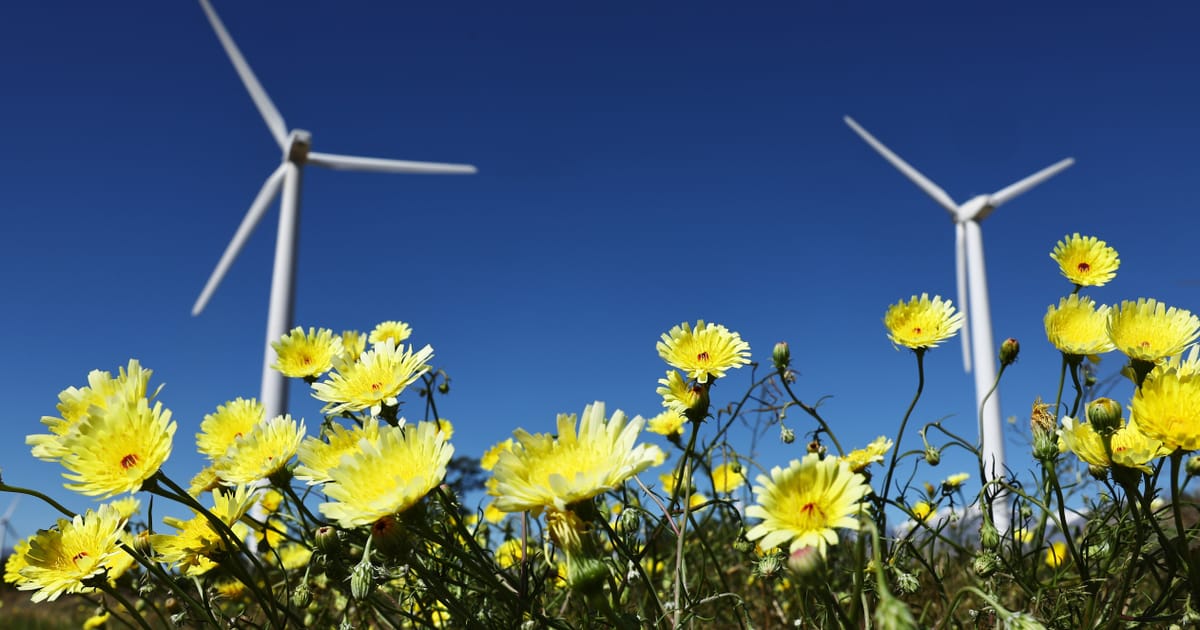
Renewable energy’s favorite season has arrived.
Spring is when everything comes together for clean power sources. Days get longer, boosting solar generation. Winter’s blustery winds keep blowing, propelling turbines to their max. And melting snow and heavy rains combine to drive hydropower generation.
Previous springs have shown us just what this wild weather is capable of. In the first week of March 2025, Texas’ power grid, known as ERCOT, set all-time records for wind and solar power production as well as battery storage discharge.
Now, just a few weeks into spring, and with plenty more renewable power generation added in the past year, Texas is once again reaching new heights. On March 14, ERCOT reached an all-time high of 28.7 gigawatts of wind power, according to GridStatus.io. Even more impressive is the state’s solar generation, which has already set multiple records so far this year.
And in California, batteries stored a ton of that clean energy, and then set record after record for dispatching it throughout March.
A lot of those records were only made possible thanks to the U.S. adding 26.5 GW of utility-scale solar power generation in 2025, and another 5.7 GW of wind generation. A massive 13 GW of grid battery installations last year helped make full use of those renewables.
There’s an added bonus to all these records happening as the weather starts to warm. Most of us are starting to turn down our furnaces and heat pumps, but haven’t yet turned on our air conditioners. That means overall power demand tends to be at its lowest in the spring, and with renewables at their peak, we need far less fossil-fueled power to pick up the difference.
That confluence resulted in something monumental in March 2025: For the first time ever, fossil fuels accounted for less than half of U.S. power production across a whole month, while clean sources generated the rest. Let’s see if the U.S. can repeat that feat this year.
More big energy stories
A global energy crisis is in full swing
Continued conflict in the Middle East is highlighting the risks of relying on fossil fuels.
It’s been five weeks since the U.S. and Israel first attacked Iran, sparking a conflict that has largely shut down oil and gas production and transportation in the region. Domestic natural gas supplies have blunted the blow in the U.S., but much of the world is facing a major energy crisis. Thailand has encouraged workers to ditch business suits to curb the use of air conditioning, while Sri Lanka has implemented a four-day workweek to limit fuel use.
The EU’s energy chief this week similarly urged residents to drive and fly less, and pushed countries to speed their transition to clean energy, saying fossil fuels’ price volatility won’t end even with a resolution in the Middle East. That’s been especially clear in the years since Russia’s 2022 invasion of Ukraine, which spurred the EU to cut off Russian gas supplies and turn its attention toward a solar and wind buildout instead.