
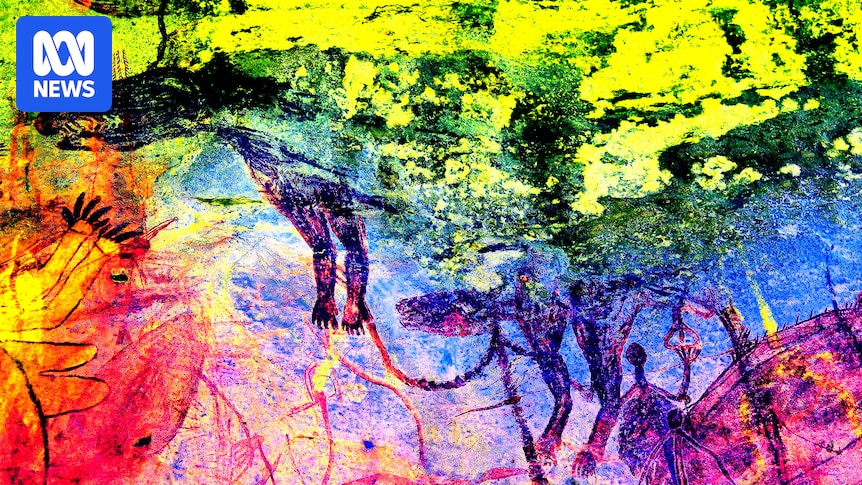
Rock art paintings depicting Tasmanian tigers and Tasmanian devils in the Northern Territory have prompted researchers to question how recently each species became extinct on the Australian mainland.
Loading…
Researchers from Griffith University and traditional owners examined 14 previously undocumented paintings of the Tasmanian tiger, or thylacine, and two showing the Tasmanian devil at Awunbarna and Injalak Hill in west Arnhem Land.
Griffith rock art specialist Paul Taçon said researchers had previously estimated each species died out on the Australian mainland around 3,000 years ago.
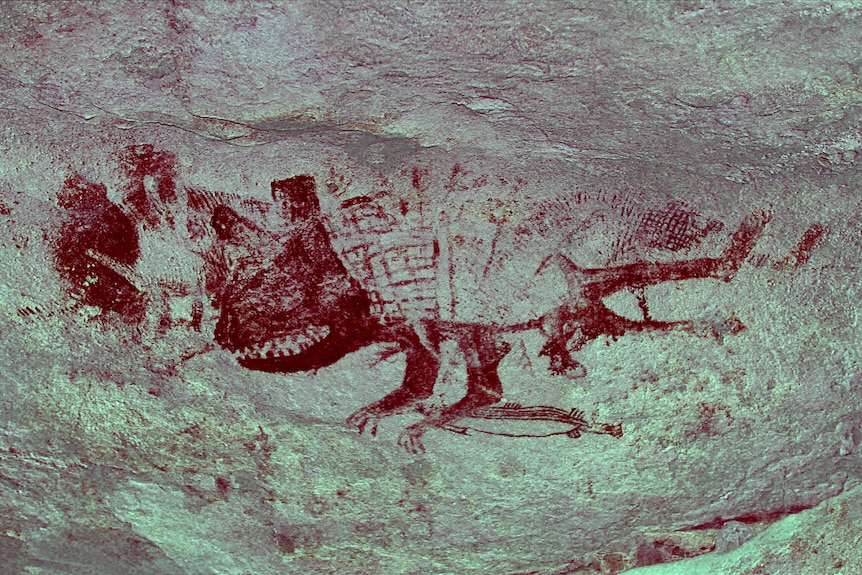
A digitally enhanced painting of a Tasmanian devil in an Awunbarna cave-like site showing barbed lines that may represent spears. (Supplied: Paul Taçon / Griffith University)
However, Professor Taçon said white pipe clay used in some of the newly documented works indicated the images were likely to have been painted within the last 1,000 years.
“Most of them are red and yellow ochre but some have white — and white doesn’t last very long — so they’re younger than we would expect,” he told ABC Radio Hobart.
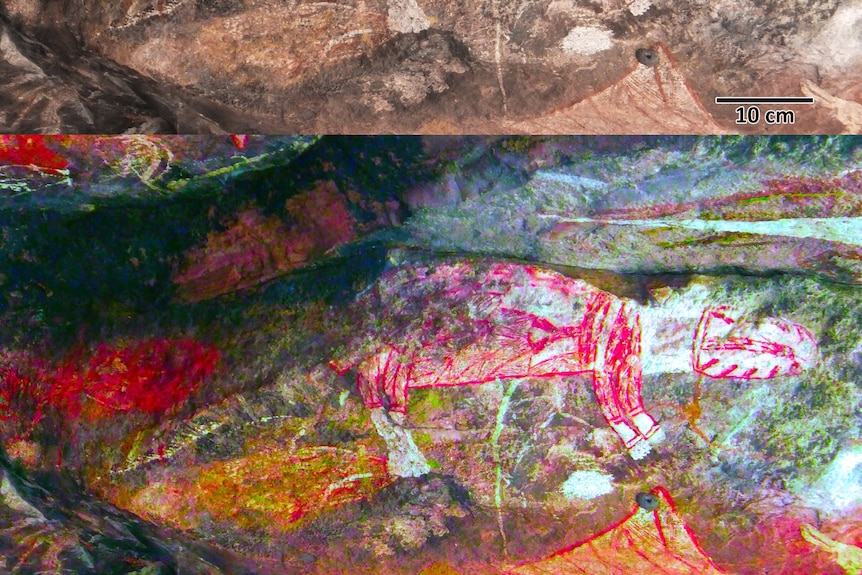
A digitally enhanced red and white painting of a thylacine, with the white ochre indicating the painting could be newer than previously believed. (Supplied: Paul Taçon / Griffith University)
But Professor Taçon said while the paintings reaffirmed the animals’ cultural significance for the region, there was also a possibility the artists had emulated works from hundreds of years earlier.
“We can’t exactly tell,” he said.
Hunting with thylacines
While researchers have been identifying thylacines in Arnhem Land rock art for decades, there has been a debate about the criteria used to identify the animals.
In examining the paintings at Awunbarna and Injalak Hill, Professor Taçon’s team used six features, including pointed ears and an upturned tail, to identify thylacines in the images.
Djalama man Joey Nganjmirra, who worked on the study with the Griffith team, said west Arnhem Land traditional owners maintained a detailed oral history of Tasmanian tigers in the region.
“They used to tell stories about going hunting with thylacines,” he said.
Professor Taçon said thylacine rock art in Arnhem Land often showed the animals in tandem with the Rainbow Serpent – a key ancestral figure in Aboriginal Dreamtime stories.
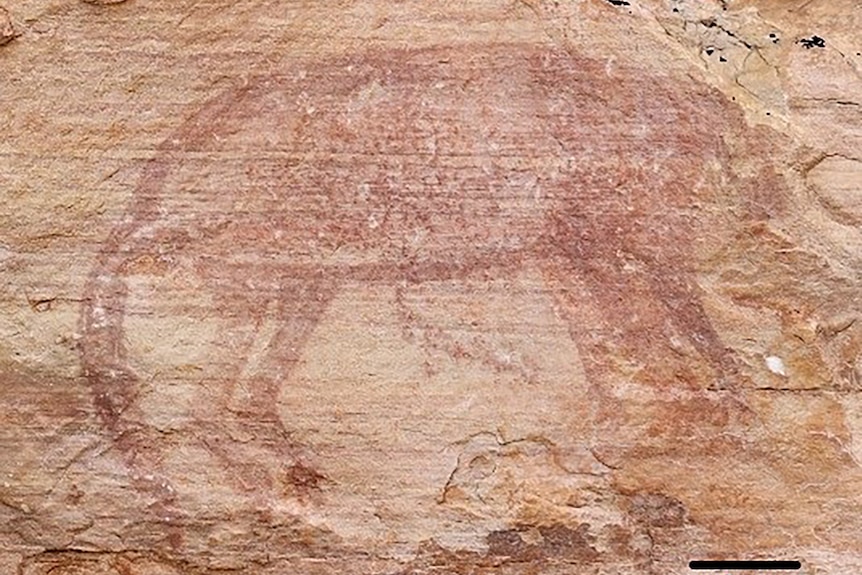
A painting of a thylacine at Injalak Hill in west Arnhem Land. (Supplied: Benedict Dyson / Griffith University)
“In Arnhem Land they have a name for the thylacine, it’s djankerrk, and they also have lots of stories of thylacines and about their behaviour,” he said.
“The Rainbow Serpent is said to have had two thylacines as pets.”