
Despite the war and persistent economic strain, new forecasts from the Bank of Israel and the Finance Ministry paint an unexpectedly upbeat picture, projecting sharp growth, rising living standards and low inflation over the next two years.
Just days before Passover, the Bank of Israel and the Finance Ministry published forecasts showing a sharply improved outlook, with the economy projected to grow by nearly 10% over this year and next, living standards to rise by 7.5%, investment to jump by 22% and inflation to remain near 2%.
1 View gallery
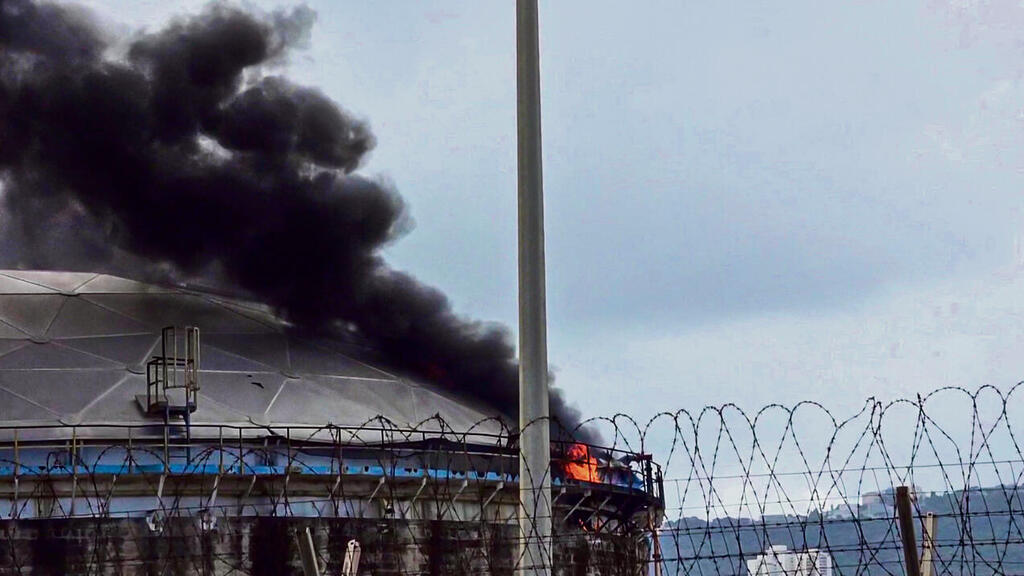
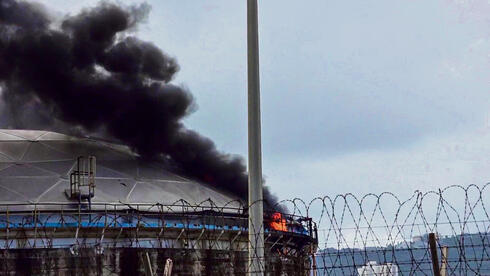
The submunition from Iranian cluster missile hits the Haifa oil refineries
(Photo: Reuters)
The labor market is expected to continue facing a relative shortage of workers, pushing wages higher. Most importantly for economists, the ratio of government debt to GDP is forecast to stabilize at around 70% — somewhat high and mildly concerning, but not threatening.
In short, according to official models, Israel will absorb a second war with Iran and a fourth Lebanon war without severe side effects. Both conflicts, economists assume, will end by late April — after all, Prime Minister Benjamin Netanyahu has already said in an interview with a U.S. television network that “we are past the halfway point.” The resilience of the Israeli economy, they suggest, will once again prove itself. But what if it doesn’t?
What if the war in Lebanon becomes protracted, as in the past? What if reports in the foreign press that “Iran is winning” prove even partially correct? What if the Trump administration concludes the war harms it politically and economically and withdraws?
These questions find no answers in the official forecasts. From their perspective, the storm will soon pass and spring is just around the corner.
The reluctance of Israel’s economic community to outline worst-case scenarios is understandable. Such projections dominated discourse in 2023 and 2024, often proving overly pessimistic and damaging economists’ credibility. Still, it is not enough to vaguely warn of “significant risks” to an otherwise reassuring outlook. Israel has been here before — on the brink, in 1984 during the Lebanon War and in 2003 during the Second Intifada — and recovery took years.
Economists in the Finance Ministry, the Bank of Israel and think tanks should present not only baseline scenarios but also harsher alternatives, including the high cost of protracted conflict. “Tell us the truth,” the author argues. “Yes, Israel is a resilient economy, but resilience is not infinite.”
The Passover Haggadah recounts how the Israelites wandered in the desert for 40 years before reaching the Promised Land, instructing each generation to see itself as if it personally left Egypt. This year, amid a prolonged war with no clear end, the metaphor feels especially relevant. Scarcity is already being felt — but how real is it?
“Following the war with Iran, everyone is talking about an energy crisis,” said Prof. Leo Leiderman, head of the Institute for Economic Strategies at the Peres Academic Center and chief economic adviser to Bank Hapoalim. “But the shortage problem is not limited to energy supply. This is a global shock reshaping trade systems, commodity markets, supply chains and geopolitical power.”
Even if the war ends tomorrow and oil prices fall, he said, “the geo-economic world will not return to where it was. Disruptions are the new norm. Those who do not prepare logistically for instability will not remain competitive.”
Dr. Anat Hochberg Marom, an expert in geopolitical risk, pointed to additional vulnerabilities. “Qatar holds about 35% of the global helium market,” she said. “Helium is critical for semiconductors, defense systems, MRI machines, electric vehicles and 5G infrastructure. A blockade of the Strait of Hormuz directly affects supply.”
She warned that fertilizer production — dependent on natural gas — is also being hit, threatening global food security. “We are facing a global food crisis,” she said.
The impact is already visible. “The global commodity price index has risen 17% since the war began,” Leiderman said. “Container shipping costs are up 37%, synthetic rubber and sulfur 40%, polyethylene 33%. Electricity prices have surged in Europe, and gas prices are rising too.”
According to the OECD, inflation in the United States could reach 4.2% this year and 4% in Britain.
More pessimistic scenarios are also emerging. “Many economies could face stagflation — inflation alongside rising unemployment, stagnant growth and higher interest rates,” Leiderman said.
Israel will not be immune. “More than 80% of imports arrive through the ports of Ashdod and Haifa,” he noted. “Some shipping companies are already reducing their frequency due to security risks.”
While the Bank of Israel forecasts only a modest rise in inflation to 2.3%, Leiderman is more cautious. “There is a significant inflation risk,” he said, pointing also to government fiscal policy and rising transport costs. “We are likely to see broad price increases.”
Damage to infrastructure across the region, she added, positions Israel — with its expertise in logistics, cybersecurity, semiconductors and artificial intelligence — as an attractive strategic partner.
Israeli companies could benefit from increased demand in sectors ranging from chip production to smart logistics, cybersecurity and defense systems. “There is potential for contracts worth $10 billion to $15 billion,” she said.
From a geopolitical perspective, Hochberg Marom concluded, Israel is increasingly positioned as a critical technological, security and logistical bridge between Asia and Europe, potentially strengthening the Abraham Accords.
The missile strike on the Haifa oil refinery complex did not disrupt Israel’s electricity supply, but it offered a stark reminder of the country’s energy vulnerability. The threat is one that keeps Prof. Arie Zaban, president of Bar-Ilan University and a leading energy researcher, up at night. Bar-Ilan University President Prof. Arie ZabanPhoto: Anat Kazula
“The natural gas framework,” he tells ynet’s parent newspaper Yedioth Ahronoth, “has indeed given us almost complete energy independence — about 90% of electricity is produced from local natural gas (72.5%) and solar energy (14.5%) — but it has not provided energy security, which is a very different concept.”
“Natural gas,” Zaban emphasizes, “replaced oil in electricity generation and thereby made an enormous contribution to Israel’s economy, up to half a trillion shekels, both through much lower prices than in Europe and a significant reduction in air pollution and greenhouse gas emissions.
“The discovery of large gas fields also laid new foundations for trade agreements with Egypt, Jordan and Lebanon, and indirectly Syria, agreements whose importance becomes even more dramatic when natural gas sources in the Arab Gulf states are under Iranian attack.”
And yet, you are not at ease.
“In the current war, our weakness in energy security has been exposed. All of our natural gas is supplied from a very small number of platforms in Israel’s economic waters in the Mediterranean, which may be vulnerable to attacks, damage and even accidents. This concentration worries me greatly, not because we might return to the oil crisis of the 1970s. Israel’s energy efficiency has improved impressively since then. Nor because we’ll have to line up at gas stations or avoid using air conditioning during heatwaves—but because we may lose our most important technological advantages.”
What do you mean?
“I mean the continuous supply of electricity for the production and maintenance of artificial intelligence, which is rapidly becoming one of our critical resources. AI, which is penetrating more and more areas of our economic, security, social and scientific lives, relies on server farms, data centers and supercomputers that consume enormous amounts of energy. As Nvidia’s legendary CEO once said: ‘Energy is the fundamental layer on which AI rests. It all runs on energy.’”
According to reports by the International Gas Union and the chief economist of BDO, active natural gas reserves can supply all projected demand for the next 40 years.
“Indeed, according to reliable energy forecasts, we have and will have enough natural gas to meet future needs. However, relying on it as an almost exclusive domestic energy source, along with the concentration of gas fields, exposes Israel to risks and a lack of energy security in a war-prone region. We are already feeling the energy security problem in practice: two out of the three natural gas reservoirs have been shut down, to one extent or another.”
Zaban’s response to these risks are diversify, decentralize and store. Diversification is the most important. He says the transition to solar energy must be urgently expanded, not only for climate reasons, worthy as they are, but also for security reasons.
“Unlike natural gas platforms concentrated at sea, solar energy production can be spread across the entire country, from the Negev desert to fields in the Jordan Valley to rooftops in central areas, thereby creating energy security even in emergencies. Damage to one solar field, or part of it, would have only a marginal impact,” Zaban says.