
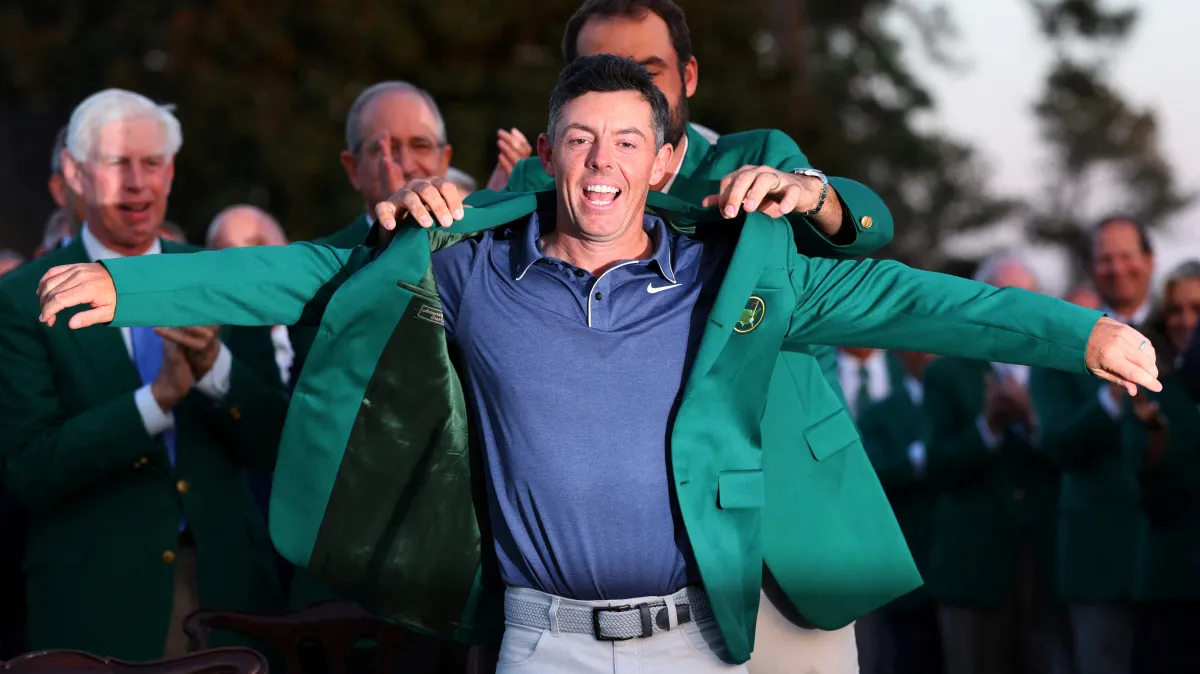
It is hard to think of a more torturous path to the zenith than that taken by Rory McIlroy. Whenever he got to the threshold of the pantheon of greats he found the welcome mat pulled from under his feet. So one year from his greatest day we asked players, commentators, writers and his psychologist for their lingering thoughts about one of sport’s most stumbling, staggering, nailbiting, yin-yang triumphs.
The rollercoaster
By Luke Donald, former world No 1 and two-times Ryder Cup-winning captain
McIlroy had led by four after ten holes, but a fourth double bogey of his tournament on the 13th set alarm bells ringing, and after missing a putt to win in regulation, he needed an extra hole against Justin Rose.
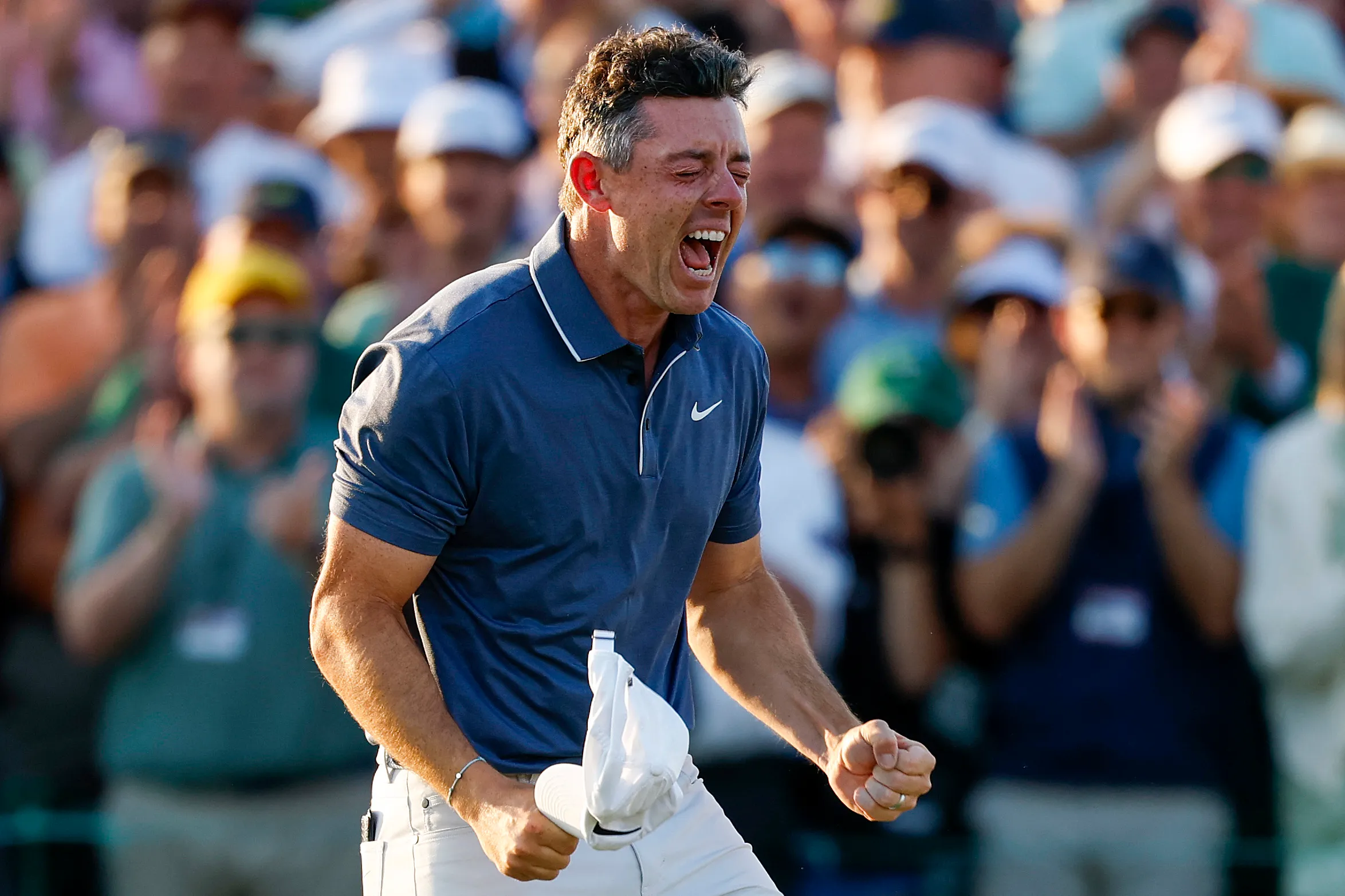 McIlroy unleashes a roar in celebration of a Masters win that left him with a career full set of majors Harry How/Getty Images
My abiding memory is the pure range of emotions. I was sitting at home watching it on TV with my wife. I’ve never experienced such highs and lows and I can’t imagine what Rory was feeling, but I felt like I was living every shot with him, jumping off the couch with the great shots, covering my face with my hands with the bad ones, especially the wedge in the water on 13.
It looked like he’d lost it when he made bogey on the last, but it just shows the resolve that he had to step up and make birdie in the play-off. Fourteen years’ torment of trying his hardest finally came out. It’s a moment in sport that everyone will remember, and they’ll remember where they were when they watched it.
The grand slam
Paul McGinley, former Ryder Cup-winning player and captain
McIlroy became only the sixth man to complete the career grand slam and the first since Tiger Woods in 2000, also joining Gene Sarazen, Ben Hogan, Gary Player and Jack Nicklaus.
It’s got to be the grand slam for me. You know, only the sixth player in the history of the game to complete the grand slam. It’s like being A+ in four different subjects at school.
You’ve got the charm and the history and everything that goes with the beauty of Augusta compared to the links and the weather that goes with the Open Championship, and then to the US Open and the tough test that always is, and the PGA, which is basically a PGA Tour event but with maybe the strongest field in golf.
The difficulty is getting from three to four. A lot of people have been stuck on three. Tom Watson got stuck on three. Phil Mickelson got stuck on there. It’s a heavy burden to carry when you’re sitting on three and, in some ways, that was a tougher mental hurdle than actually winning the Masters. Then you throw in the fact that it’s 11 years since he’d won a major championship and he had been the most dominant player consistently over those years.
And remember he had not won the US Open the previous year from a commanding position. That was really raw and he got a lot of stick when Bryson [DeChambeau] got in ahead of him. He also went head to head with Patrick Reed [at Augusta in 2018] and kind of folded on the last day too. So there were a lot of legacies and disappointments and false expectations.
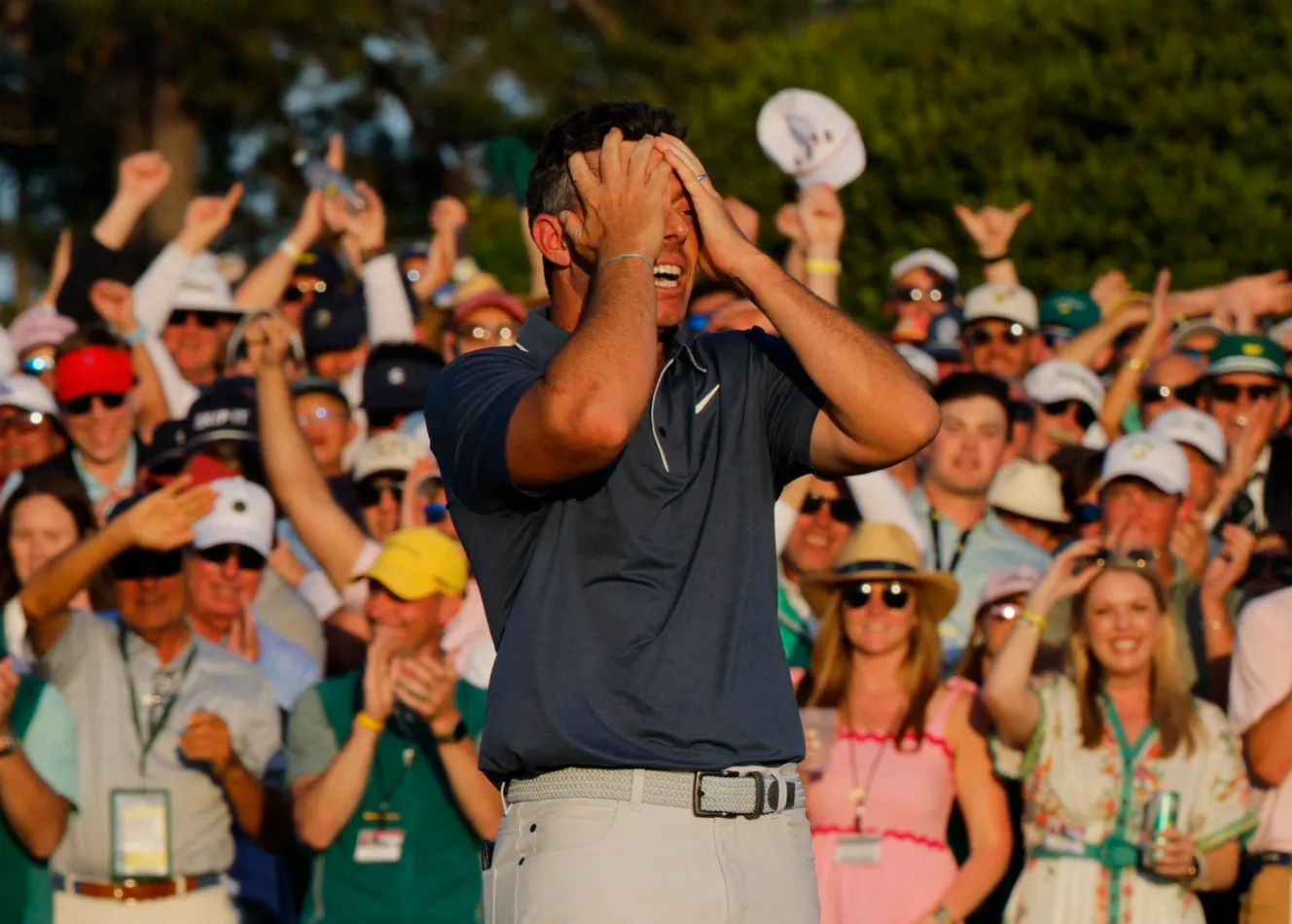 McIlroy celebrates his greatest day on the golf course with a mix of delight and reliefREUTERS/Brian Snyder
I’m huge on the grand slam and I’m surprised people don’t make more of it. I know he was great in the Ryder Cup and I know he won at Pebble Beach and the Players, but he’s won all those tournaments before. This was a new level.
The shot on the 15th
By Gary Player, nine-times major winner, including three Masters titles
In a three-way tie at the top with Rose and Ludvig Aberg, McIlroy arced an iron around dangling branches and over water to set up a birdie and regain the lead.
It was the culmination of all of his trials and tribulations, coming down to that last putt in the play-off against Rose. Rory’s game has always been the right fit to win at Augusta but experience is such a critical component. His seven-iron on 15 may be remembered as the defining shot of his career. It was his time.
After I won the [US] PGA Championship in 1962, the US Open was the only major missing to complete the career grand slam, and that became a great motivation. I wanted to be the youngest to achieve it. In many ways, Jack [Nicklaus] and I were pushing one another, quietly competing to see who might accomplish it first.
I tip my cap to Jack. The week before the US Open at Bellerive in 1965, there was a tournament in Greensboro, and Jack encouraged me to skip it and spend time preparing properly. That was a wonderful gesture of sportsmanship.
Did it make things easier after completing the grand slam? Absolutely not. In fact, in many ways it becomes more difficult because expectations grow, both from others and from yourself. What it did give me was confidence that I could compete and win anywhere in the world against the very best. The grand slam was a milestone, but it was never the finish line.
The Friday morning
By Bob Rotella, McIlroy’s psychologist and author of Golf is Not a Game of Perfect
The first bounce back.
It was the fact that he didn’t let anything bother him or upset him. He didn’t give any meaning to any of his missed shots. He just was on a mission to win the tournament.
I didn’t invent the idea that this is not about perfection. It’s not a theory. It’s just some crazy son of a gun made it into a game of mistakes instead.
When I asked Rory, he said his favourite shot was the one on the 16th hole where they were honouring the 50th anniversary of Jack Nicklaus’s win and had the pin in the same place, back right. He knows if you miss right you’re going to make a bogey. And he said: “I just trusted myself and hit such a beautiful tee shot.” That’s the one he said he was most proud of.
I was to the left of the green watching the finish. It was a beautiful thing. We had talked every morning before he teed off in the building at the end of the practice range. And he lived it. He did it great.
I thought he won the tournament on Friday morning after he didn’t finish the way he wanted on Thursday. You know, he’s playing great and then lost four shots in the last four holes. And then he came out and it was all about, “OK, now we’re going to find out what you’re all about.” And he came out and shot 66.
The six threes
By Iain Carter, BBC golf correspondent
McIlroy started the third round in blistering fashion.
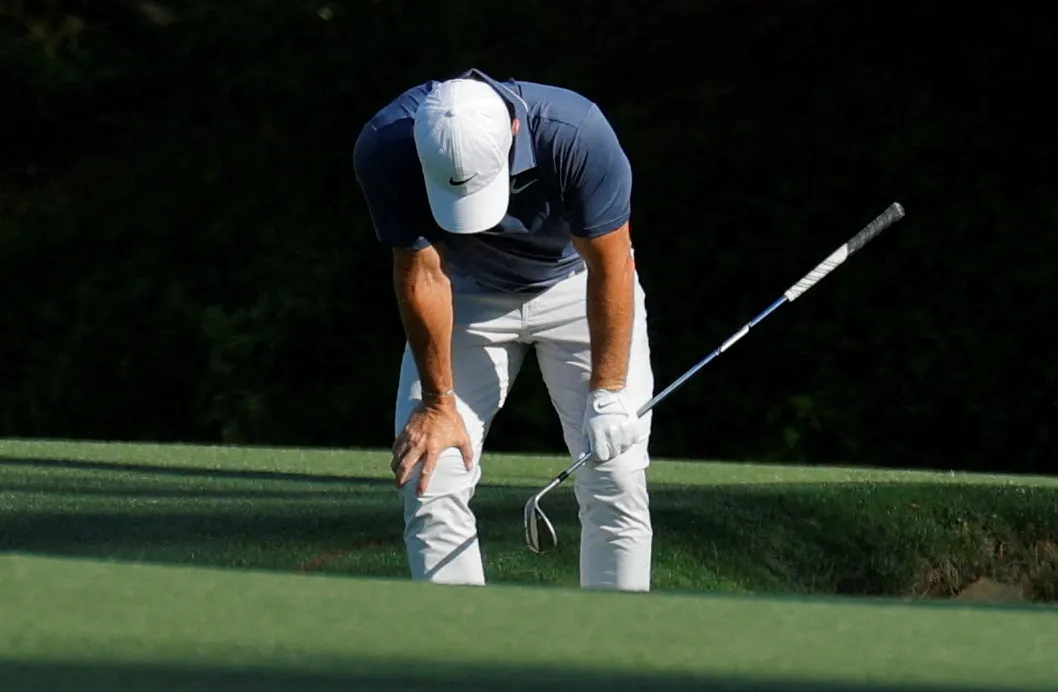 McIlroy finds water at the 13th to set alarm bells ringingREUTERS/Mike Blake
Apart from the extreme rollercoaster of the final day, what I remember most is how McIlroy began his third round. He was in third place after a strong Friday finish and unleashed six threes in a row, including an eagle at the 2nd and birdies at the 1st, 3rd and 5th holes. That was when I started to believe, but when he dumped his wedge into the water on 13 in the final round I was a doubter again. Commentating for BBC 5Live on the winning putt is a genuine career highlight. There is always a story with Rory and it felt as though nearly two decades of extraordinary narrative had built to that unforgettable moment.
The eight-iron on the 17th
By Butch Harmon, coach to Tiger Woods, Phil Mickelson, Greg Norman and, more recently, Tommy Fleetwood
That birdie gave him the lead and seemingly the win.
I was very surprised with the pitch shot on 13 when you have a slope 30 feet left of the hole that will bring the ball nicely down the flag. I think he just lost his concentration. And then the phenomenal shot to 17 was just so hard to get it close, but as a Rory fan I was nervous. Now it’s off his back. He can walk around in his Green Jacket all day long. It was spectacular.
The strange decisions
By Padraig Harrington, three-times major winner and three-times senior major winner
McIlroy made some odd choices as the pressure grew, but so did Bryson DeChambeau who led after two holes of the final round.
Everybody in golf will put Rory up there on a pedestal and you assume the game is easier for him, but he won like a rookie winning his first tournament. From a golfer’s perspective, it was great to watch the highs and lows, the fallibility, the appreciation that everybody goes through the same things and we all have our demons. It might not have been evident in other weeks but it was very evident that Sunday.
Who knows where he’d have gone if he didn’t win the tournament? There was a lot on the line, but it was one of the best tournaments to watch ever, just the ups and downs, the great shots, the bad shots and the craziest tactical decision ever made in golf by DeChambeau on the 3rd hole.
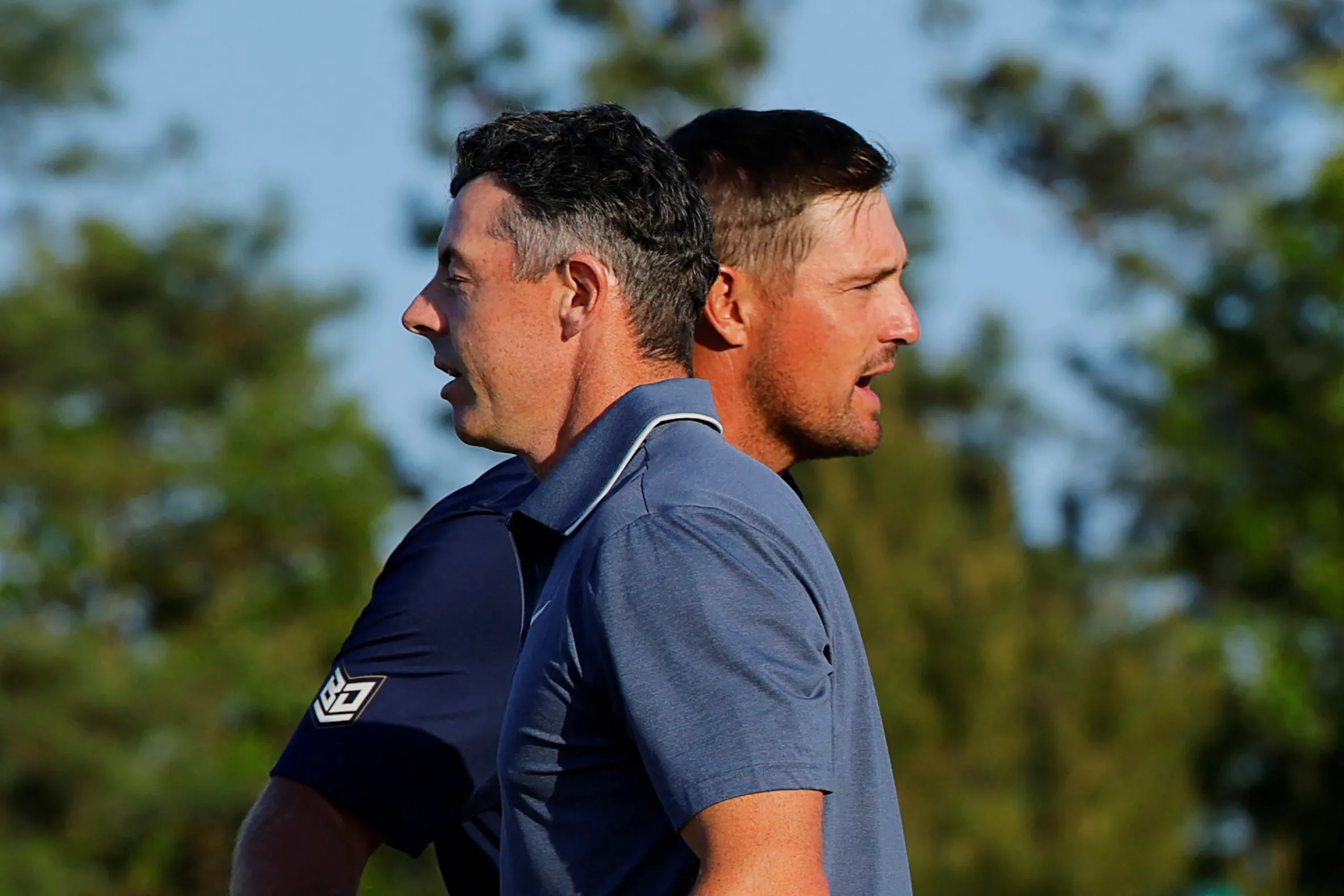 DeChambeau, having had the tournament by the scruff of the neck, lost his way with some poor shot choicesREUTERS/Brian Snyder
Bryson went from trying to tell us that it was a par 67 to trying to be the cleverest golfer on the course last year. On the 3rd hole he had the tournament by the scruff of the neck and could drive the green. There are times you’ve got to take it on and laying up there is a terrible option. Every stats guy in the world would tell you that. He had a chance to really put his stamp on the tournament, but he hit an iron and blew it.
Rory also did things he would never normally do. He hit three-wood off 13, but he’s still probably able to hit an iron on to the green from where he is. At any other tournament, he would have done, but he lays up. I think it was the right play, but it was very unfamiliar for Rory. He’s probably trying to play a pitch into 15 feet, left of the hole off a right-to-left slope. Again, it was something he’s not used to, playing safe. He probably thought it was going too left and second-guessed that mid-swing. To most people, a crazy shot went into the water, but it happens. They weren’t wrong decisions but they were unfamiliar ones.
How many majors will he get? He once told me nine. I believe I got three because I was always thinking more than one but I was never thinking four. I think what you believe deep down is very hard to change. If he believes it’s nine he’s going to get there. The thing with Rory is he’s fit and because he has the length he could be competitive into his 50s if he wants to be.
The greatest Masters
By Brandel Chamblee, Golf Channel analyst
A career in microcosm.
I remember sitting on the set and I was trying to think of a particular term and maybe it wasn’t the most elegant way of phrasing it, but I called it the most bipolar performance I’d ever seen. And, you know, I was trying to get my arms around how spectacularly great he was at moments and how spectacularly horrible he was too.
I don’t know that any of us have ever seen the like of that performance. One minute he was Tiger Woods in his prime and the next he was Greg Norman hitting that shot into 18 in 1996. To see such a juxtaposition between those two characters was so shocking.
We’ve seen players sort of stumble their way in. We’ve seen them lose tragically and win heroically, but I don’t know that we’ve ever seen the combination of heroism and tragedy in one player. It was like a Shakespeare play and he was playing all the characters.
There’s a saying that when people show you who they are, believe them. And when Rory made a mess of the 2011 Masters he came back and won the next major he played by eight. Fast forward to what we saw last year and he was that exact same person, except that he was doing it in one round. You could say from 2011 to 2025, not much had changed.
I didn’t think there was any possible way he could lose it when he was playing 13. And then when he hit that shot and then bogeyed 14, I didn’t think there was any possible way he could win it. And then when he hit the shot into 15 I didn’t think there was any possible way he could lose it. And then when he hit it into the right bunker on 18 I didn’t think there was any possible way he could win again.
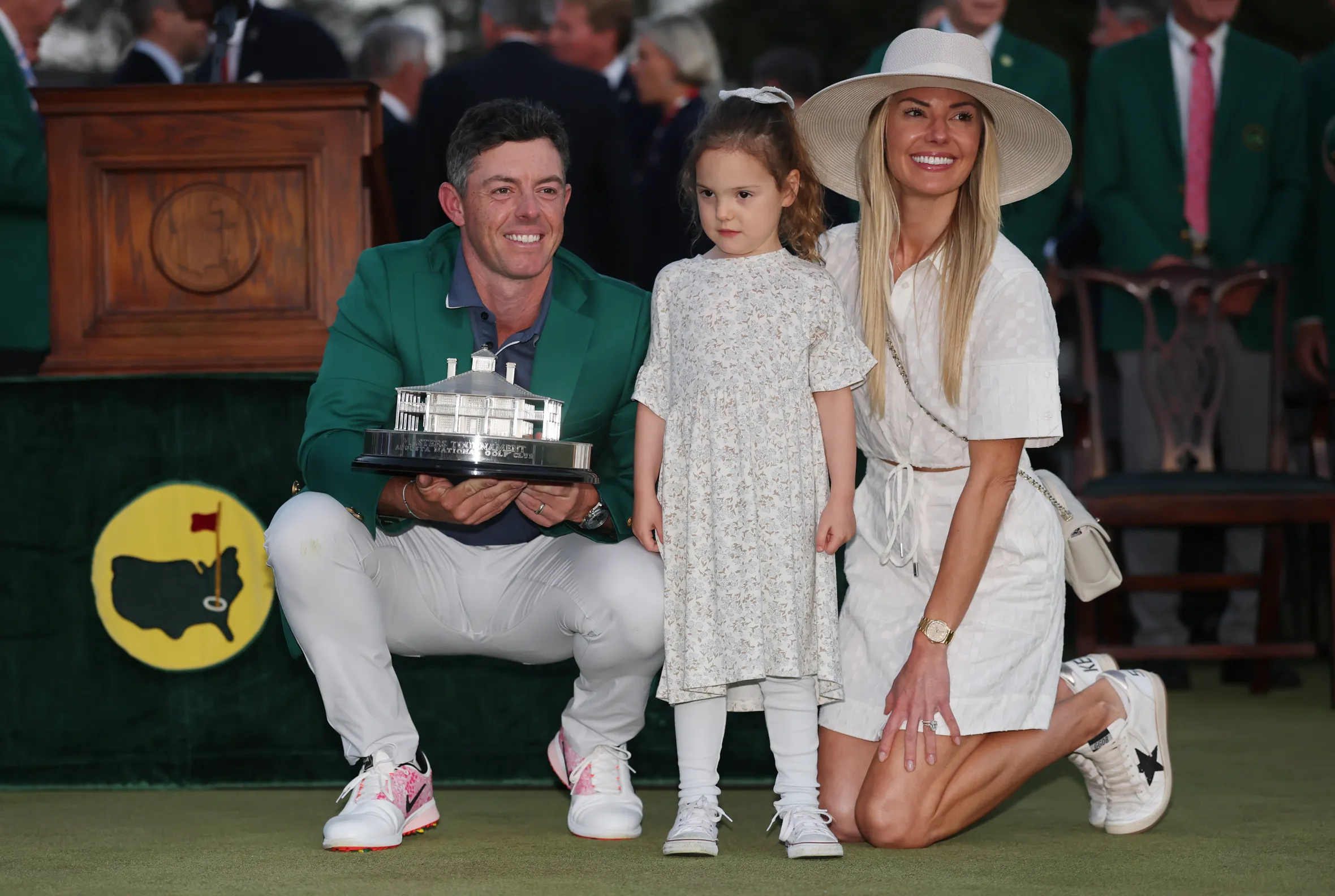 McIlroy, his voice cracking, spoke directly to daughter Poppy, seen here with his wife Erica Stoll, during his victory speechMichael Reaves/Getty Images
I try to rage against presentism, but I can’t think of another major in the history of the game that would have meant more, both to the player and to the game. Gene Sarazen would not have known he won the career grand slam. It seemed inevitable when Ben Hogan did it in ’53 and certainly when Jack Nicklaus did it in ’66. We had Jack on the show last year to sum up what it meant to win the grand slam and he acted like he hadn’t given it any thought. And Gary Player, well, I don’t know that the whole world was pulling for Gary because he was simultaneously playing with Jack and Arnold Palmer. For Tiger, it was an inevitable march.
As for the Masters, Jack’s win in ’86 was a nice way to sum up his career, but in no way did it change the way you viewed Jack. By 2019, when Tiger won again, there was no way he was ever going to catch Jack.
Rory’s is the greatest Masters ever.
The victory speech
By Alan Shipnuck, author of the new biography Rory
“Never give up on your dreams,” he tells his four-year-old daughter, Poppy.
For me it was the Green Jacket ceremony when he spoke directly to Poppy and his voice was cracking and you could tell that he had spent a long time thinking about what he wanted to say.
It was so heartfelt and eloquent and distilled this whole quest. The lesson is just never quit. Rory has superhuman gifts as a golfer, but the reason that win resonated so deeply was because it was about stuff. It was not about birdies and bogeys, it was about the humanity of it.
The Masters
Augusta, Georgia
Thursday to Sunday
TV Sky Sports. Full tournament coverage from 2pm on Thursday