
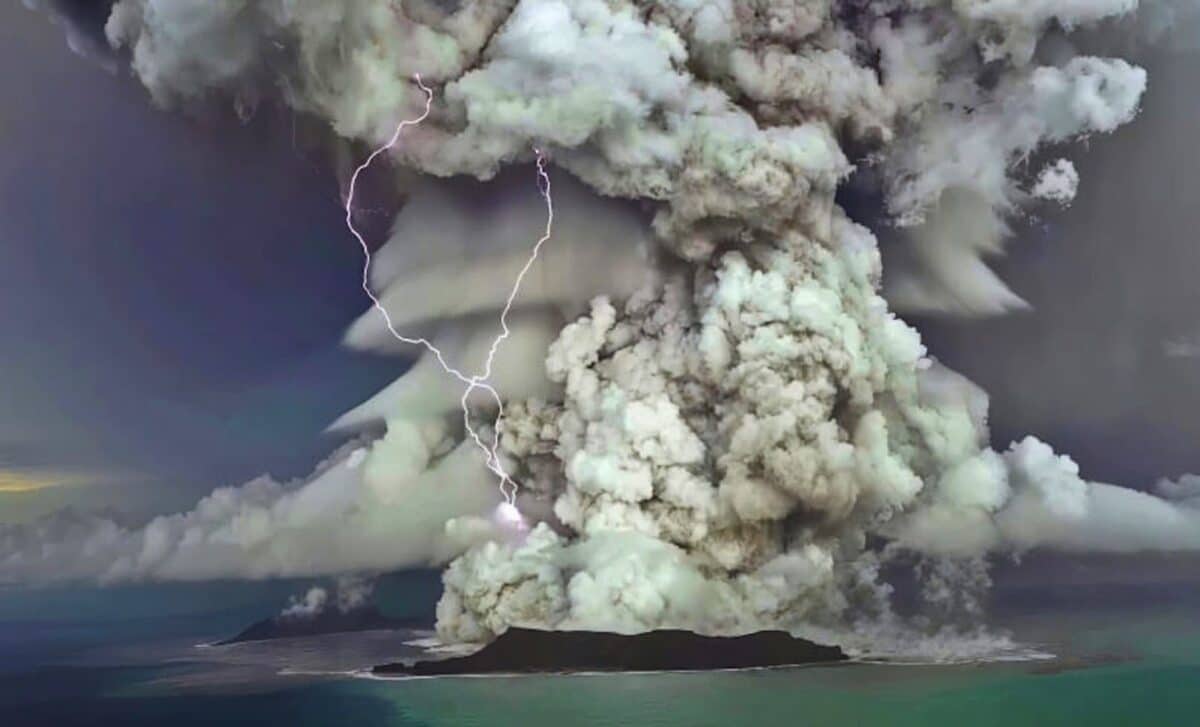
A new international scientific assessment of the 2022 Hunga Tonga-Hunga Haʻapai eruption has explained why the largest volcanic plume ever measured cooled the stratosphere instead of heating it.
The blast injected roughly 146 teragrams of water vapor into the stratosphere, equal to about 10 percent of the water already present in that layer. According to NASA’s Jet Propulsion Laboratory, the amount was nearly four times the water contribution of the 1991 Mount Pinatubo eruption. As of late 2025, most of that moisture remains in the upper atmosphere, and no earlier eruption in the modern record has produced anything close to that level of sustained stratospheric water increase.
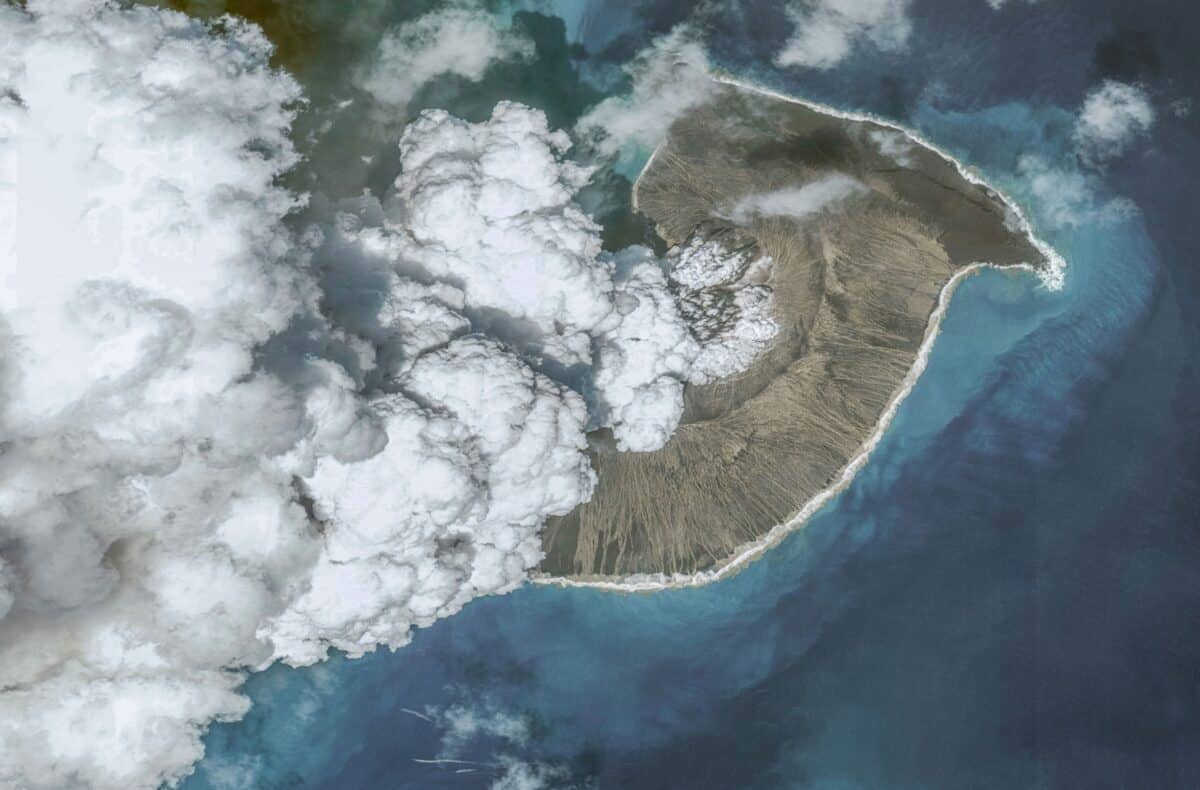 Tonga’s strange volcanic eruption was even more massive than we knew. Credit: Getty
That water vapor changed the rules. Typical large eruptions like Pinatubo release sulfur dioxide, which forms reflective particles that warm the stratosphere. Hunga did the opposite. The extra water released heat to space, cooling wide regions of the stratosphere by 0.5 to 1 degree Celsius (0.9 to 1.8°F). A report from the University of Colorado Boulder noted that this behavior contrasts sharply with every major eruption previously observed.
The Tallest Plume Ever Measured
The plume reached 35.4 miles into the sky, piercing the mesosphere, the layer where shooting stars burn up and most aircraft cannot fly. National Geographic confirmed this as the highest volcanic plume ever recorded.
Why so violent? The Hunga caldera sat roughly 490 feet below the ocean surface. That depth was ideal: deep enough for seawater to be superheated by erupting magma, but shallow enough that ocean pressure did not muffle the explosion.
A study published in the Journal of Volcanology and Geothermal Research proposed that the climactic blast was driven by gas forced hydraulic failure, not a simple magma water interaction. The reaction pulverized rock into fine particles and converted vast quantities of seawater into vapor that rode the eruption column into the upper atmosphere.
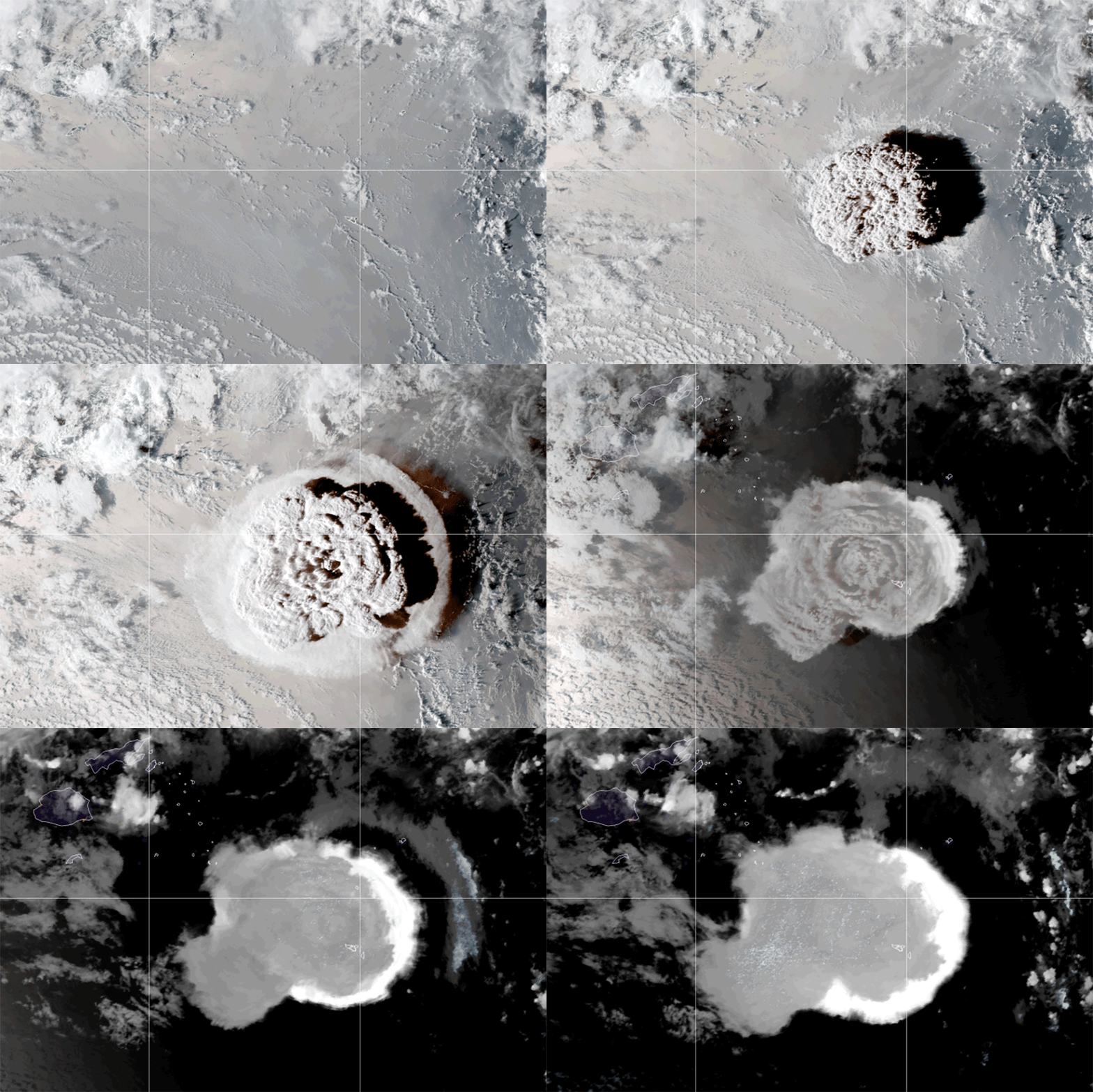 This looping video shows an umbrella cloud generated by the underwater eruption of the Hunga Tonga-Hunga Ha’apai volcano on Jan. 15, 2022. Credits: NASA Earth Observatory/Joshua Stevens/GOES imagery/NOAA and NESDIS
Seafloor surveys by New Zealand’s National Institute of Water and Atmospheric Research estimated the blast excavated around 2.3 cubic miles of rock, which would make Hunga the largest eruption recorded in the past century. The crater deepened by approximately 2,300 feet, and pyroclastic flows radiated at least 50 miles from the rim, blanketing the ocean floor in fine white sediment and severing undersea communication cables that linked Tonga to the outside world.
Cooling the Stratosphere, Sparing the Surface
Most major volcanic eruptions warm the stratosphere because dark sulfate particles absorb incoming solar radiation. At Hunga, seawater intercepted most of the sulfur before it could escape upward. Only a small fraction reached high altitudes. The resulting sulfate signal was far weaker than Pinatubo’s, while the water vapor signal was without precedent.
That water vapor acts like a radiator, sending heat back out to space. The cooling signal reached higher atmospheric layers in the months following the eruption.
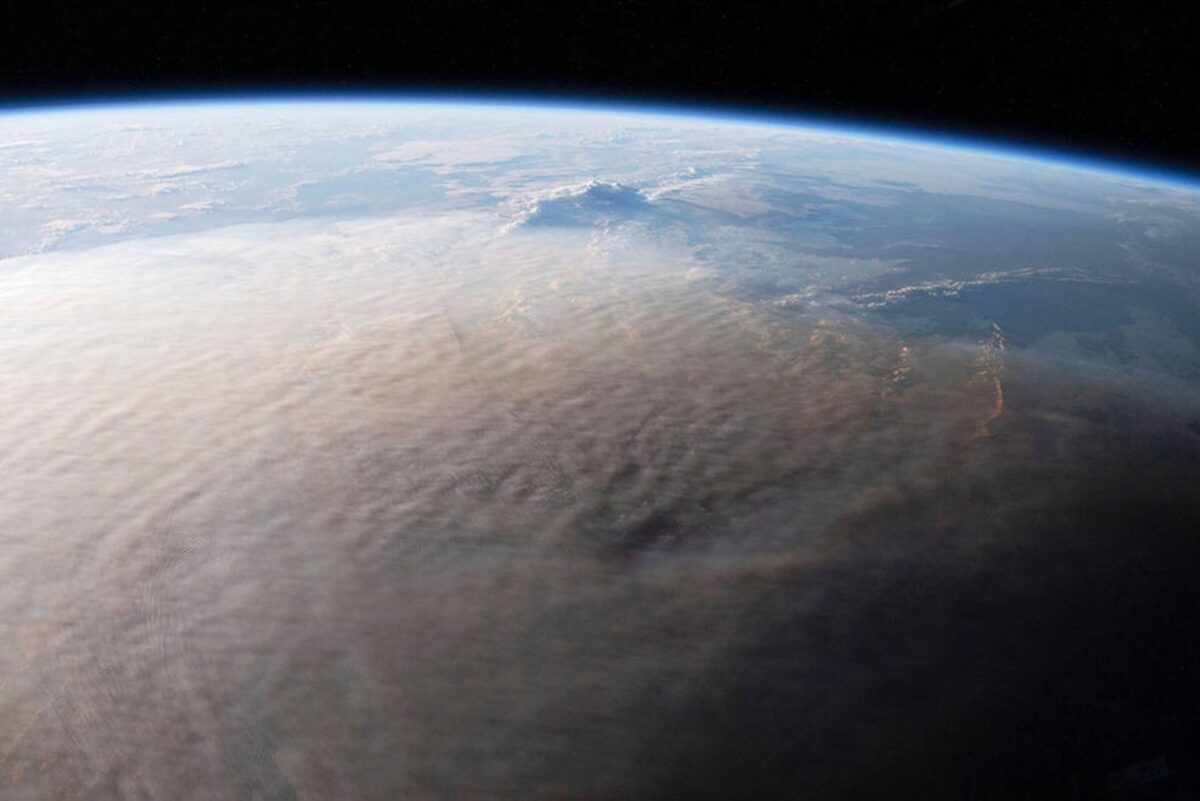 An image from Jan. 16, 2022, shows the ash plume from the Hunga Tonga-Hunga Ha’apai volcanic eruption that occurred the day before. Credit: NASA
Despite that upper-atmosphere disruption, surface temperatures showed almost no response. Ground level cooling reached only about 0.05 degrees Celsius (0.09°F), far below the 0.25 to 0.5 degrees of surface cooling that Pinatubo produced.
Professor Amanda Maycock of the University of Leeds confirmed the report shows Hunga had a net cooling effect overall and did not cause the record global warming observed in 2023 and 2024. That finding closes a debate among climate scientists who had wondered whether the eruption contributed to those recent heat records.
A Tsunami That Crossed Every Ocean
When the eruption column tore into the sky, the displaced atmosphere sent pressure waves racing around the planet four times over six days. These ripples disturbed ocean surfaces as far away as the Mediterranean, raising sea levels there by roughly a foot in what scientists call a meteo tsunami. The only confirmed prior occurrence of this phenomenon was during the 1883 explosion of Krakatau.
Closer to the volcano, the collapse of the caldera floor and pyroclastic flows entering the ocean generated a conventional tsunami as well. Waves struck nearby Tongan shores at heights estimated above 50 feet in some locations. The simultaneous combination of a collapse driven tsunami and a globally propagating atmospheric tsunami had not previously been observed in the instrumental record.
What Remains in the Atmosphere
The elevated stratospheric water vapor is expected to persist for several more years, well beyond the timeline of a typical sulfate driven eruption. Dr. Sandip Dhomse of the University of Leeds noted this extended atmospheric residence means the memory of the Hunga event will outlast that of most historic eruptions.
Short term ozone reductions were recorded across parts of the Southern Hemisphere, though these appear driven primarily by changes in air circulation rather than direct chemical destruction of ozone molecules. Antarctic ozone loss remained within normal seasonal ranges.
Dr. Yunqian Zhu, a senior research scientist at the University of Colorado Boulder, said the eruption demonstrated how water rich volcanic events can affect the stratosphere and how essential global cooperation is in monitoring such rare phenomena.