
CERN has forever changed the way we study the world around us.
The iconic laboratory has made studying the impossible possible. And physicists at CERN have recently made a remarkable discovery of a ‘mysterious proton’ that disappears as quickly as it appeared, vanishing in a fraction of a second.
What implications will this have for science and the world in the years to come?
CERN is a landmark achievement for the human race
CERN serves as a prime exemplar of how we can work together to achieve our goals as a species, regardless of nationality or political affiliation.
It was founded right after the Second World War to bring together European scientists to work on some of the most important studies at the time. Today, it hosts over 12,000 scientists from every nook and cranny of the world.
It essentially operates as a “science-without-borders” hub for the world.
Over its history, CERN has enabled scientists from nations that normally want nothing to do with each other to come together and work on projects. Nations that were normally on opposite ends of the political divide have worked on the same experiments at CERN.
Society is entering a new world of possibilities thanks to several new tech advancements
Technology has changed the world in uncountable ways over our collective history.
We have reached a tipping point where technology now receives the vast majority of investments from the richest people and organizations in the world. Most major tech companies have jumped on board the artificial intelligence bandwagon.
AI is, without a doubt, the revolutionary technology that will propel the world into the next era in our progression as a civilization.
Anthropic’s AI agent, Claude, recently made a remarkable milestone possible when it took control of a tomato plant. It was able to grow several tomatoes with no human interference or input, proving that we have only now begun to scratch the surface of what it is capable of.
The rate at which we are revolutionizing the tech industry is astonishing.
We even have devices that use AI to turn our dreams into a short video to share with family and friends. The possibilities of this new technology are seemingly endless. Google’s AlphaFold AI project recently won a Nobel Prize in Chemistry, proving that the potential of tech is growing.
So, back to CERN. The iconic hub for cooperative science, led by researchers from the University of Manchester, has recently discovered a mysterious proton in their latest experiment.
CERN physicists have found an odd proton that vanished as quickly as it appeared
The world of particles has been a hidden mystery that we are only recently beginning to understand.
Some of our technological progressions have only really benefitted mankind in mundane ways, such as new robots revealed at CES that can blow on your morning cup of coffee to cool it down. As Brad Pitt’s character in the film Snatch said, “Save your breath for cooling your pies.”
But this experiment at CERN has far more meaningful implications for us as a society.
The mysterious atomic glue that holds protons together may have been explained
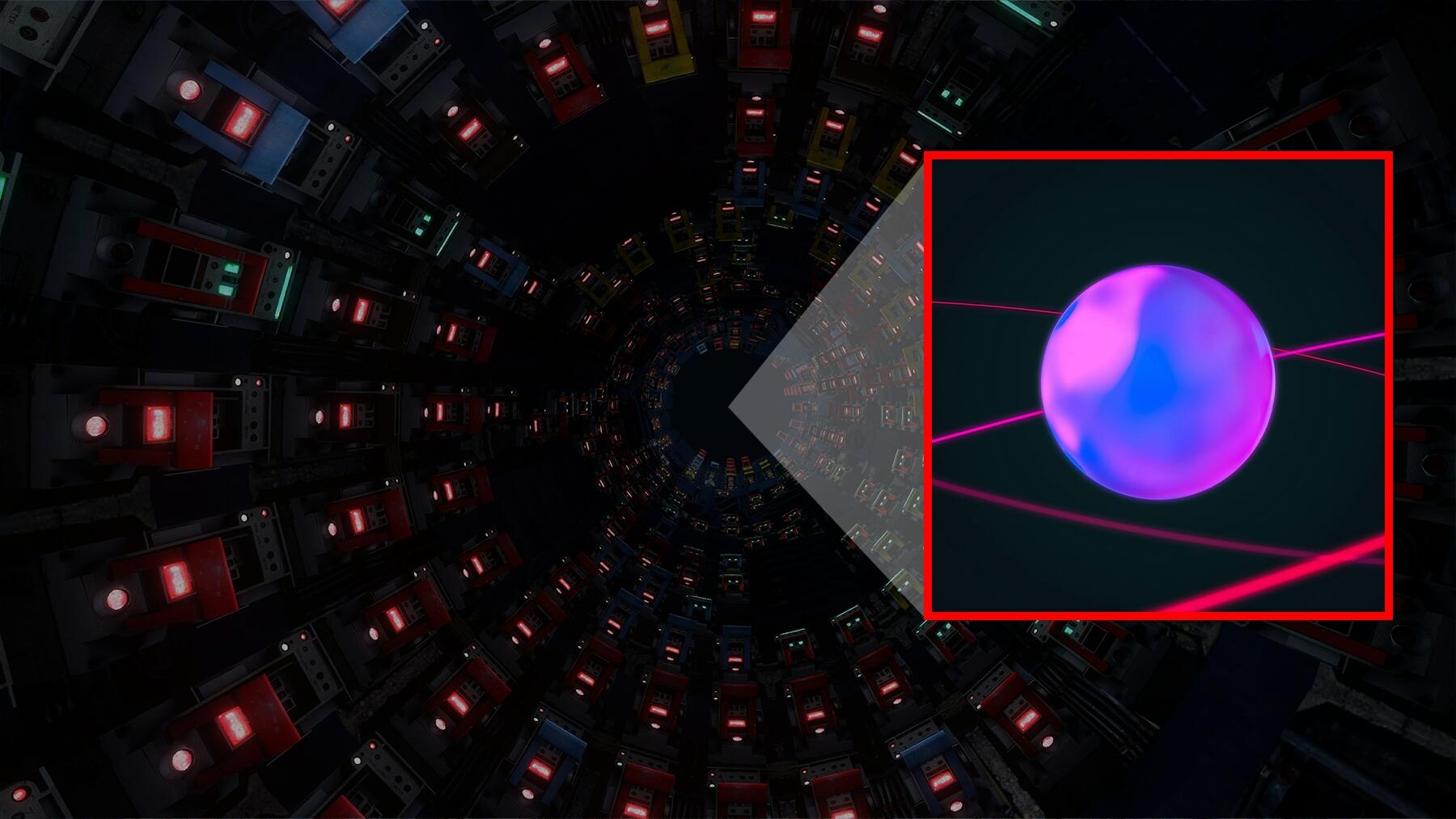
Physicists at CERN have recently detected a rare heavy particle that vanished as fast as it showed up. The high-mass particle acts like a heavy-duty cousin to the proton particle. It appears for only a fraction of a second before decaying, but it’s there regardless.
It was identified by the LHCb detector and could help us to understand the strong nuclear force that holds atomic cores together like a close-knit family.
We have learnt that the world of molecular life holds many mysteries that require a pragmatic and scientific approach to understand. Such as a recent ‘upload’ of mouse neurons into a “matrix-like” simulation.
What will the long-term implications and possibilities for technology be thanks to the detection of the high-mass particle made by CERN?