
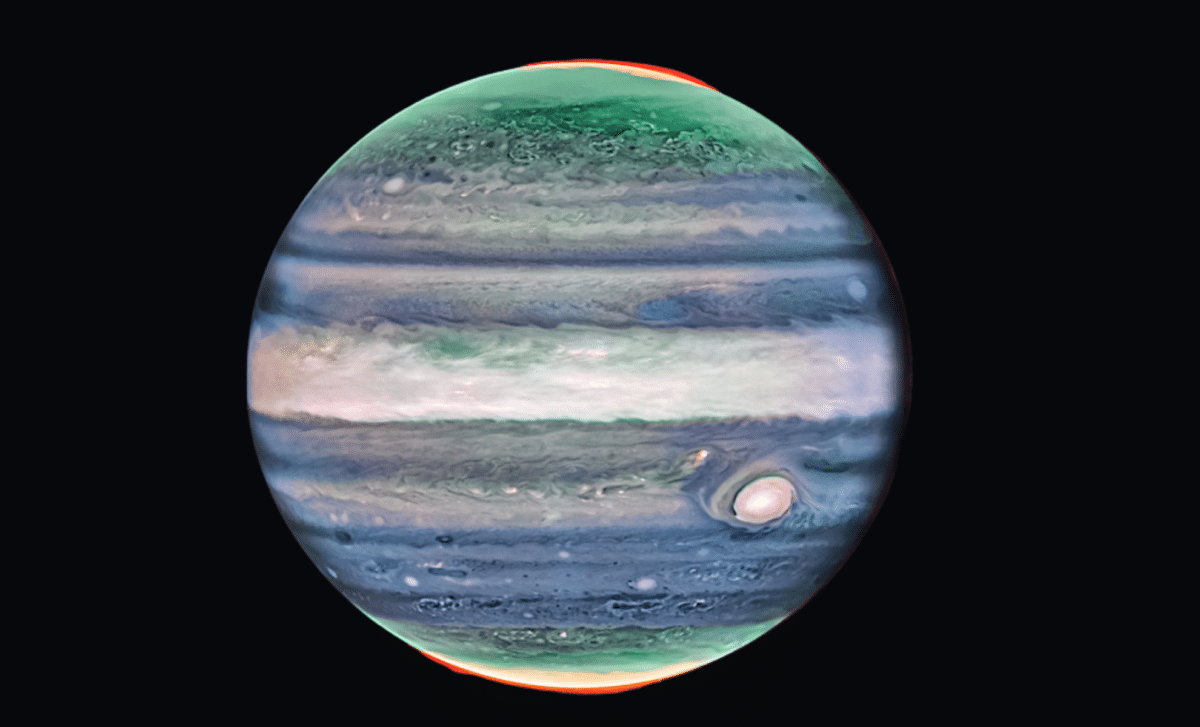
Researchers have finally mapped Jupiter’s upper atmosphere with unmatched detail, exposing a stable, planet-wide structure that has remained largely unchanged for years. This discovery, published in The Astrophysical Journal Letters, promises to revolutionize our understanding of not only Jupiter but also the behavior of atmospheres across the solar system. For decades, scientists have speculated about the causes of Jupiter’s atmospheric patterns, but new observations show a far more consistent and enduring phenomenon than previously imagined.
The Discovery That Redefines Jupiter’s Atmosphere
The traditional view of Jupiter’s atmosphere was one of chaos and unpredictability. However, after extensive observations made by Kate Roberts and her team at Boston University, a clearer, more structured picture has emerged. The team, which compiled a global map of Jupiter’s upper atmosphere, revealed that temperature gradients across the planet’s hemispheres are far more stable than once thought. The team’s work dismantles decades of assumptions about the planet’s atmospheric variability, presenting a new model in which the poles remain much warmer than the equator, but without random bursts of heat.
Roberts and her colleagues found that Jupiter’s atmospheric temperature smoothly decreases from the poles to the equator, with temperatures ranging from 833 Kelvin (1,040°F) at the poles to 754 Kelvin (900°F) at the equator. This consistent pattern over multiple years challenges previous theories that suggested chaotic or sporadic temperature changes, offering an essential tool for studying how heat moves and is distributed on giant planets.
“This stability establishes a fixed baseline for interpreting how heat and charged particles move across the planet, setting up the mechanisms that drive those patterns,” Roberts said.
What Does This Mean for Understanding Planetary Atmospheres?
The discovery of a stable atmospheric system on Jupiter isn’t just important for planetary science; it also has significant implications for understanding the atmospheres of other gas giants and even our own planet. Jupiter, known for its magnetic fields and intense auroras, reveals a complex interplay of heat distribution and charged particle movement that scientists now recognize as vital for comprehending upper atmospheres on a larger scale.
“Understanding upper atmospheres as a whole will help us understand Earth,” said Roberts.
This insight ties directly into the broader question of how atmospheres behave under extreme conditions, critical knowledge for future studies of exoplanets and planets in our own solar system. If these patterns are applicable to other planets, including Earth, then scientists may finally be able to explain the strange atmospheric behavior on exoplanets or gas giants like Saturn and Neptune.
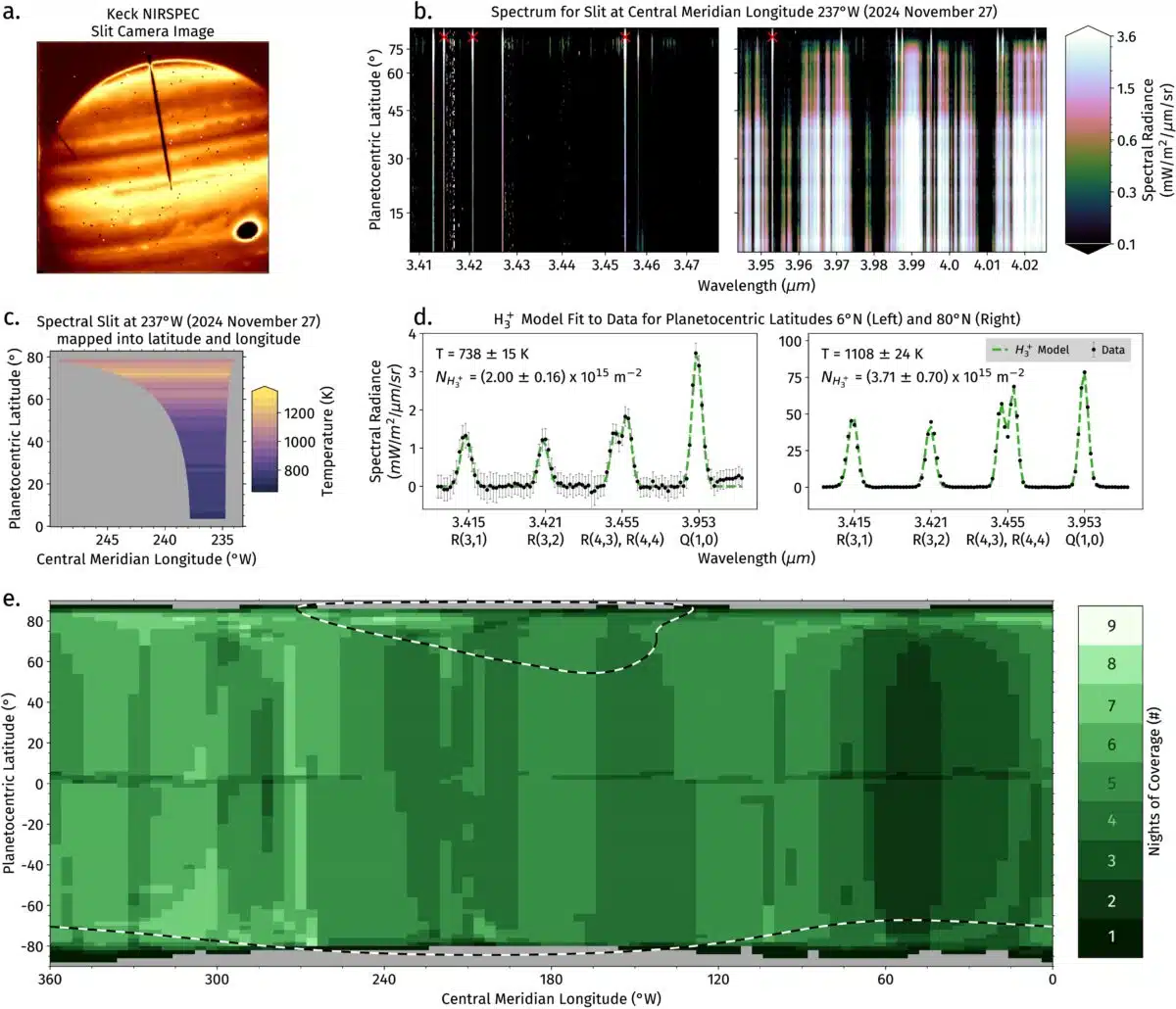 (a) Slit camera image of Jupiter in wavelengths 1.0–2.5 μm with the spectral slit aligned perpendicular to the planet’s equator. The (saturated) GRS appears in the bottom right of the frame. (b) Example of two extracted and rectified echelle orders from a typical calibrated spectrum mapped in latitude, in this case from 2024 November 27. Narrow emissions that brighten at 75°N and beyond are H. Emission lines used in temperature and density calculations are marked with a red ×. (c) Spectral slit mapped into latitude and longitude, representative of its physical size on the planet. The colors filling each bin are from H model fits to each of the 186 spatial pixels along the slit in the data (panel (b)), with sample fits shown in panel (d). (d) Emission lines cropped in wavelength from their wider spectrum have been fit with the H model, h3ppy. We provide both a low-latitude (left) and high-latitude (right) example to show the uncertainties on the data (black points), derived from Poisson noise propagation, and the quality of resulting fits (green line). Uncertainties at high latitudes are smaller than the data markers. Note the latitudinal trend in emission line magnitude from differing y-axis scales. (e.) Data coverage per 2° latitude, 4° longitude bin in terms of the number of nights that contributed to that bin. On average, each bin is covered by 5 nights of observation and contains 60 spectra.
The Role of Winds and Charged Gas in Jupiter’s Upper Atmosphere
Perhaps the most fascinating aspect of the study, pubslished in The Astrophysical Journal Letters, is the role that winds play in Jupiter’s upper atmosphere. Unlike Earth, where atmospheric currents drive much of the planet’s weather, Jupiter’s upper atmosphere is shaped by planet-wide winds that steer charged gases up and down along magnetic lines. These winds are essential in maintaining the stability seen in the new maps. They are responsible for lifting or sinking charged gases like H3+, a hydrogen ion that gives off infrared light, providing critical insights into the atmospheric conditions of the gas giant.
The discovery of stable, vertical gas motion driven by these winds is key to understanding how Jupiter’s ionosphere behaves. These winds not only determine where charged gas piles up, but they also control the brightness patterns seen in infrared light across the planet. This revelation helps resolve a long-standing mystery about the glowing streaks in Jupiter’s atmosphere, which were once thought to be temperature-driven but are now understood to be linked to the density of charged particles instead.
Jupiter’s Energy Balance: A Global Perspective
The study also highlights an unexpected aspect of Jupiter’s energy balance: the planet does not trap all the energy it receives but instead releases enormous amounts of energy back into space. The team’s measurements suggest that around 25.8 trillion watts of energy are emitted by Jupiter’s upper atmosphere at noon, with over half of that energy coming from lower latitudes, not the auroras.
This revelation complicates previous theories about where Jupiter’s heat comes from and challenges scientists to reconsider the dynamics of heat distribution on gas giants. With the new stable atmospheric map, Roberts and her team are now able to test theories about how energy is lost from the planet, shedding light on Jupiter’s energy cycle and the broader processes that govern planetary atmospheres.
“The goal of my research is to try and narrow down where all this extra energy is coming from,” Roberts said, underlining the importance of ongoing investigations into the planet’s complex energy dynamics.