
Scientists studying the samples returned from asteroid Bennu by NASA’s OSIRIS-REx mission have found a surprisingly intricate chemical landscape. This asteroid, known for its rich carbon content, has revealed a complex pattern of organic material and minerals that offers clues about how water, a key element needed for life, interacted with the surface of this ancient space rock.
Bennu’s samples are particularly important because they have remained untouched by Earth’s atmosphere and weather. Unlike meteorites that burn up as they enter the atmosphere, Bennu’s samples have been preserved in their original state. This pristine condition gives scientists a rare opportunity to study how water, minerals, and organic compounds interacted in space billions of years ago. It is like opening a cosmic time capsule, a snapshot of conditions that may have shaped not only Bennu but also many other bodies in the early Solar System.
Led by Mehmet Yesiltas, a team of researchers focused on a sample known as OREX-800066-3, which was collected during the OSIRIS-REx mission and delivered to Earth in September 2023. The team used advanced techniques including nanoscale infrared and Raman spectroscopy to analyze chemical variations at an incredibly small scale of around 20 nanometers. The results were fascinating.
A Patchwork of Chemical Regions
Instead of a uniform mixture, the Bennu sample revealed three distinct chemical regions. One area was dominated by aliphatic organic compounds, simple carbon-based molecules. Another area was rich in carbonate minerals, which form when water reacts with other minerals. The third region contained nitrogen-rich organic compounds.
 A close-up of eight sample trays with final material from asteroid Bennu. Credit: NASA/Erika Blumenfeld & Joseph Aebersold
These regions did not mix evenly. The organic materials and minerals were distributed in a patchwork pattern, suggesting that water did not affect the OSIRIS-REx sample uniformly. Some areas were altered more intensely than others, creating this complex chemical landscape. As the authors of the study explained:
“Their fine-scale heterogeneity shows that water did not alter Bennu uniformly. Instead, fluids flowed through restricted pathways, preserving nitrogen-rich organic compounds while precipitating diverse carbonates and organosulfur species.”
How Water Shaped Bennu’s Surface
As stated in the latest research, published by Proceedings of the National Academy of Sciences, the presence of these three distinct regions provides solid evidence that liquid water once played a crucial role in shaping its chemistry, but in an uneven manner. This challenges the assumption that water behaves uniformly on small bodies. The survival of delicate organic molecules through these interactions with water is also remarkable. It suggests that organic materials on asteroids like Bennu might be more resilient than previously thought.
“These results demonstrate that fragile organic molecules can survive aqueous alteration on small bodies and that different alteration pathways operated on Bennu,” wrote the study team.
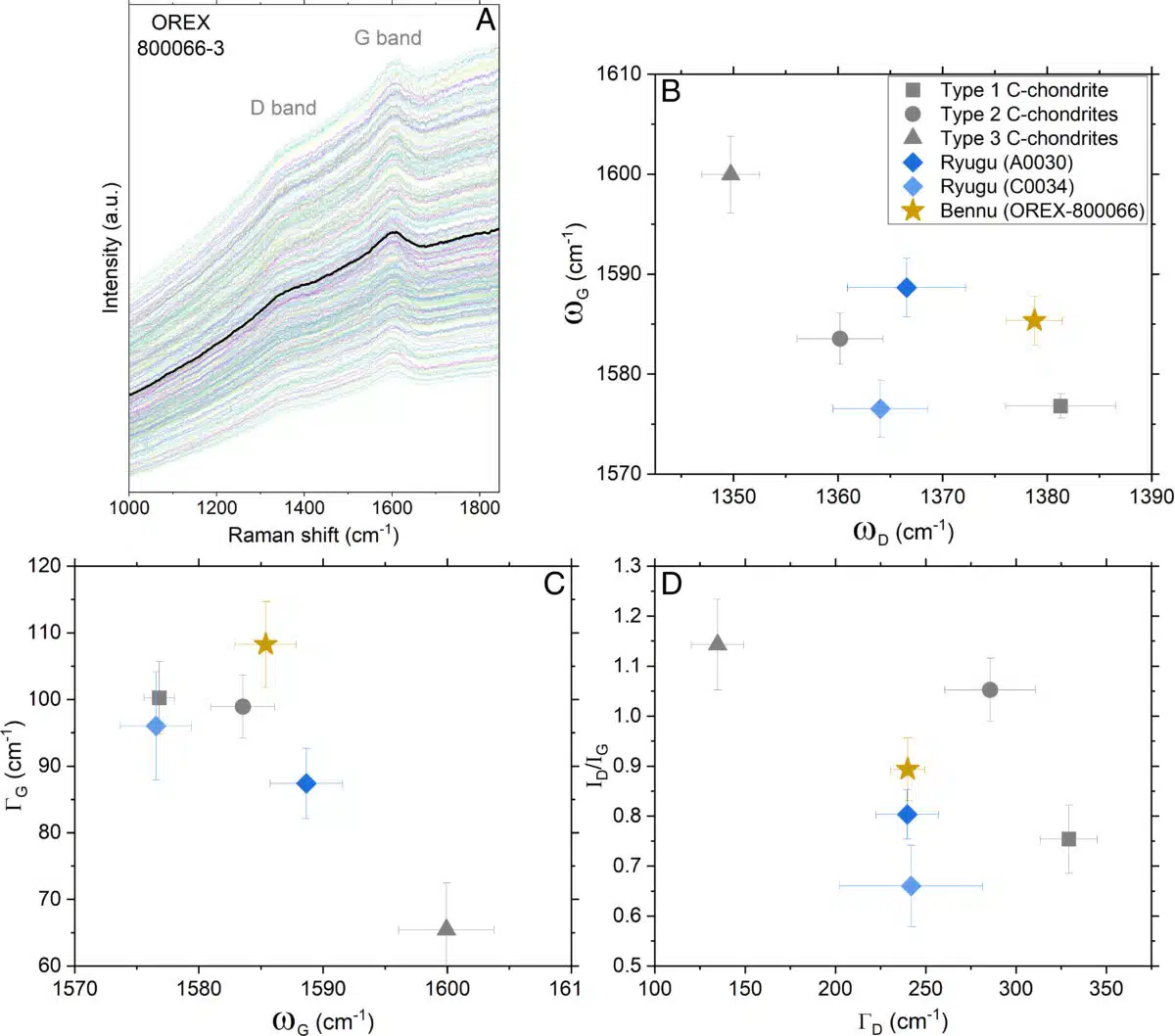 Raman spectroscopy analysis of asteroid Bennu sample (OREX 800066-3) compared to different types of chondrites and samples from the asteroid Ryugu. Credit: PNAS
A Pristine Record of the Solar System’s Evolution
By studying how water, minerals, and organic compounds interacted on Bennu, scientists are piecing together a larger picture of how these processes might have played out on other asteroids and planetary bodies.
“These findings improve our understanding of how water, minerals, and organic matter interacted on primitive asteroids,” concluded the authors.
Further analysis of these impeccably preserved pristine samples promises to unlock additional chapters of Bennu’s chemical history, giving researchers new clues about the fundamental partnership between water and organic compounds in shaping the early Solar System.