
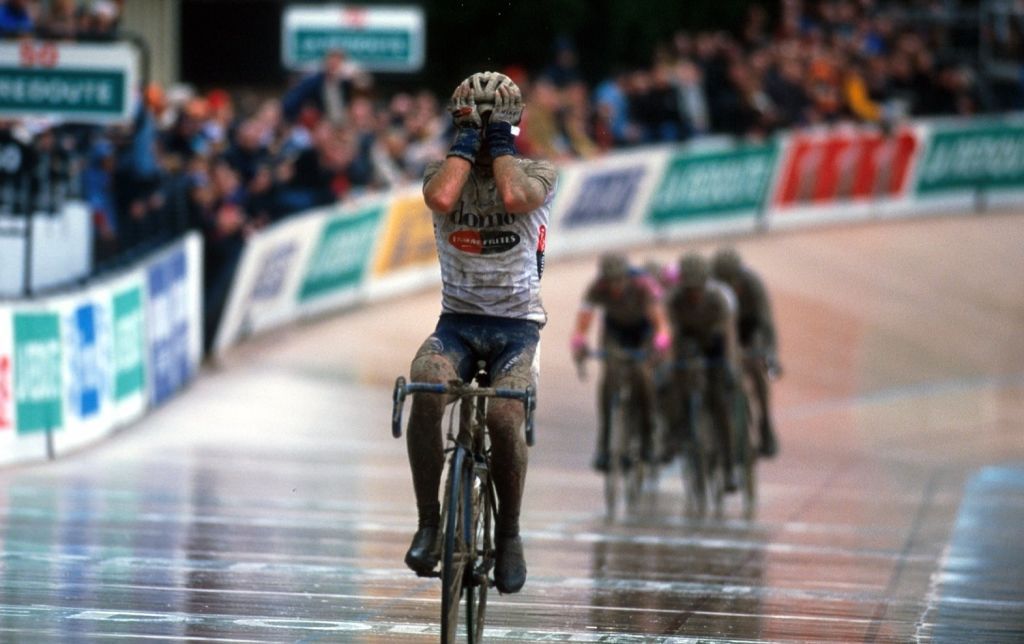
The 2001 edition of Paris-Roubaix has its place in the annals of cycling history for a number of reasons. 25 years on, the race is remembered as the muddiest Roubaix ever, with crashes, mechanicals and the power of the brand new Domo-Farm Frites-Latexco team ripping the race to pieces.
Managed by Patrick Lefevere, Domo-Farm Frites-Latexco swept the podium in a superlative display of strength. However, it wasn’t Johan Museeuw or reigning world champion Romans Vainsteins sitting on top of the pile. That honour unexpectedly fell to Servais Knaven, a rider who has become synonymous with the Hell of the North ever since and jointly holds the record for the most finishes of the race with 16.
“It’s always been a special race for me from the first time I started. I fell in love immediately,” Knaven tells Cyclingnews a quarter of a century on. “Winning Roubaix was the best moment of my cycling career.”
Article continues below
You may like
When a domestique becomes a winner
Knaven went into the 99th edition of Paris-Roubaix with a focus on supporting his more decorated teammates. By 2001, Museeuw had won the Tour of Flanders three times and Roubaix twice (he would go on to win in the velodrome again the following year). Vainsteins had just finished on the podium of Milan-San Remo having claimed the rainbow bands six months earlier in Plouay. Others, such as Wilfried Peeters, also sat higher in the pecking order than Knaven.
The team was feared by the rest of the peloton in the Classics that year, but up to that point had not yet landed a landmark victory.
“It was the first year of the team. We were really chasing a big win and we didn’t really have the best results until that day,” Knaven remembers.
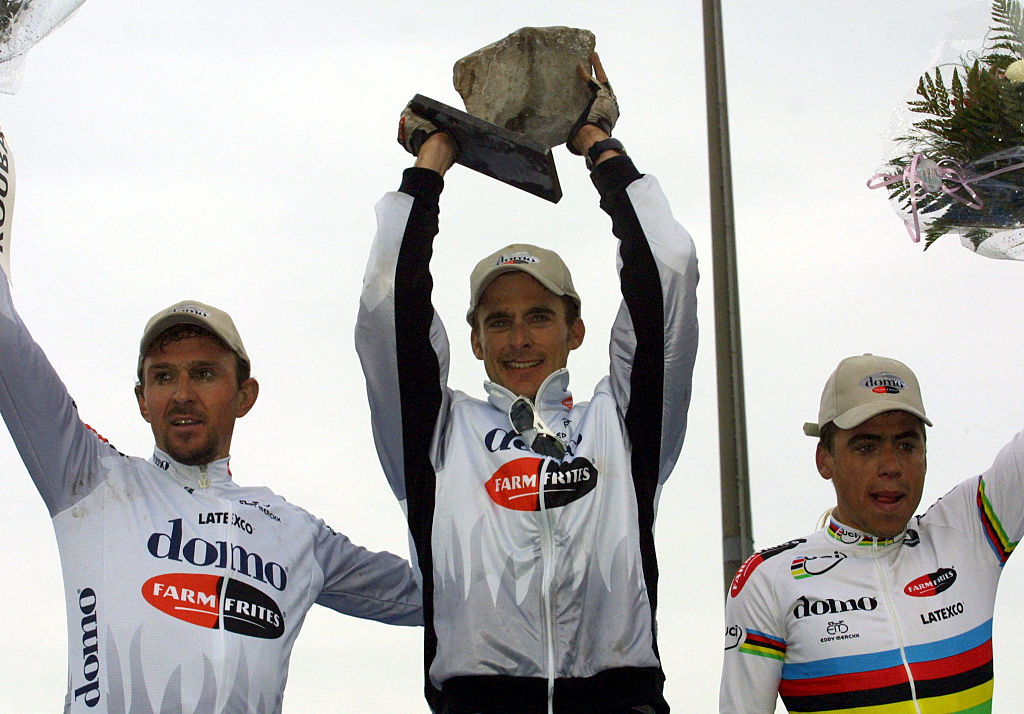
The team proved their status as a fearsome Classics squad with 1-2-3 in Roubaix (Image credit: Getty Images)
In the days before the 2001 edition of Paris-Roubaix, the heavens had opened over the route, creating a covering of muddy sludge over the pavé. The surface under the wheels of the riders caused crashes early on. Many of those who avoided the falls suffered multiple mechanicals, including Knaven and Museeuw.
Domo-Farm Frites-Latexco worked as a team and invested early in good positioning, with Knaven taking the wind.
“I was just helping to position ahead of the first section but because it was raining, after the first section, we were only left with ten or fifteen riders. Another ten came back but those guys were always a little bit on the back foot and we were always in a good position,” Knaven says.
What to read next
“We were one team. We helped each other to be in the front at each section so we could avoid all the problems.”
One of the key moments of the race occurred at the fearsome Trouée d’Arenberg, which was almost unrideable in the conditions. Knaven worked on the front to position Museeuw before teammate Peeters launched an attack. With numbers in a small chasing group behind Peeters, the team could preserve energy.
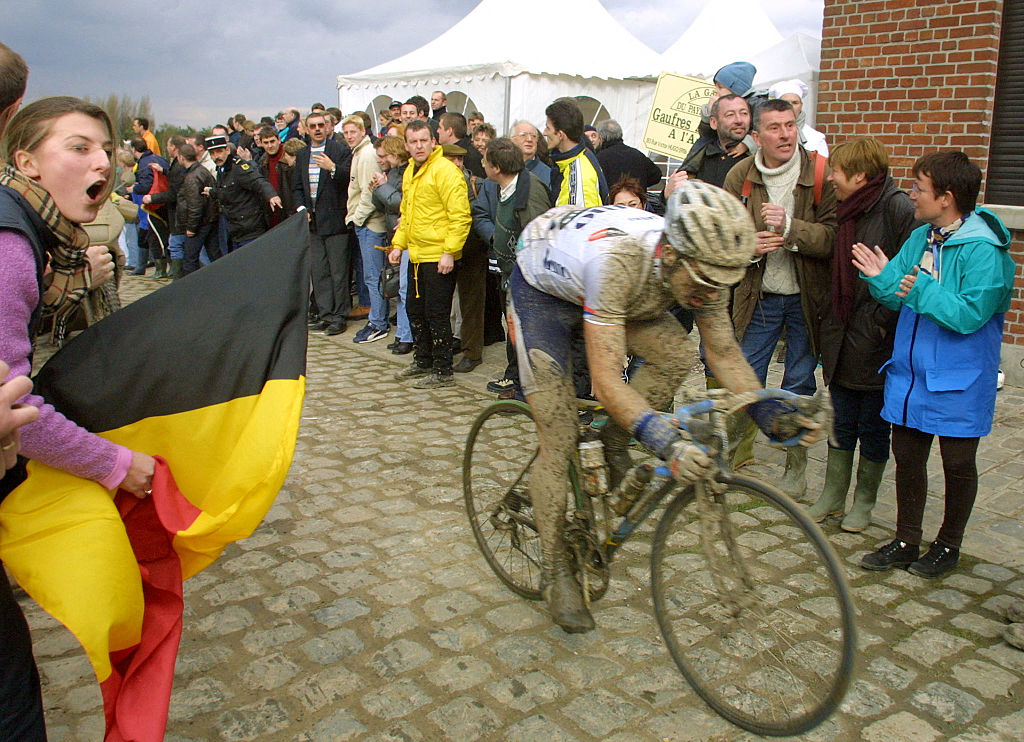
Knaven on the attack (Image credit: Getty Images)
Peeters was caught within the final 25km, but Museeuw suffered a puncture, meaning the team had to wait for their leader. Once the Belgian was back in the group, it was time to finish the job. There were seven left in the front group, and four of them were representing Domo-Farm Frites-Latexco.
The instruction from the car came through for the team to attack one after another.
“That’s how we played the game in the final on the tarmac. That’s where the real game started,” Knaven says. He went with 10km to go at a railway crossing, immediately building a gap.
Knaven never looked back and powered away from the group which contained the likes of George Hincapie. He arrived at the famous velodrome alone, 34 seconds ahead of Museeuw with a further seven back to Vainsteins who took the sprint from the chasing group for a historic 1-2-3 for Domo-Farm Frites-Latexco. Knaven wiped the mud off his jersey to reveal the sponsor’s logo beneath and celebrated the biggest win he will ever take.
“I don’t remember anything at all about the finish, because you’re so overwhelmed, you still cannot believe it,” says Knaven now.
“The gear was way too big. I was totally empty,” he says of the final solo ride to the line. “You have the little climb towards Roubaix, which felt like Alpe d’Huez for me.”
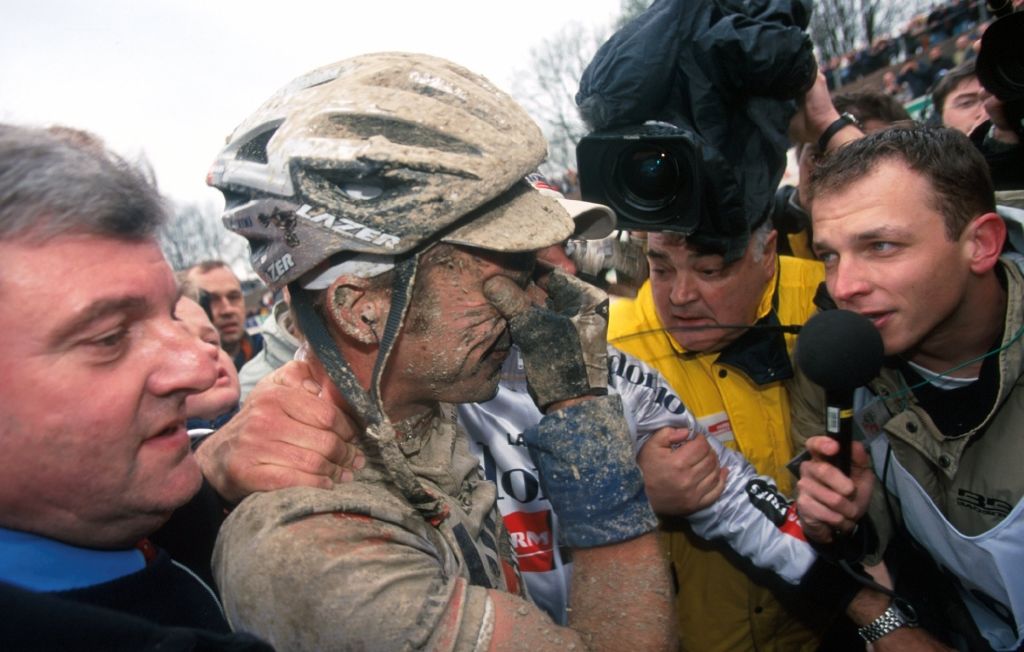
Knaven was in disbelief at the finish (Image credit: Getty Images)
Knaven now heads up the fleet of Shimano neutral service vehicles for ASO and will return to the cobbles once more this year for Roubaix. In a strange mirroring, the now 55-year-old credits his 2001 win in part to a neutral service mechanic, who got him back on the bike after a puncture.
The team ran lower tyre pressures than their rivals, giving them the advantage of extra grip on the slippery cobblestones. However, having a neutral service tyre on the back helped Knaven with his final attack.
“I got a spare wheel from neutral service and the wheel was pumped really hard, so all the sections after that were the hardest of the whole day for me because I didn’t have the right tyre pressure. It was just a matter of surviving. But then looking back, with that hard tyre I could go a lot faster on the tarmac.”
A new era at Paris-Roubaix
The Hell of the North has changed a great deal since Knaven’s win 25 years ago. In particular, the tech has moved forward: tyres are wider, tubeless has been introduced, bikes are stiffer and faster.
The average speed at Roubaix has also never been higher than in the last four years, with a record of 47.8kph set by Mathieu van der Poel in 2024. The prevailing logic is that with higher speeds, the race opens up to lighter riders as the bikes glide over the stones, rather than bobble through them.
This is one of the reasons, according to Knaven, that Tadej Pogačar can contend for this Monument in his mission to win them all. The 2001 winner is in no doubt that the reigning world champion could win the race one day.
“For sure, the tubeless tyres helped Pogačar to be up there. I’m not saying it’s only that, because he’s the best rider in the peloton, but it is super nice to see him being there in action and for him it is a big goal to try to win it, but for sure the tyres help.
“When you were very light and you were riding in the past you were bumping a lot more. Then, as a light rider, it was more of a disadvantage than for a heavy rider. I’m happy with that. It’s nice to see that nowadays the weight is less of an issue.”
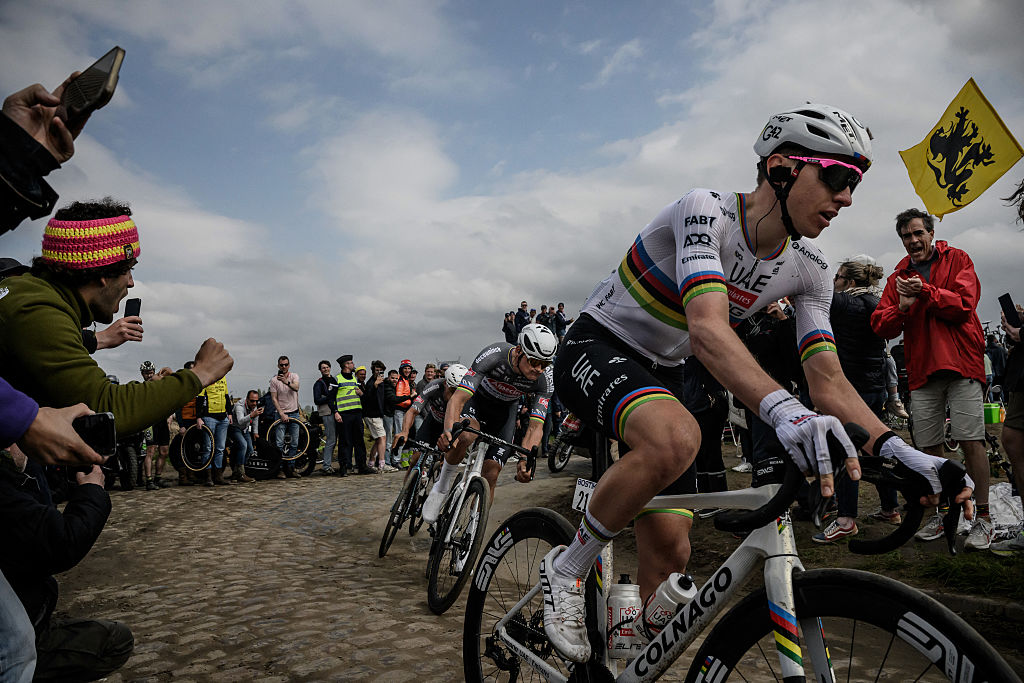
Tadej Pogačar hugely impressed on only his first Roubaix ride in 2025 (Image credit: Getty Images)‘It’s something that’s in you’
Famously, the bike that Knaven won upon 25 years ago has never been washed. It remains caked in mud and is now on display in the Rapha store in Amsterdam.
The feeling that Paris-Roubaix emits for Knaven has never changed since he first cycled on those famous roads more than 30 years ago. Even though Knaven went on to win a stage of the Tour de France in 2003 and enjoy a successful career as a sports director with Team Sky and then AG Insurance-Soudal, it is that remarkable Sunday in April 2001 that he cherishes most of all and will be remembered for.
“When I come back to do the recon [with the Shimano neutral service], it always gives a special feeling. Of course because I won it but even without winning, I think I would still have that special feeling for the race.
“And when I ride the cobbles now – I’m not doing it a lot – but I still can ride the cobbles. It’s something that’s in you. Even though I’m not going that fast anymore, I’m still enjoying it.”
Get unlimited access to our unrivalled 2026 Spring Classics coverage with a Cyclingnews subscription. We’ll bring you breaking news, reports, and analysis from some of the biggest races on the calendar, including Milan-San Remo, Paris-Roubaix and the Tour of Flanders. Find out more.