
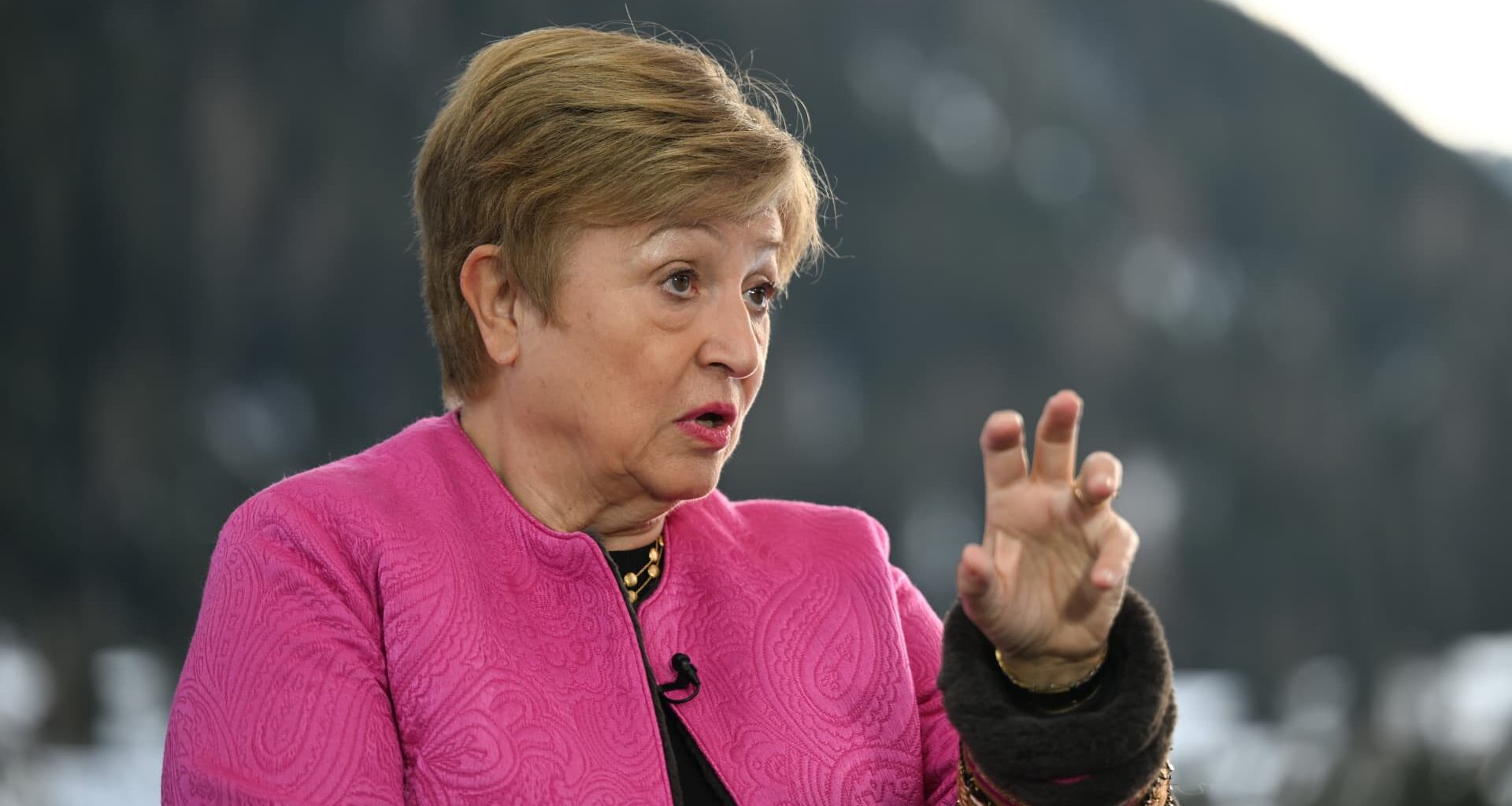
Kristalina Georgieva, managing director of the International Monetary Fund (IMF), in Davos, Switzerland, on Monday, Jan. 19, 2026.
Bloomberg | Bloomberg | Getty Images
Higher inflation and weaker growth ahead are inevitable for the global economy as a consequence of the Iran war, the head of the International Monetary Fund warned on Monday as the institution prepares to cut its forecasts.
“All roads now lead to higher prices and slower growth,” IMF managing director Kristalina Georgieva told Reuters in an interview on Monday night.
Before the war, the IMF anticipated issuing a small upgrade on its outlook for global growth of 3.3% in 2026 and 3.2% in 2027, according to Georgieva.
But those expectations have since been upended as the Iran conflict has sent shockwaves through the global economy that are unlikely to unravel anytime soon, even if the war is brought to a rapid resolution.
The U.S. and Israel’s attack on Iran six weeks ago has triggered a significant shock to energy supply as the effective closure of the Strait of Hormuz, a vital shipping corridor, brought marine traffic in the Gulf to a standstill.
Shipping through the crucial maritime passage has slowly resumed, with 8 tankers reportedly transiting Monday, compared to an average of fewer than 2 transits per day in March, according to S&P Global Market Intelligence.
But traffic volumes remain at a fraction of pre-war levels, with an average of 20 million barrels of crude oil and products transiting through per day in 2025.
Global oil supply has reduced by 13%, according to the IMF, while severe damage has been done to other critical supply chains. Georgieva warned that the poorest countries lacking sufficient reserves will be the most affected.
“We are in a world of elevated uncertainty,” she added, citing geopolitical tensions, technological advancements, climate shocks and demographic shifts. “All of this means that after we recover from this shock, we need to keep our eyes open for the next one.”
The dual threat of higher prices and slower growth is driving fears of a return to “stagflation” among consumers, business leaders and policymakers. The Iran war is expected to dominate discussions at next week’s spring meetings of the World Bank and the IMF, with Georgieva presenting a speech on Thursday.
“Directionally, it is stagflation,” said Mark Zandi, chief economist at Moody’s Analytics. “It’s higher inflation and weaker economic growth that is the result of policy — tariff policy and immigration policy.”
— CNBC’s Anniek Bao and Jeff Cox also contributed to this report.