
Scientists have uncovered the secret origins of gold beneath the ocean floor. A study published in Communications Earth & Environment reveals that gold in volcanic island arcs forms not through a single, isolated event, but from repeated, high-degree melting of a hydrous mantle. Led by marine geologist Dr. Christian Timm, the study provides fresh insight into how gold and other noble metals are concentrated in magmas long before they ever reach the surface, suggesting a much deeper, more complex alchemy at work in Earth’s crust.
A New Understanding of Gold Formation
For centuries, gold has captivated humankind, driving exploration and sparking wealth in the most unlikely of places. But where does this precious metal come from? The answer, until now, has been shrouded in mystery. Scientists have long known that volcanic island arcs, like those found beneath the Kermadec Islands near New Zealand, are rich in gold. But why?
This new research, led by Dr. Timm at the GEOMAR Helmholtz Centre for Ocean Research Kiel, answers that question. The findings, published in Communications Earth & Environment, suggest that gold enrichment in these regions is the result of multiple melting events in the mantle, events that occur far below the ocean floor, where oceanic plates subduct beneath each other. The process is not a one-off, but rather a gradual and repeated concentration of gold as the mantle melts and releases metal-rich magma.
“When we analyzed these samples, we found that their gold concentrations are often several times higher than those of comparable magmas from mid-ocean ridges,” says Dr. Timm. “This raised the key question: which processes are responsible for this enrichment?”
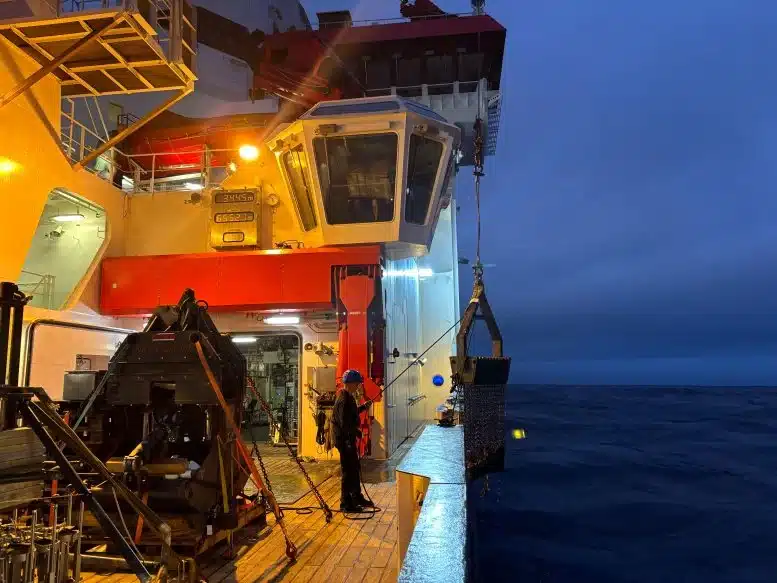 The chain bag dredge is being hauled back on board during the sampling expedition in the South Pacific with the research vessel SONNE.
Credit: Christian Timm, GEOMAR
The Role of Hydrous Mantle Melting
At the heart of the discovery is the behavior of Earth’s mantle, which, under intense heat and pressure, melts in the presence of water. This process is essential in volcanic island arcs, where oceanic plates meet and one plate is forced beneath the other in a phenomenon known as subduction. Water from the subducting plate lowers the mantle’s melting point, allowing it to melt at much higher temperatures.
But water alone isn’t the full story. Dr. Timm’s research emphasizes that the key to gold enrichment is not just the introduction of water into the mantle, but the degree to which the mantle melts over time.
“We initially assumed that water released from the subduction zone directly controlled gold enrichment,” says Timm. “However, our data show that water mainly facilitates mantle melting. The key factor for high gold concentrations is the high – and in part repeated – degree of melting.”
As the mantle undergoes repeated melting, gold and other sulfur-loving metals, such as copper and platinum, become increasingly concentrated in the resulting magma. Over time, these metals rise to the surface, fueling the volcanic activity that characterizes island arcs.
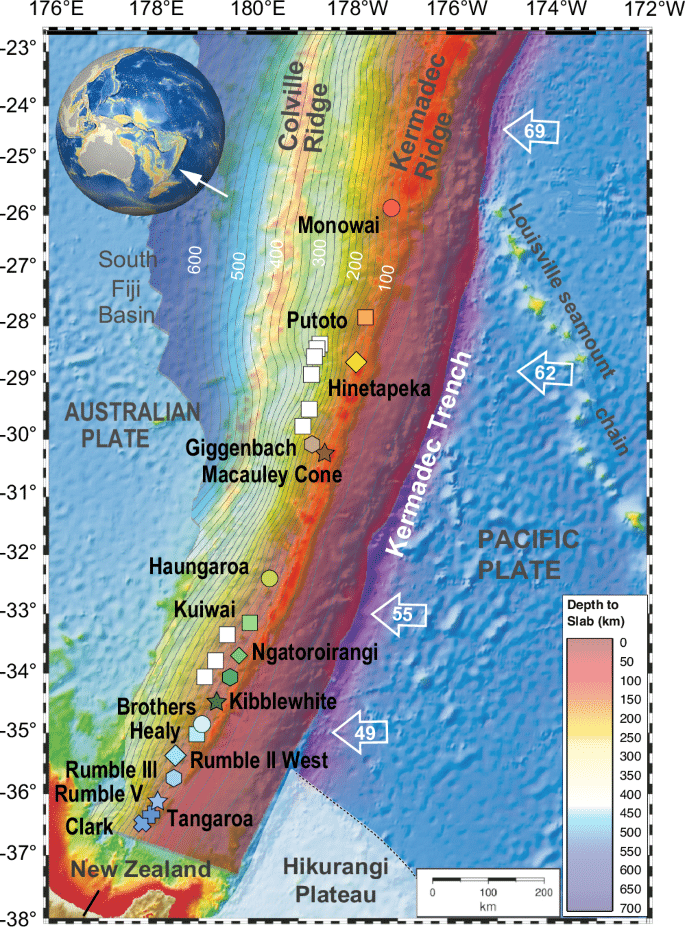 Bathymetric map of the Kermadec arc system
Volcanic Glass: A Window Into the Mantle’s Secrets
To uncover the details of this multi-stage melting process, the team examined 66 volcanic glass samples collected from the seafloor near the Kermadec Islands. These glasses, which form when lava cools rapidly underwater, preserve the chemical composition of magma before it undergoes crystallization. Some of the most informative samples were what researchers called “primitive glasses,” which represent magma before it has been altered by cooling.
The team discovered that these primitive glasses contained gold concentrations significantly higher than those found in comparable basalts from mid-ocean ridges. This discovery provided strong evidence that the mantle, in these volcanic island arcs, undergoes a unique form of melting that enriches the magma with gold.
The Life Cycle of Gold
The study’s findings represent the first step in understanding the full life cycle of gold. As Dr. Timm explains, gold’s journey begins deep in the mantle, long before it ever reaches the surface.
“We are effectively looking at the first step in the life cycle of gold,” he concludes. “It begins with the transfer of gold from the mantle into a melt that eventually forms volcanoes. The alchemy starts long before the metal reaches the surface.”
This process, the research suggests, contributes to the formation of gold-rich deposits not just in island arcs, but potentially in hydrothermal systems associated with subduction zones. These systems, which occur where magma interacts with water beneath the ocean floor, may also be key sites for the creation of economically viable gold deposits in the future.
The Bigger Picture: Implications for Gold Deposits
This discovery doesn’t just illuminate the mystery of gold’s origin, it could have broader implications for understanding the formation of gold deposits in regions around the world. For example, hydrothermal sulfide deposits, which are known to contain high concentrations of gold, often form in the same subduction zones where these processes take place.
“We identified a mechanism that could contribute to the elevated gold contents observed in hydrothermal systems in subduction zones,” Dr. Timm explains. “However, this link still needs to be investigated further.”
As the team moves forward with their research, these findings may offer new insights into how gold-rich hydrothermal systems are formed, potentially aiding exploration for gold deposits in the future.