
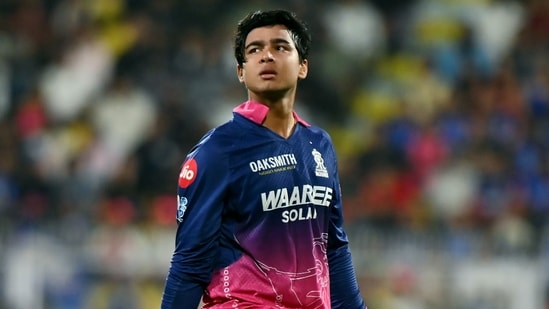
Vaibhav Sooryavanshi did not need a half-century or century against the Mumbai Indians to make the point. In Rajasthan Royals’ 27-run win in the rain-shortened 11-over contest in Guwahati, the teenager blasted 39 off just 14 balls, struck five sixes, and once again changed the pace of the innings almost instantly. RR piled up 150/3, MI were held to 123/9, and the Royals stayed unbeaten after three games. For Sooryavanshi, though, the significance of the knock goes beyond one more highlight. It strengthened the start to IPL 2026, which is already becoming one of the most valuable return stories of the season.
 Vaibhav Sooryavanshi walks back to the pavilion after losing his wicket to Shardul Thakur. (ANI Pic Service)
That is because the real story around him right now is not simply about entertainment or promise. It is about output. More specifically, it is about how quickly that output is turning into a measurable value for the Rajasthan Royals. Across the three IPL 2026 matches currently in our balance-sheet analysis, Sooryavanshi has already generated ₹3.53 crore in profit. His total match worth stands at ₹3.77 crore, while the total charged contract cost across those appearances is only ₹23.57 lakh. In simple terms, RR are getting explosive top-order value at an extremely low burden point.
Why Vaibhav’s return already looks different
The easiest trap with young players is to reduce everything to novelty. A teenage batter arrives, plays one extraordinary innings, social media takes over, and the discussion becomes more about age than cricket. That is not where Sooryavanshi’s 2026 start sits anymore. The sample is still small, but the pattern is already too strong to dismiss as one wild evening.
His first three knocks of the season read 52 off 17 against Chennai Super Kings, 31 off 18 against Gujarat Titans, and 39 off 14 against Mumbai Indians. Put together, that is 122 runs off only 49 balls, which gives him a strike rate of 248.97. He has hit 10 fours and 11 sixes already, meaning 106 of his 122 runs have come in boundaries. That is 86.9% of his total runs. Those are not the numbers of a batter feeling his way into a campaign. Those are the numbers of someone imposing his method on matches immediately.
What makes the return more significant is the variety within those three innings. The CSK blitz was the headline-grabber, a pure top-order burst that announced his arrival. The GT innings was shorter, but still valuable in showing he could sustain the same attacking identity without needing a perfect setup. The MI knock then arrived in a shortened, high-volatility game where every ball carried extra weight. In all three situations, the theme stayed the same: Sooryavanshi found the scoring window early and widened it fast.
The MI game was the latest push
That is why the discussion should not get stuck only on the first-ball six off Jasprit Bumrah. It was the image of the match and, naturally, the moment that will travel the furthest. But if the focus remains only there, the bigger point gets lost. The Bumrah shot was theatre. The season around it is substance.
This is not a case of one famous stroke inflating a player’s reputation. It is a case of repeated impact, building a genuine value case. In our model, Sooryavanshi’s profit across the three matches breaks down to ₹1.32 crore against CSK, ₹0.75 crore against GT, and ₹1.47 crore against MI. That progression shows the balance sheet is not being carried by a single freak outing. The MI game was the biggest single push so far, but it landed on top of a foundation that had already been built.
If Vaibhav Sooryavanshi’s IPL 2026 start were treated like a stock investment, the return would look extraordinary. Based on our balance-sheet model, his first three matches have produced roughly a 15.98x return on cost. That means a ₹100 investment would have grown to about ₹1,598, while a ₹1 crore investment would have grown to roughly ₹15.98 crore, delivering an estimated profit of about ₹14.98 crore. And the striking part is the time frame: this return has come in just three matches.
How RR are benefiting from it
For the Rajasthan Royals, this is the real win. They are not just getting a young batter who draws attention. They are getting a player who is already delivering elite tempo from the top of the order and doing so with extraordinary scoring efficiency. His boundary percentage, his strike rate, and his ability to shape innings early are combining to create outsized returns almost every time he walks out.
Three matches are not enough to settle a season. But they are enough to establish direction. Right now, that direction is very clear. Vaibhav Sooryavanshi’s return is not merely giving RR excitement. It is giving them one of the most profitable starts by any player in IPL 2026.