
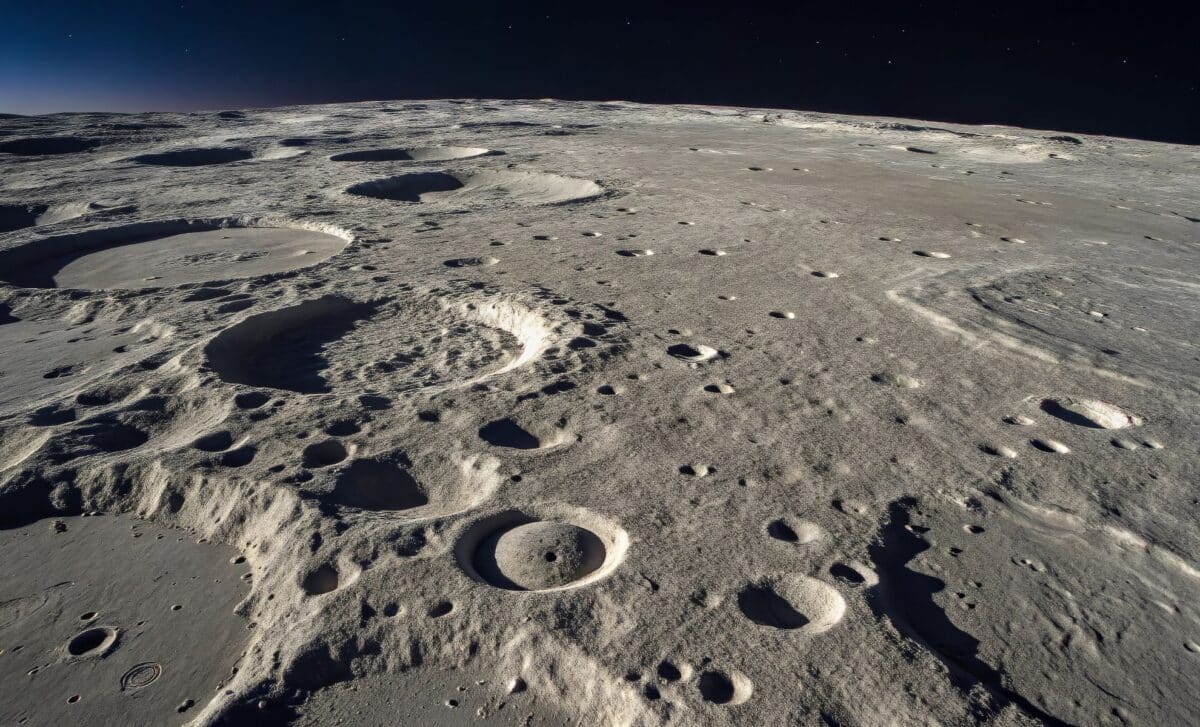
The Moon may not hold the easily accessible water reserves scientists once hoped for. New high-resolution observations of its darkest regions suggest that ice, if present, is far more diffuse than expected, casting uncertainty over future human missions.
This finding directly challenges long-standing assumptions about the viability of sustained lunar exploration. Water is not just a convenience in space, it is a necessity tied to survival, fuel production, and long-term habitation.
For years, scientific efforts have focused on identifying water sources in extreme lunar environments. Those efforts are now entering a more complex phase, where detection itself remains a major limitation.
Moon’s Shadowed Areas May Not Be Water-Rich
The search for lunar water has long centered on permanently shadowed regions (PSRs), especially near the Moon’s south pole. These areas never receive sunlight due to the Moon’s slight axial tilt of about 1.5 degrees, allowing temperatures to remain low enough for ice to persist over billions of years.
According to earlier missions such as NASA’s Lunar Prospector and India’s Chandrayaan-1, hydrogen signatures consistent with water ice had been detected in these regions.
Yet these signals were indirect. They pointed to the presence of hydrogen, not necessarily to concentrated, extractable ice, something that remained to be visually confirmed. For Shuai Li, a researcher at the University of Hawai’i, the debate is not settled:
“I think, based on what data we have now…, we are pretty sure there is ice on the surface.”
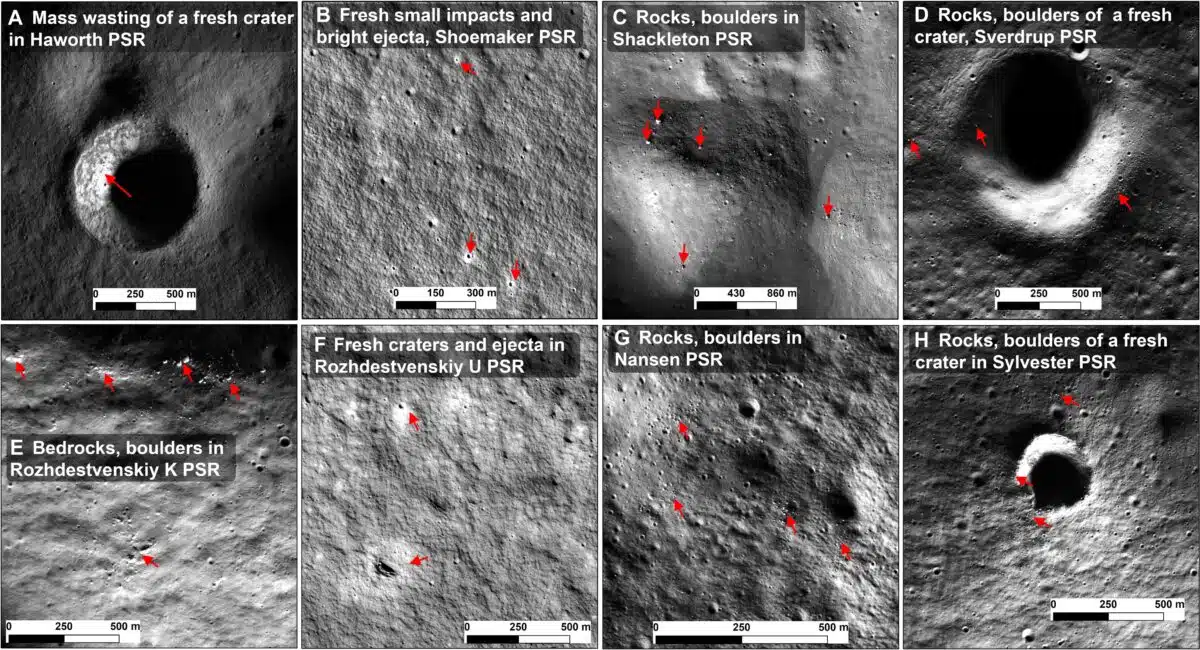 High-resolution ShadowCam images show craters, boulders, and ejecta in permanently shadowed lunar regions. Credit: Science Advances
ShadowCam Finds No Clear Signs of Usable Ice
To push this investigation further, researchers from the University of Hawai‘i analyzed images captured by ShadowCam, a NASA-developed instrument aboard the Korea Pathfinder Lunar Orbiter, launched in 2022.
As stated by the study published in Science Advances, the team searched for two optical properties typical of ice, strong reflectivity and forward scattering of light. Neither signature appeared in the regions studied.
For ice to be detectable by ShadowCam, it would need to make up roughly 20 to 30 percent of the surface material, the lunar regolith. The absence of such signals suggests that if ice exists, it is below this threshold and therefore not directly visible with current tools.
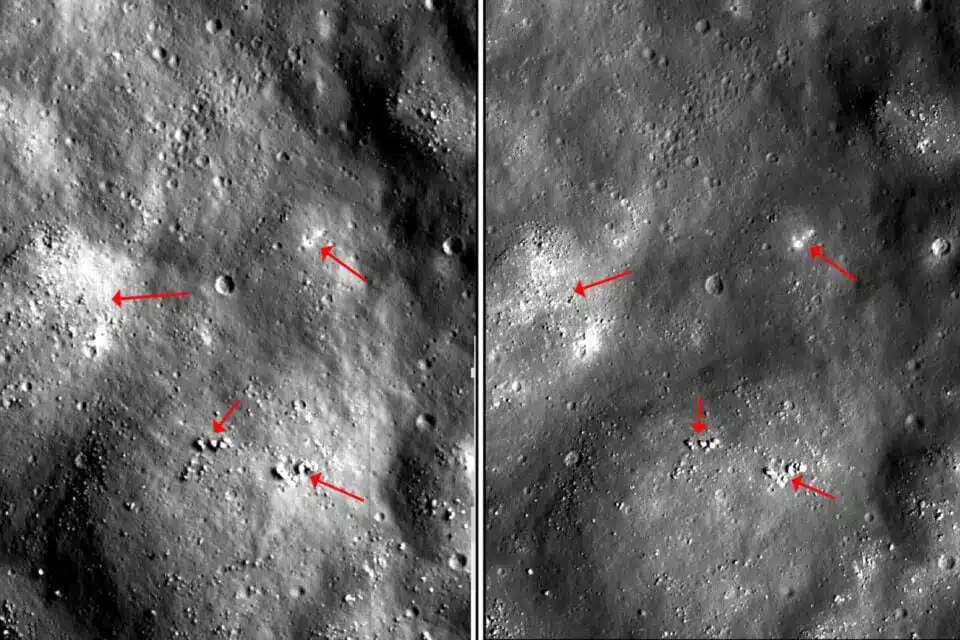 ShadowCam scanned the Moon’s permanently shadowed areas, hunting for signs of water ice. Credit: Science Advances
Scattered Traces Exist, But Practical Use
The results do not indicate a completely dry Moon. Some localized areas showed optical characteristics consistent with ice concentrations above 10 percent. Still, such levels are considered too low for efficient extraction.
As explained by the research team, instruments capable of detecting concentrations below 1 percent will be required to fully resolve the question. Until then, the true distribution of lunar water remains uncertain.
This matters because programs like NASA’s Artemis rely heavily on in-situ resources. Water would support life systems and could be split into hydrogen and oxygen for fuel. Without sufficient accessible ice, the cost and complexity of maintaining a human presence on the Moon increase sharply. As David Kring of the Lunar and Planetary Institute puts it:
“Orbital measurements like those that are reported in the current paper are fabulous in that they can provide broad regional surveys, but oftentimes what you’re looking for can only be addressed by in situ, ‘boots on the ground’ exploration activities.” Hed added that: “The sooner that we get robotic and human assets on the lunar surface to investigate this particular issue, the sooner we’ll have some definitive answers.”
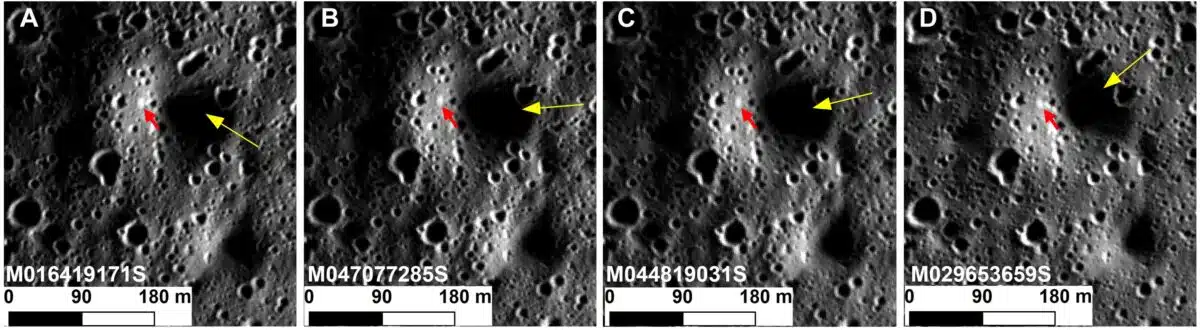 High-resolution ShadowCam images of permanently shadowed lunar craters show no clear signs of surface ice deposits. Credit: Science Advances