
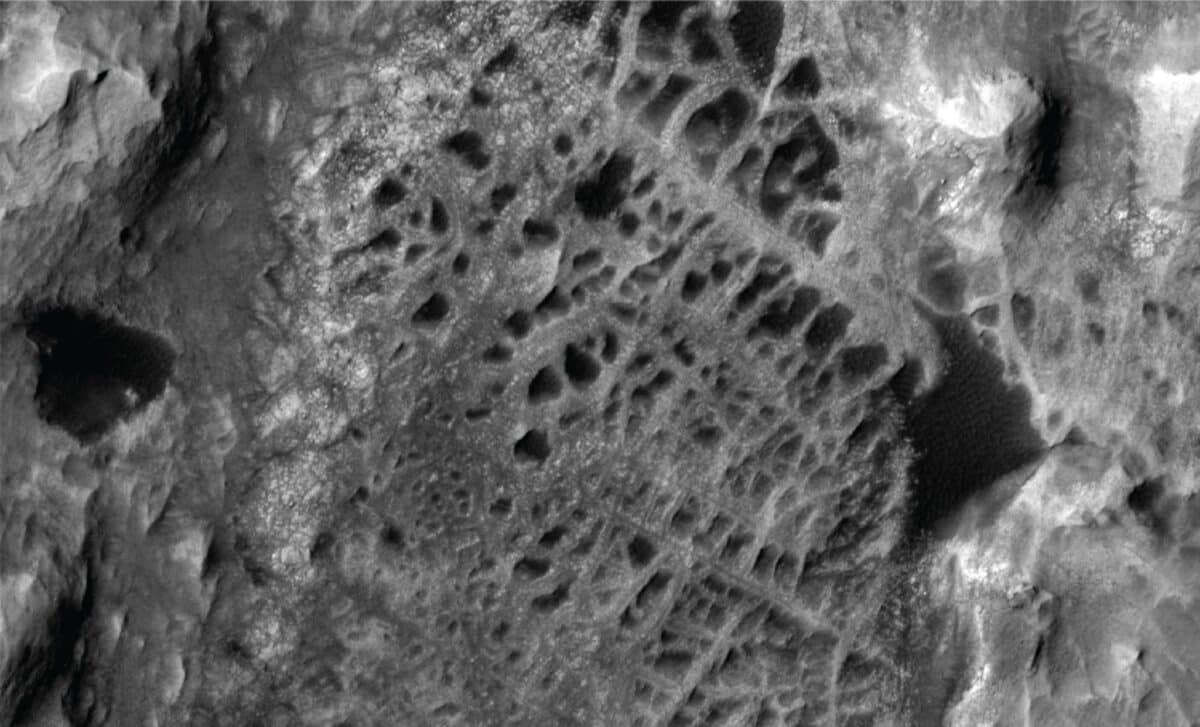
NASA’s Curiosity rover has delivered the first close-up views of intricate, web-like rock formations on Mars, revealing evidence of groundwater processes that may have lasted longer than expected. The discovery, made on the slopes of Mount Sharp.
For about six months, the rover has been exploring a region marked by ridges and sandy hollows known as boxwork. Until now, these formations had only been seen from orbit, leaving open questions about their composition and origin.
By examining them directly, scientists are gaining insight into how water once moved beneath the Martian surface. These findings contribute to a broader effort to understand how long Mars remained a potentially habitable world.
Tracing Ancient Groundwater Through Mineral Veins
From orbit, the formations resemble giant spiderwebs stretching across the terrain. On the ground, Curiosity observed ridges standing 3 to 6 feet high, forming a network shaped by geological processes linked to water. According to a press release published by the NASA, groundwater once moved through fractures in the bedrock, depositing minerals that hardened over time.
“Those minerals then strengthened the areas that became ridges while other portions without mineral reinforcement were eventually hollowed out by wind,” wrote the U.S space agency experts.
The rover also confirmed that dark lines identified in earlier images are central fractures. These features mark the pathways where water circulated and minerals accumulated.
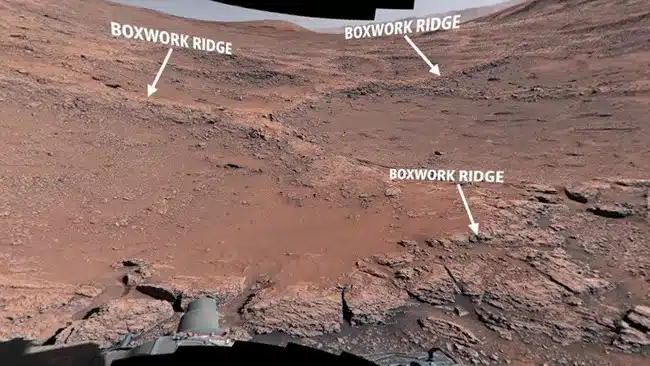 Curiosity view of Mars boxwork ridges shaped by ancient water. Credit: NASA/JPL-Caltech/MSSS
Elevated Features Point to Ancient Water
The boxwork’s position high on Mount Sharp is a key detail. The mountain rises about 5 kilometers and preserves layers formed under different climate conditions. As explained by Tina Seeger of Rice University, the presence of these formations at such heights on Marsindicates that :
“ the groundwater table had to be pretty high,” she said. “And that means the water needed for sustaining life could have lasted much longer than we thought looking from orbit.”
This suggests that water may have remained available beneath the surface even as rivers and lakes disappeared. Each layer of the mountain reflects a phase in Mars’ climatic evolution, with signs of drying punctuated by intermittent wet periods.
Nodules with a Chemical Twist
During its investigation, Curiosity identified nodules on Mars, small mineral features associated with past water activity. Their location stood out because they appear along ridge walls and in hollows rather than near the central fractures. As explained by the mission scientists, this pattern remains unexplained and may indicate multiple phases of groundwater activity.
“We can’t quite explain yet why the nodules appear where they do,” Seeger stated. “Maybe the ridges were cemented by minerals first, and later episodes of groundwater left nodules around them.”
The rover also drilled samples from different parts of the region. Analyses detected clay minerals in ridge tops and carbonates in hollows, both linked to water-driven processes. One sample underwent wet chemistry analysis, a method used to detect organic compounds.
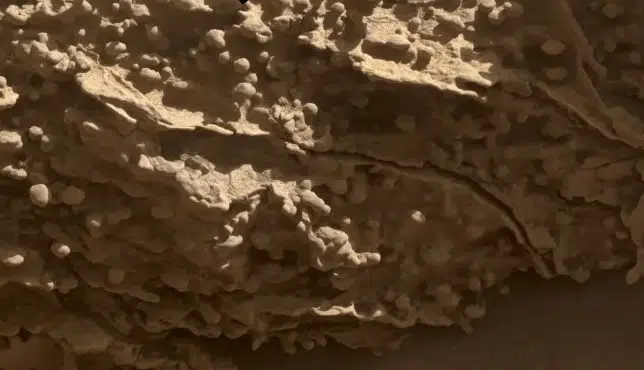 Curiosity captured these pea-sized Martian nodules. Credit: NASA/JPL-Caltech/MSSS