
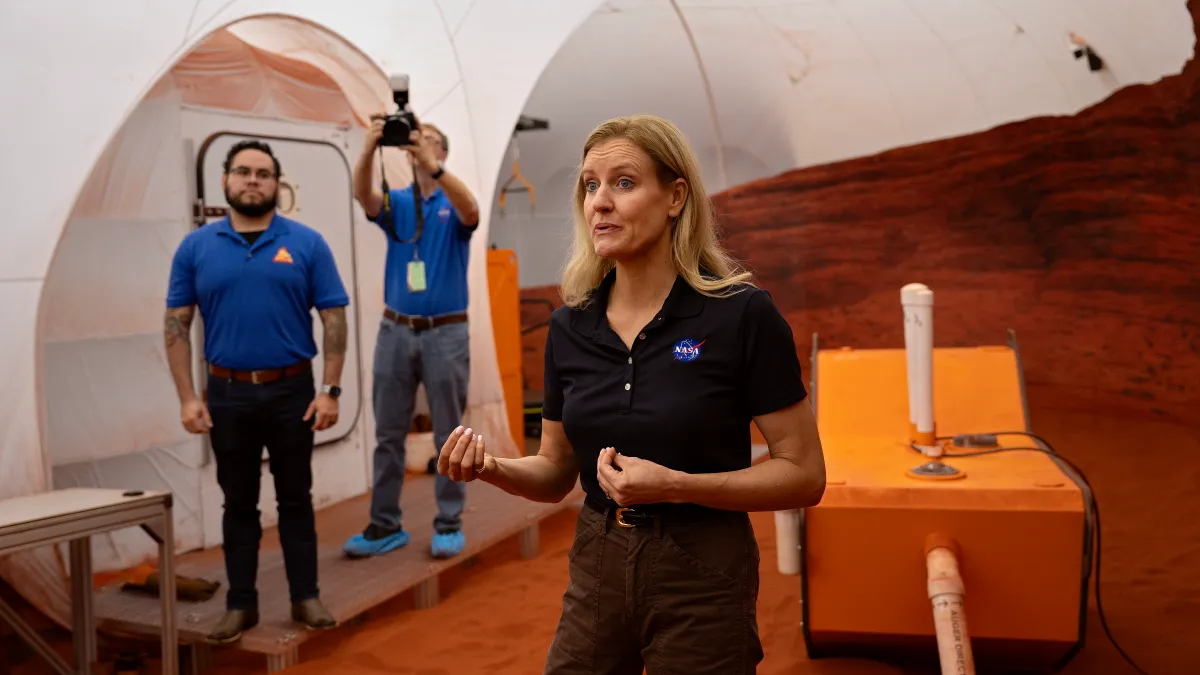
While Artemis II focused attention 250,000 miles away on the moon, a separate venture testing the boundaries of human exploration has been unfolding a stone’s throw from Nasa’s mission-control centre.
At Mars Dune Alpha, a 3D-printed habitat at the Johnson Space Center (JSC) in Houston, Texas, four volunteers are taking part in Chapea-2, a simulated 378-day expedition that has them isolated from the outside world with limited resources, tight living space and constant pressure to adapt.
The two missions are worlds apart but share a common goal: learning how humanity can survive beyond Earth.
US newsletter
A balanced, fair and fact-checked take on global news and culture for our US readers.
Sign up with one click
“It’s great progress for humanity to be sending crews back to the moon over 50 years since our last visit,” James Spicer, Chapea-2’s flight engineer, told The Times by email (no phones allowed on “Mars”).
“Future Artemis missions and missions to Mars will be shaped by the lessons learnt from Artemis II as well as from analogues such as Chapea … the knowledge that we’re an early piece of the puzzle is a big motivation behind our work every day in the habitat.”
The Chapea mission — which stands for Crew Health and Performance Exploration Analogue — is based in a 1,700 sq ft habitat inside a hangar at JSC.
Spicer, a private-sector aerospace engineer, was selected along with Ross Elder, a US air force test pilot, Ellen Ellis, an acquisitions officer in the US space force and Matthew Montgomery, a hardware engineer and independent film producer. They entered the habitat on October 19 last year and will emerge on October 31 this year.
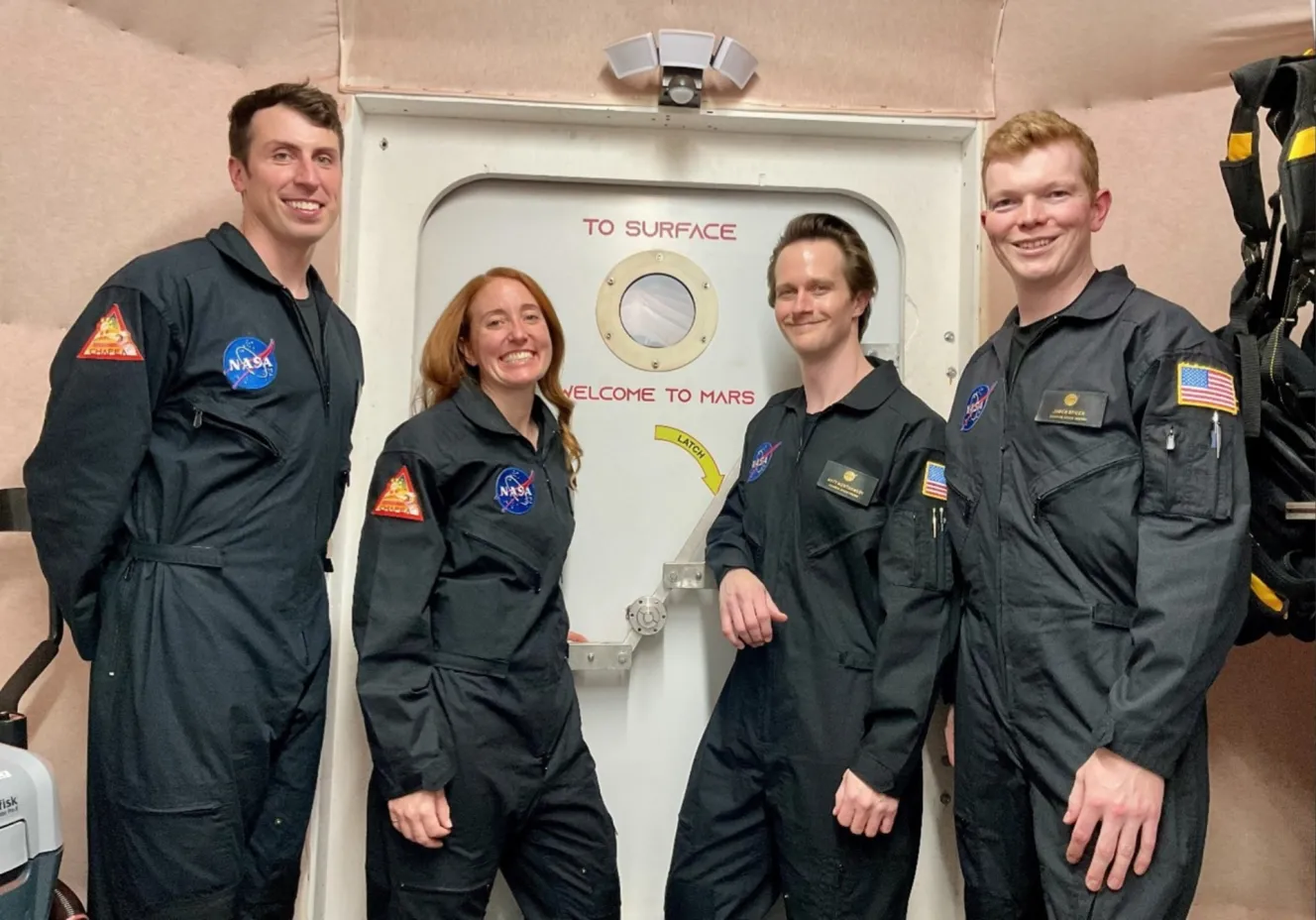 The Chapea-2 crew. From left: Ross Elder, Ellen Ellis, Matthew Montgomery and James SpicerNASA/CHAPEA
Each has a small single bedroom. There is a shared toilet and shower, living room and kitchen. Daily activities are modelled on the real challenges of working on Mars. There are simulated “Marswalks” in a yard filled with red sand, robotics operations involving drones and vehicles, geology tasks such as rock identification, habitat maintenance chores, physical exercise and cultivating crops.
Their work will help guide the planning and design of future missions to Mars. The purpose is also to investigate behavioural health and how the crew adapts and responds to stressors such as isolation, confinement and equipment failures.
The sacrifices are real: no fresh fruit for months, no spontaneous visits home and no casual conversations with friends. Food is an assortment of dehydrated and thermo-stabilised options, similar to those used by the military.
“Although we’re not replicating the effects of microgravity or deep-space radiation, there’s a lot we can learn on the ground. Travelling to Mars alone will likely take more than six months; understanding the nutritional requirements and physiological needs of the crew is critical to mission success,” said Ellis, the crew medical officer.
“There are so many aspects of this study that fascinate me. How do you design a habitat that effectively meets the crew’s needs? What are the major stressors for a long-duration mission? How do you optimise space for crew collaboration? What are good strategies for managing constrained resources?”
Communication with their handlers and families is via email only and subject to delays of up to 22 minutes, simulating the lag between Earth and Mars.
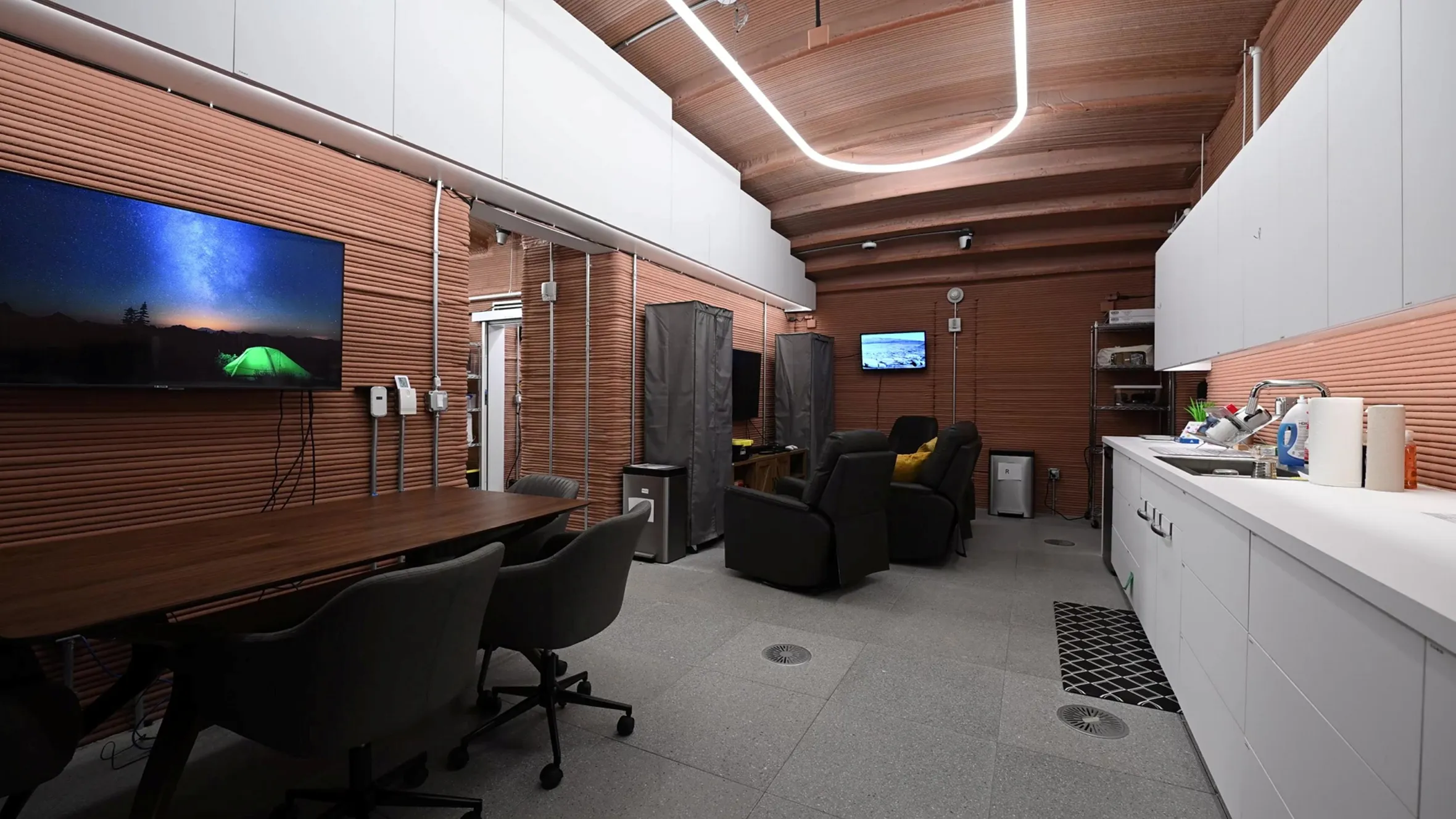 Inside the team’s living quartersJSC/NASA/SWNS
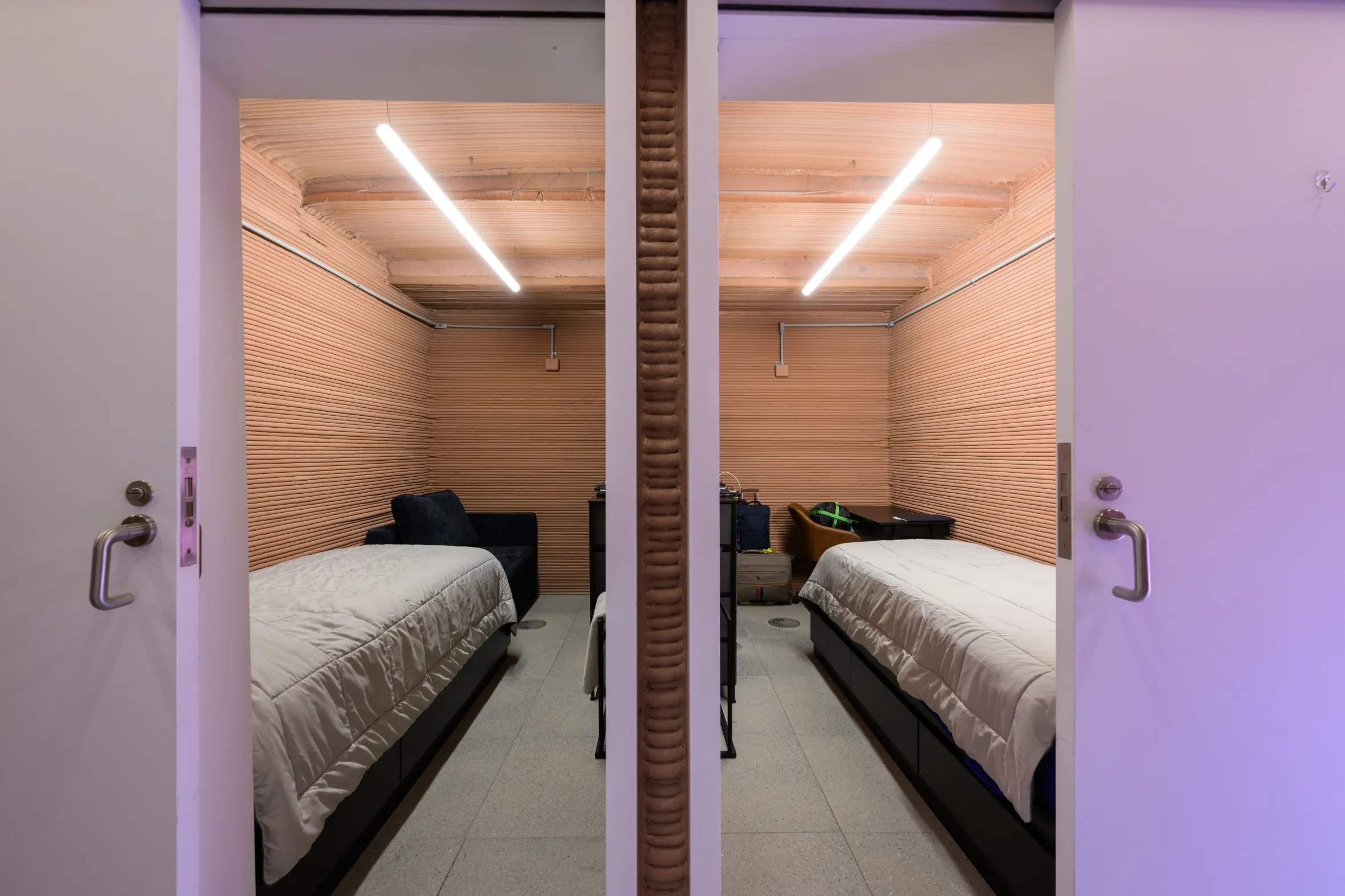 JSC/NASA/SWNS
Spicer, who grew up in Worcestershire before moving to the US, credits the patience of friends whose emails, voice notes and photos are “a lifeline to the outside world”.
“We have no real-time communication with friends, family or ground-support staff,” he said. “We must be able to make decisions autonomously as a crew, often with no time to wait for a clarifying question to travel to Earth and a response to make it back.”
“We have also faced various equipment failures and had to compensate with workarounds using the materials we have with us. We do have a 3D printer, which has proved useful in creating some spare parts … hopefully lessons learnt from how our systems are failing and how we’re maintaining them will be used to better equip future Martian and lunar crews.”
Spicer spent a decade working in radio and laser-satellite communications and spacecraft assembly, integration and testing. In the habitat he has been busy “maintaining everything from our clothes washer to our fitness equipment to our carbon-dioxide scrubber”, he said.
Montgomery, as a technologist, is fascinated by the hardware, vehicles and systems that Nasa will need to fulfil its goal of landing on the moon and its missions to Mars.
“But … ultimately, the integration of that technology along with peak human performance is what’s required to further exploration. That human piece is foundational to the Chapea campaign and imagining those brave explorers who venture to Mars drives me daily,” he said.
As science officer, one of his responsibilities is managing the hydroponic crop-growth system, growing lettuce, tomatoes, peppers and herbs. Fresh produce is otherwise absent from the menu.
Elder is a test pilot and had just completed a tour of duty as the director of operations for the F-35 test force at Edwards Air Force Base, California, when he was selected to be Chapea-2’s commander.
“The transition to Mars explorer has felt both surreal and familiar in many ways. The rapid training we endured as a crew at JSC was quite akin to learning a new aircraft,” he said.
“While some might revel at the thought of getting away for 378 days, isolation and confinement is a significant challenge. There are no opportunities to feel the sun on your skin or the wind in your hair. The habitat instantly became our place of work, our gym, our recreation centre and ultimately our home.”
Taking a walk outside isn’t a walk outside; it’s an “extravehicular activity” or Eva, in Nasa speak. At Mars Dune Alpha, that means stepping outside a door marked “airlock” and into an area of red sand wearing a spacesuit, or on to a treadmill wearing a virtual-reality system that simulates the Martian landscape.
When he took his first steps on the mock-Martian surface with a crewmate, Elder said they had “grins stretched across our faces”.
“It was a very surreal moment to execute our first Eva mission far beyond the aid of Earth,” he said. “Each Eva brings new challenges and risks and can vary in focus from exploration to maintenance, or geology in lava tubes to constructing additional modules.”
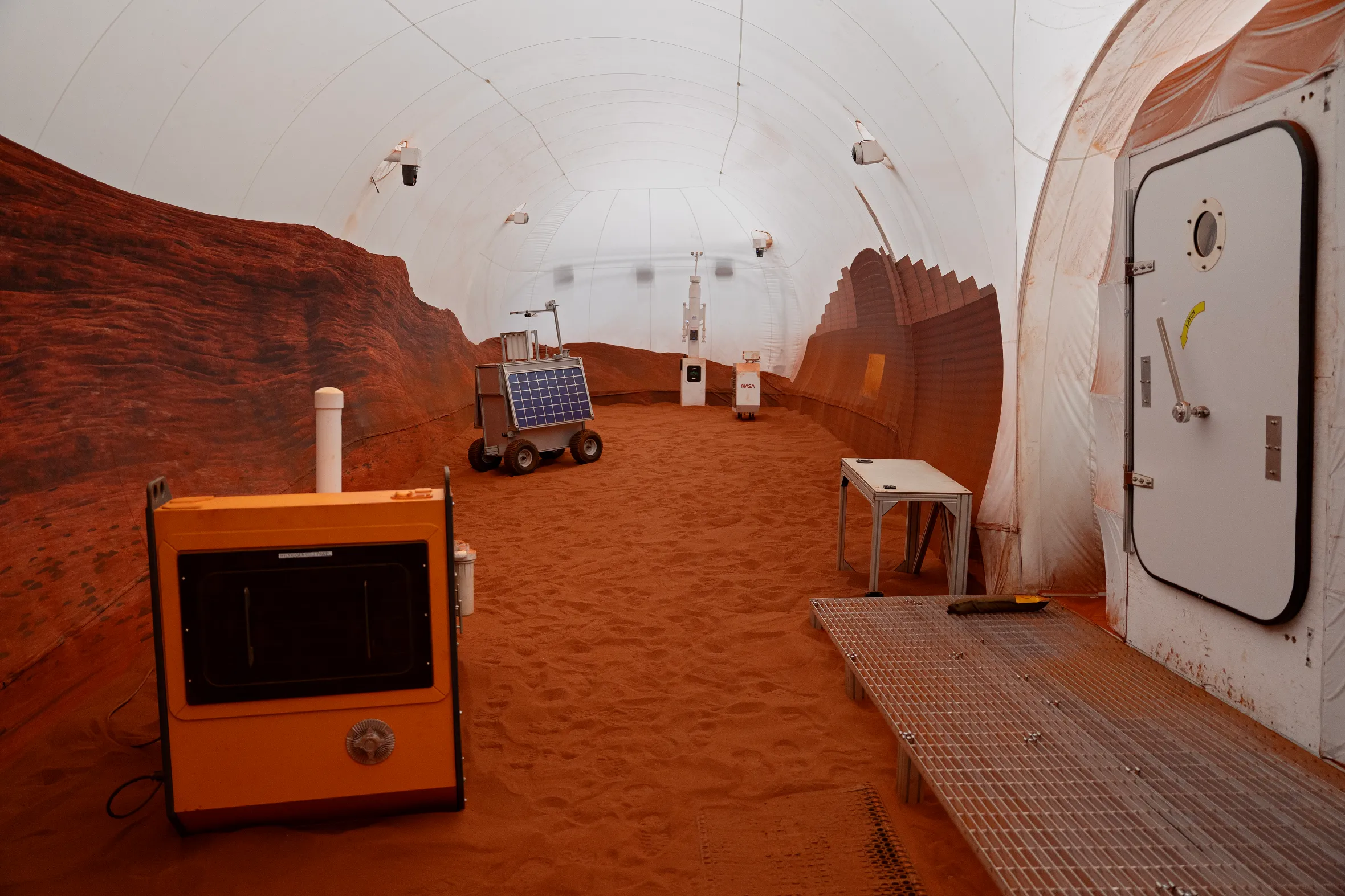 The team go for simulated “spacewalks” in red sandDanielle Villasana
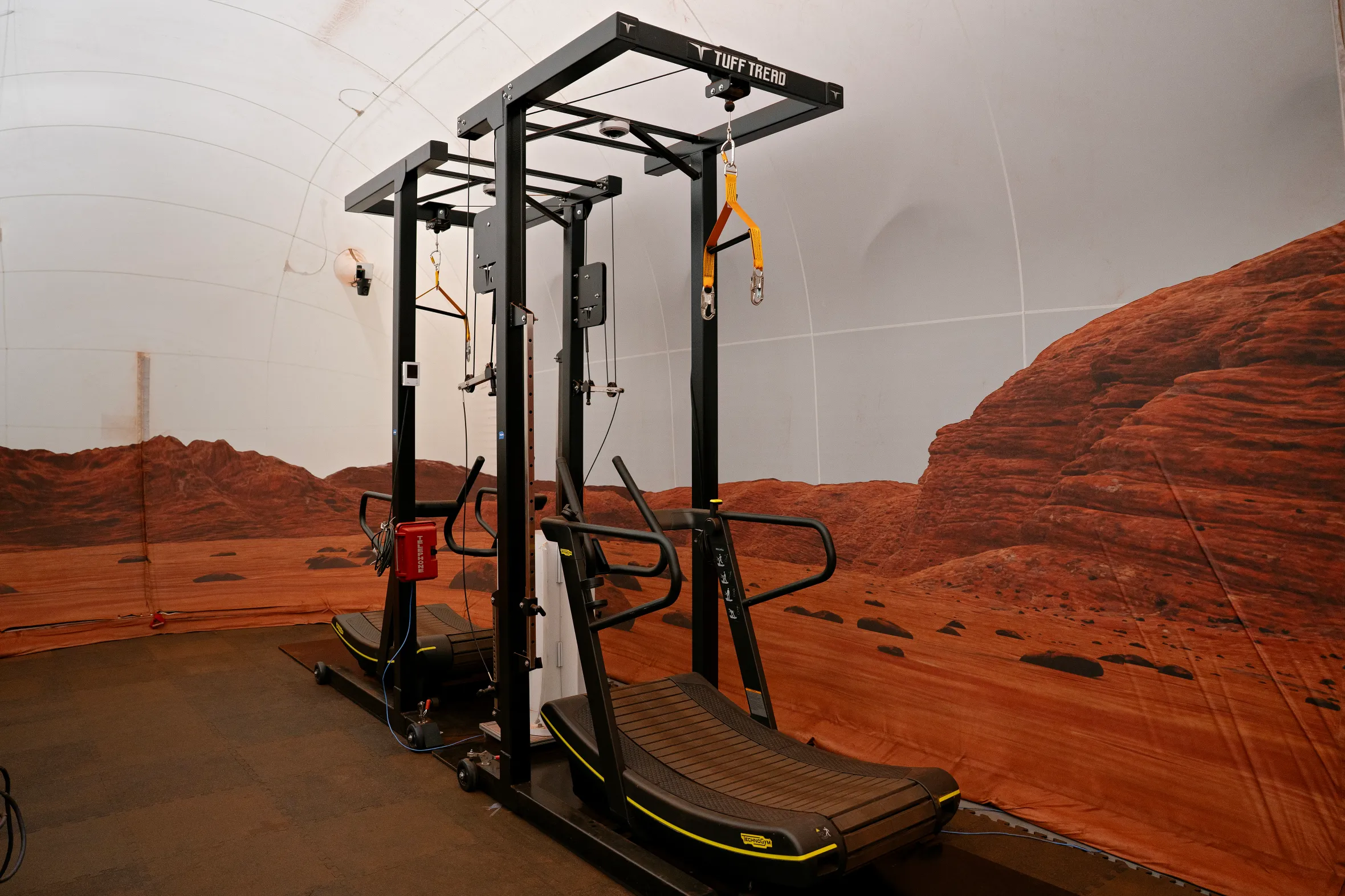 Danielle Villasana
The crew has found joy in little things. Elder is learning Russian, has a “hefty library” of digital books spanning team dynamics, self-help and professional development and plays his harmonica and banjo. Spicer took a keyboard with him to provide an “endless supply of music”. Montgomery’s idea of “down time” is reading scientific papers on geology.
Ellis has been reading anything from Mars-themed fiction to papers on team dynamics. She has two nephews in Abingdon, Oxfordshire, and dropped in on one of their Scout-troop meetings virtually before the mission.
“The kids asked great questions about Mars and were aghast to learn that we won’t get to eat ice cream for a whole year,” she said. “I find it very motivating and meaningful that our crew is participating in work that will help enable the next generation of space explorers.”
Under the Artemis programme, Nasa aims to land humans on the moon in 2028. Artemis II was a test flight of the Orion spacecraft that will take them into lunar orbit.
Elder said: “The data that we drive and collect will change how future crews live on the surface of Mars … we wish the Artemis II crew Godspeed.”