
A 35-million-year-old arachnid encased in amber is challenging what scientists thought they knew about the history of harvestmen. Found in Ukraine and the Baltic region, the fossil belongs to a group that no longer exists in Europe. The study, published in Acta Palaeontologica Polonica, documents the first fossil record of this lineage.
The species, Balticolasma wunderlichi, dates to the Eocene epoch and belongs to the subfamily Ortholasmatinae. This group includes some of the most structurally complex harvestmen known today, yet none are currently found on the European continent.
Now restricted to East Asia and the Americas, these arachnids once occupied a far wider range. The discovery suggests that their distribution across the northern hemisphere was significantly broader millions of years ago.
Two Amber Fossils, One Unexpected Presence
The new species was identified from two specimens preserved in different types of amber. One, believed to be female, comes from Rovno amber in northwestern Ukraine, while the other, a male, was recovered from Baltic amber. As explained by the researchers, both pieces were later transferred from private collections in Germany and Lithuania to the Museum für Naturkunde Berlin.
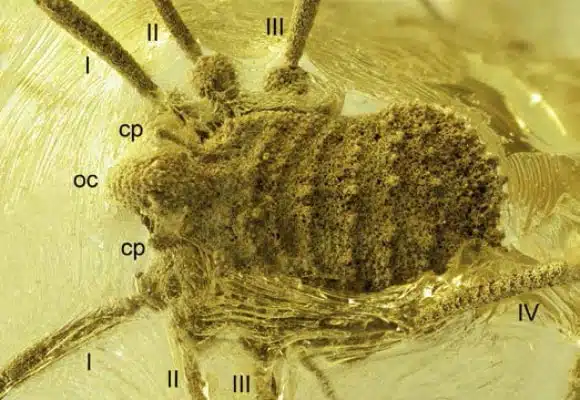 Amber-preserved specimen of Balticolasma wunderlichi, showing the intricate morphology of this 35-million-year-old arachnid. Credit: Acta Palaeontologica Polonica
This geographic separation suggests the species was not confined to a single location. According to paleontologist Christian Bartel :
“the discovery of an ortholasmatine harvestman in European amber deposits surprised us,” a reaction tied to the absence of this group in modern European ecosystems.
A Remarkably Intricate Ancient Arachnid
Members of the Ortholasmatinae are known for their elaborate morphology. As noted by the study, only seven living genera with 27 described species are currently recognized, all showing a disjunct distribution.
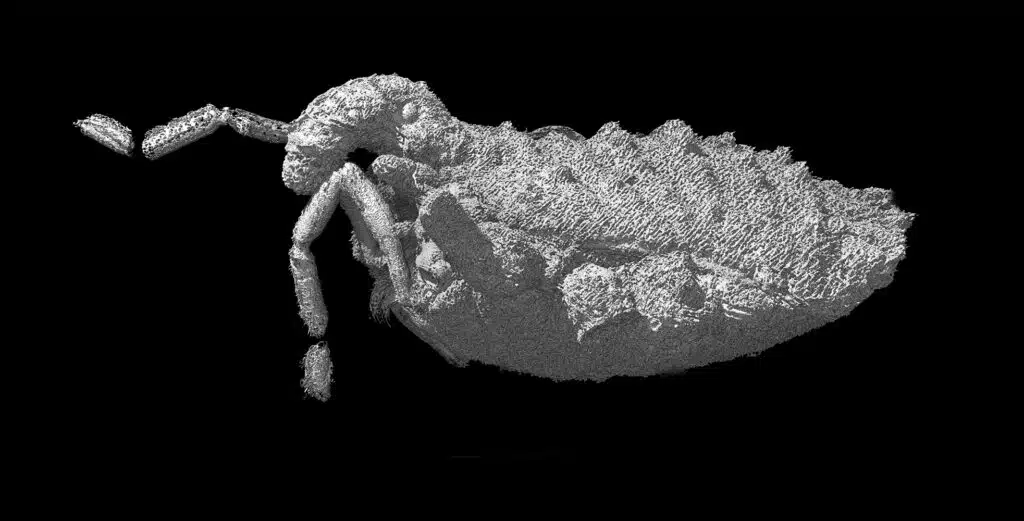 Three-dimensional reconstruction of Balticolasma wunderlichi. Credit: Acta Palaeontologica Polonica
Using synchrotron microtomography, researchers reconstructed its anatomy in detail. The scans revealed a body measuring less than 3 millimeters, flattened and covered with rows of tubercles, along with a forward-projecting, hood-like structure; features consistent with modern relatives.
Traces Of A Lineage Once Spread Across Continents
The discovery points to a significantly wider historical range for this group. As explained by Bartel, it highlighted how much their distribution has narrowed over time.
“Relatives of these animals are currently found only in East Asia as well as in North and Central America.” He added that: “evidently, 35 million years ago, during the Eocene epoch, these harvestmen were much more widely distributed across the northern hemisphere than they are today.”
This fossil captures a time when this lineage was still present in European ecosystems, before vanishing from the region.
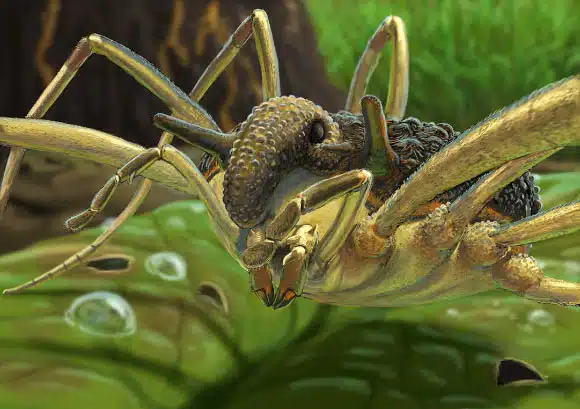 Illustrated reconstruction of Balticolasma wunderlichi. Credit: Joshua Knüppe