
A new dinosaur species has been identified from a remarkably well-preserved skull and partial skeleton found in northwestern China. Dating back around 165 to 168 million years, the specimen stands out mainly because of its nearly complete skull, something rarely seen in this group.
The fossil was uncovered in the Xinhe Formation in Gansu Province, where late Bathonian deposits revealed a partial skeleton with a skull, neck vertebrae, and a long series of tail bones. According to the study published in Scientific Reports, this level of preservation makes it possible to examine anatomical features that are often missing in similar fossils.
Eusauropods are part of a major lineage of long-necked dinosaurs that became dominant after an extinction event in the late Early Jurassic. While more famous dinosaurs like Apatosaurus belong to later branches, earlier non-neosauropod eusauropods remain less well understood, especially in East Asia.
A Rare Skull That Helps Fill The Gaps
The holotype of Jinchuanloong niedu includes a nearly complete skull with mandible, along with five cervical vertebrae and 29 caudal vertebrae. The researchers stated that the fossils with such well-preserved skulls are rare among non-neosauropod eusauropods, which has made it harder to fully understand their head structure until now.
With this specimen, scientists can finally take a close look at the skull, including how the bones are shaped and fit together. It helps paint a clearer picture of how these early sauropods likely ate and lived.
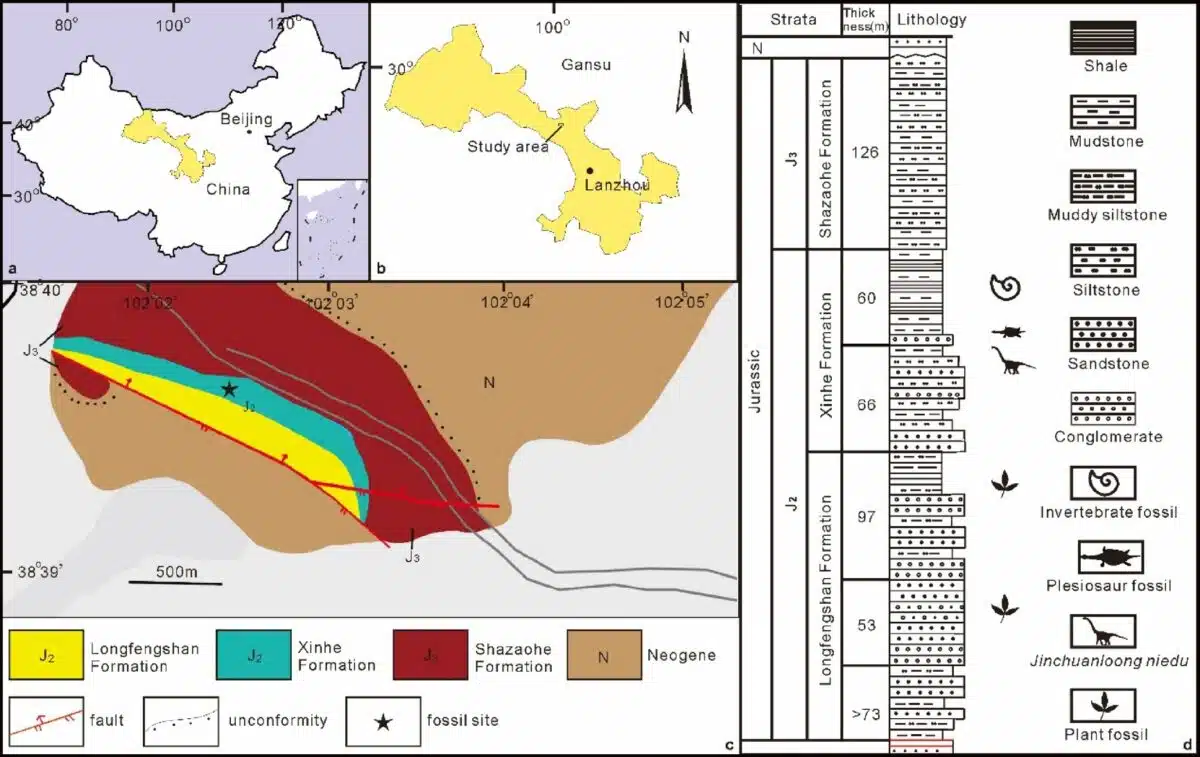 Geological context and location of the Jinchuanloong niedu fossil site in Gansu Province, China. Credit: Scientific Reports
A Mix Of Traits Seen In Different Sauropods
Comparisons with other East Asian sauropods show that Jinchuanloong combines both primitive and more advanced features.
“Sauropod dinosaurs were gigantic quadrupedal herbivores. They range from Early Jurassic to Late Cretaceous and have been found on all continents. The rich sauropod faunas in the Middle and Late Jurassic of China are mainly from southern or western China,” wrote the authors.
As the study pointed out, the fossil shows a small opening at the base of the maxillary ascending process, along with another one on the upper front part of the prefrontal bone.
Researchers also noted a particularly robust postorbital bone and spoon-shaped teeth, features that resemble what’s been seen in Shunosaurus and Turiasaurus. These findings come from detailed anatomical comparisons, backed by phylogenetic analyses using two separate datasets.
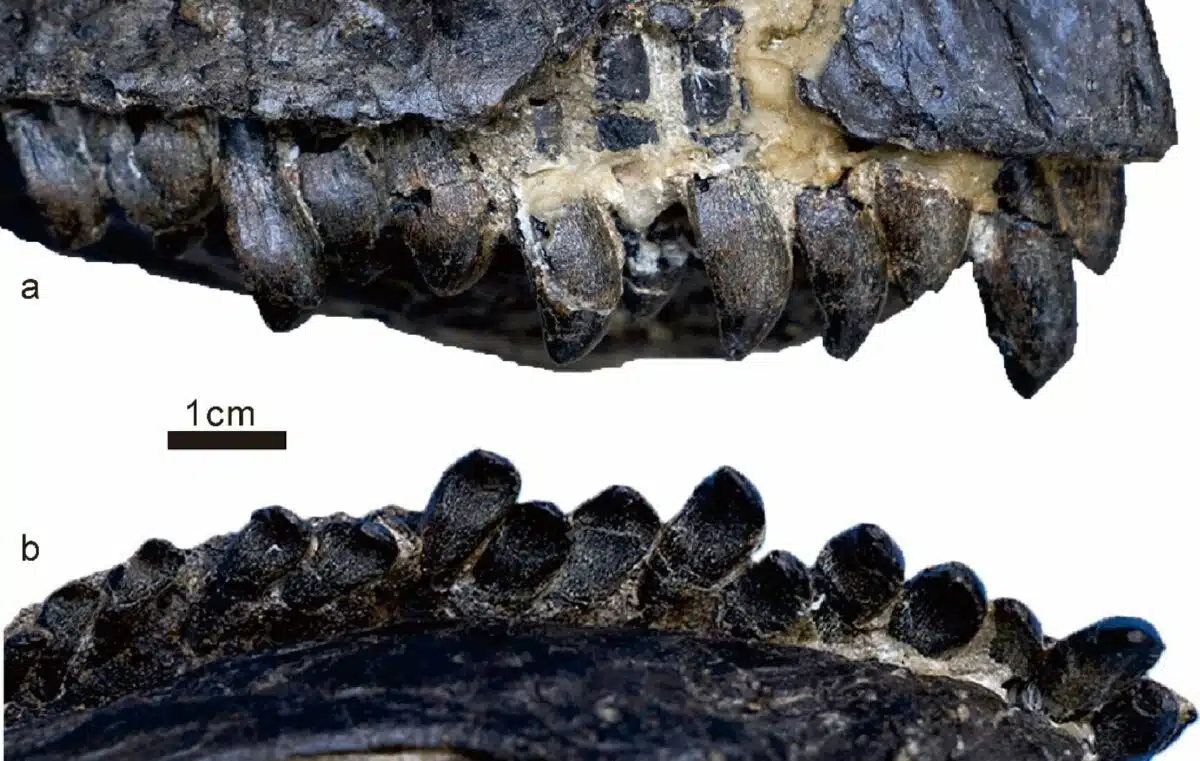 Close-up views of the dentition of Jinchuanloong niedu, showing the characteristic spoon-shaped teeth. Credit: Scientific Reports
A Missing Link in the Giant Sauropod Lineage
The analyses suggest that Jinchuanloong was a eusauropod that hadn’t yet reached the more advanced neosauropod stage. It sits just outside that group, acting almost like a close relative to the branch that later led to Neosauropoda. The researchers place it as a sister group to the clade that includes both Turiasauria and more derived sauropods.
“The discovery of Jinchuanloong niedu enriches the diversity of early diverging sauropods and provides additional information to help understand the evolutionary history of sauropods in northwest China,” as outlined by the study team.
Some clues also hint that this individual wasn’t fully grown yet. The tail vertebrae still show unfused neural arches, and the presence of a large pineal foramen is another sign it was likely a juvenile or subadult. That’s pretty striking, considering it was already around 10 meters long.
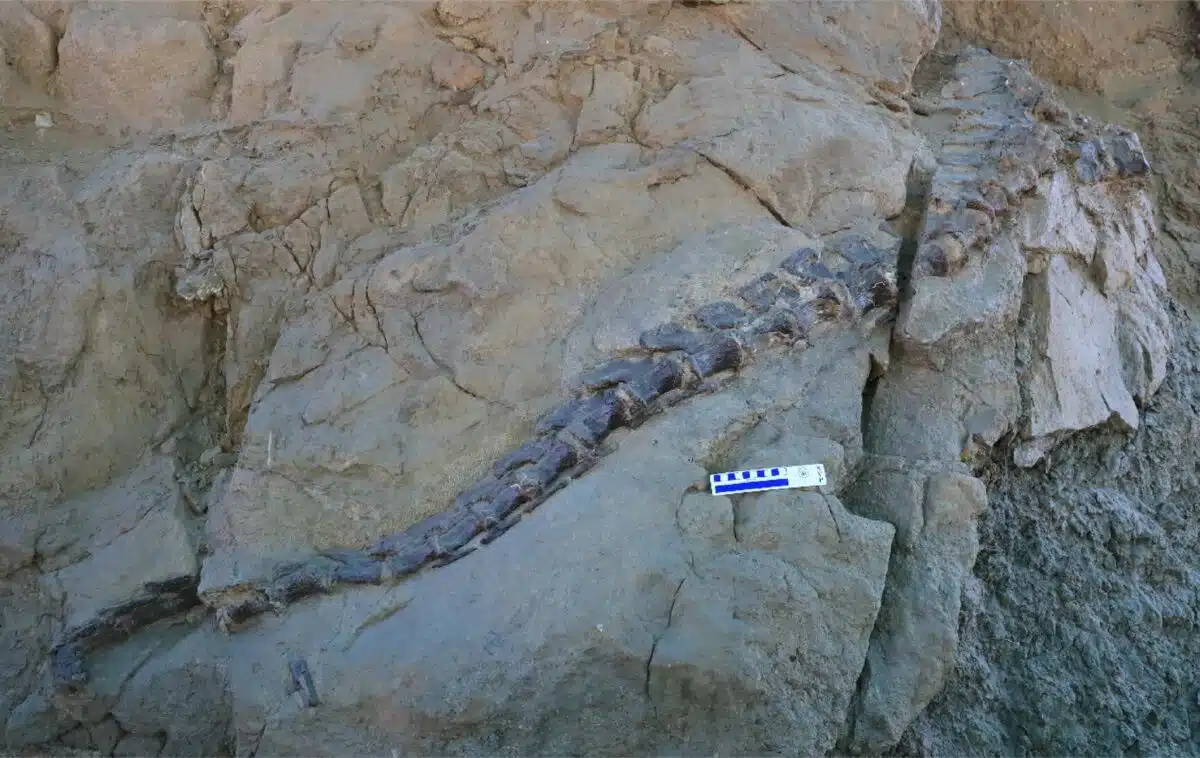 Field view of the Jinchuanloong niedu fossil as preserved in situ within the Xinhe Formation. Credit: Scientific Reports