
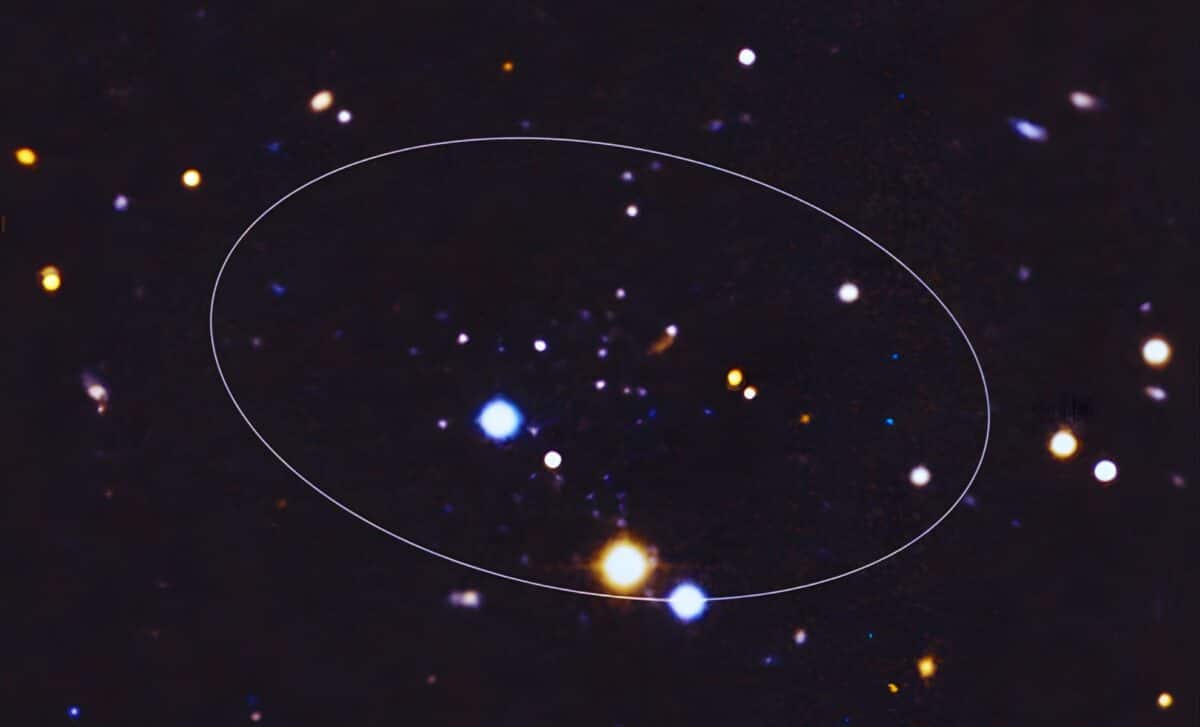
A newly confirmed galaxy lurking near Andromeda is shedding light on the universe’s earliest epochs. Named Andromeda XXXVI, this ultra-faint dwarf galaxy ranks among the dimmest and most ancient structures ever observed. The discovery, reported in late March on the arXiv preprint server, highlights how much remains hidden even in our cosmic neighborhood.
Even after years of detailed surveys, the surroundings of Messier 31 (M31) continue to reveal new companions. Ultra-faint dwarf galaxies, often called UFDs, are of particular interest because they are strongly dominated by dark matter and show very limited chemical evolution.
A Discovery Sparked By Careful Visual Inspection
Andromeda XXXVI was first identified by amateur astronomer Giuseppe Donatiello during a visual inspection of public images from the Pan-Andromeda Archaeological Survey (PandAS). His detection shows that human analysis still plays a role alongside automated techniques.
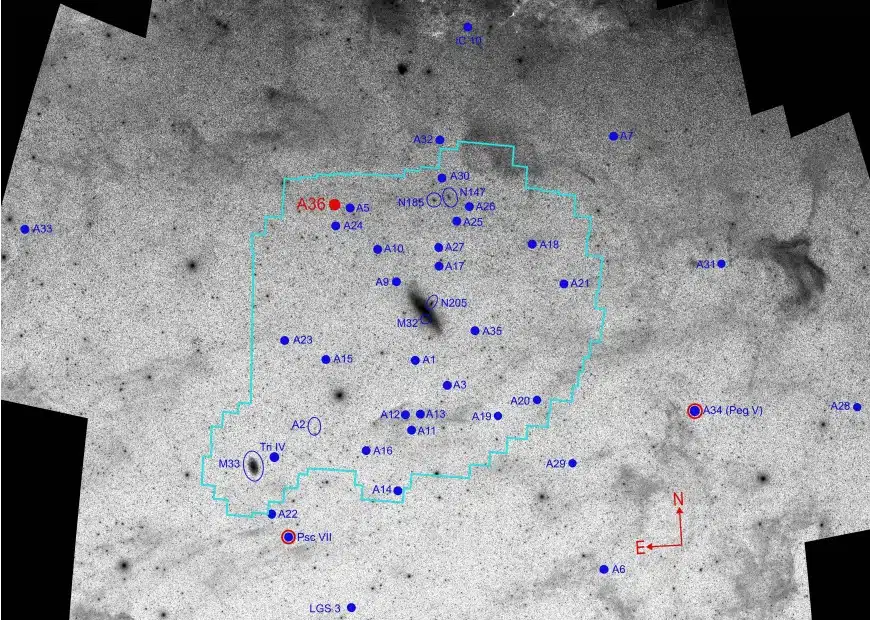 Location of Andromeda XXXVI (A36) within the satellite distribution of M31. Credit : Joanna Sakowska & al
The research team led by Joanna D. Sakowska at the Institute of Astrophysics of Andalusia later confirmed the object using deep imaging from the Roque de los Muchachos Observatory. These observations allowed astronomers to resolve individual stars within the galaxy. As reported in the study, the team used a color-magnitude diagram to analyze the stellar population and determine the galaxy’s structure and brightness, confirming its classification as a UFD.
This Tiny, Faint Satellite Is Hiding Near Andromeda
The physical properties of Andromeda XXXVI place it among the faintest galaxies known. The research indicates a visual magnitude of −6.0 and a half-light radius of 208 light-years, pointing to a very compact object. Its ellipticity, measured at about 0.015, suggests a nearly spherical shape. These characteristics make it one of the most compact ultra-faint dwarf satellites associated with Andromeda.
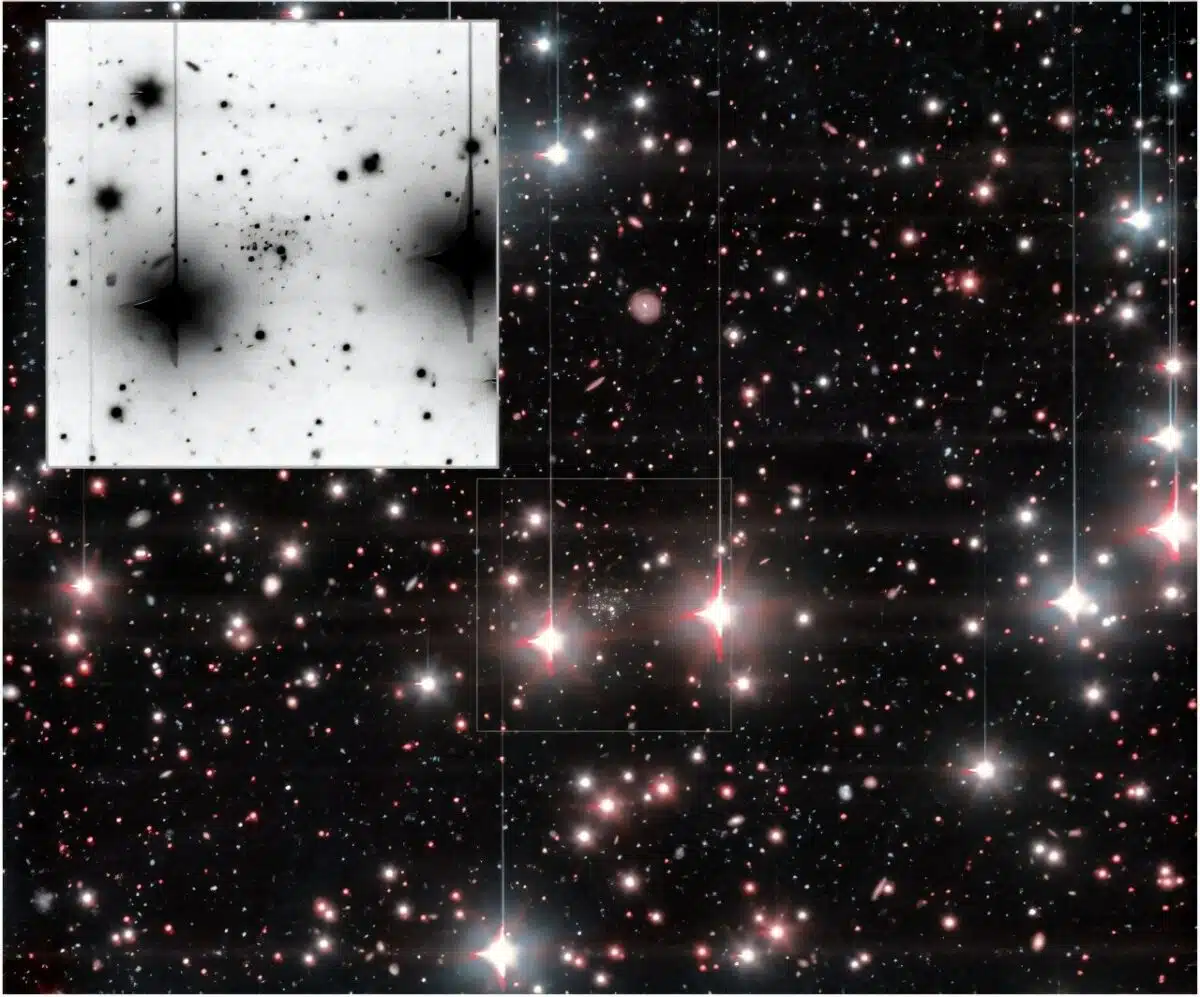 Zoom-in on the ultra-faint galaxy Andromeda XXXVI within a dense star field. Credit: arXiv
Distance measurements reinforce this classification. The galaxy lies around 2.53 million light-years from Earth and about 388,000 light-years from M31, well within its virial radius of roughly 850,000 light-years.
A Relic From The Early Universe Still Largely Untouched
The age and its composition make it particularly valuable for research. Estimates place its age at 12.5 billion years, meaning it formed during the early stages of galaxy formation. Its metallicity, measured at −2.5, reflects a very low abundance of heavy elements. The authors of the study note that this indicates minimal chemical evolution, reinforcing its status as a fossil galaxy.
The largest and sharpest image ever taken of the Andromeda galaxy — otherwise known as M31.
It is the biggest Hubble image ever released and shows over 100 million stars, thousands of star clusters in a section of the galaxy’s disc stretching across over 40 000 light-years. pic.twitter.com/AcdqCRFbGW
— Massimo (@Rainmaker1973) April 3, 2026
The same research points out that our nearest galactic neighbor
may host close to 100 dwarf satellite galaxies, with only about half currently identified. As the team of the study concluded:
“The discovery of Andromeda XXXVI highlights that visual inspection remains very complementary to automatic and machine learning approaches, using resolved and/or semi-resolved data. Both methods in combination thus remain crucial towards constructing a complete picture of Andromeda.”