
Great Britain has saved around £7 million a day since the start of the current conflict in the Middle East, as domestic solar PV and wind capacity has removed the need for importing gas, which has seen its price increase dramatically since the start of the war.
This is the key takeaway from the latest report from Ember. Published today, ‘Clean power fortifies Britain against gas price shocks’ assesses how the UK’s greater use of domestic renewable energy to meet electricity demand—and lessening reliance on importing fossil fuels from overseas, which are affected by global supply chain disruptions like the war in the Middle East—has affected energy prices in Britain.
The driving force behind these savings is the large volume of new renewable energy capacity that has been installed in recent years. In the wake of the 2021 fossil fuel crisis, Britain accelerated the deployment of new clean power capacity, exceeding 40GW of cumulative capacity in 2022, and installing 28% of the country’s total cumulative operational renewable energy capacity since 2021.
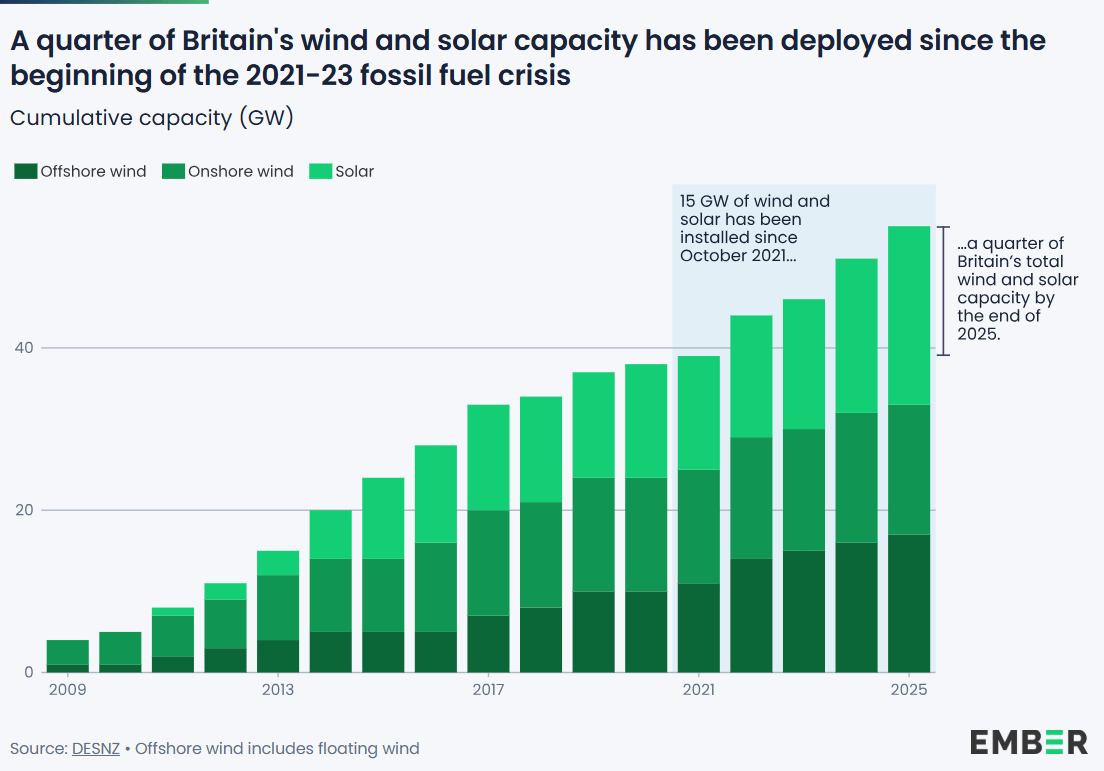
Britain exceeded 40GW of cumulative capacity in 2022 and has close to 55GW today. Image: Ember.
In the five years since the last energy crisis, the UK has added 7.7GW of new wind capacity, alongside 7.6GW of solar. Ember notes that of the 137 projects built since the last energy crisis, 106 were solar projects, by far the most of any technology type. These trends in capacity additions are shown in the graph above.
Ember also expects this trend to continue in the years to come, with 51GW of new renewable energy capacity approved for deployment, of which solar accounted for 20.8GW. The government also awarded a record 4.9GW of capacity in the latest auction round—AR7—and energy secretary Ed Miliband has already outlined plans to accelerate solar deployment “further and faster” to further protect Britain from global energy price disruption.
Solar and wind generation up 52% since 2021
Since the start of the current conflict in the Middle East, on 28 February, renewable energy has played a bigger role in the British energy mix. In the month after the start of the conflict, wind and solar generation was 52% higher than in the same period in 2021, while the contribution of gas in the energy mix has fallen by 39% over the same period.
Overall, since the start of the conflict, wind and solar has met 40% of Britain’s electricity demand, almost double that of gas, which has accounted for 23%.
As a result, while gas prices have increased in the days following the start of the conflict, the overall impact of these more expensive prices on the British economy has been diminished. Ember reports that the cost of generating electricity with gas in Britain almost doubled, from £53.58/MWh on 28 February to £104.64/MWh within a month, on 20 March.
This change was also very rapid, with gas prices reaching £95.67/MWh on 4 March, an increase of more than £30/MWh in less than a week. Ember concludes that, had British gas usage not declined, and remained at the same levels as in 2021, these increased gas prices would have meant Britain would spend an additional £7 million per day on importing gas.