
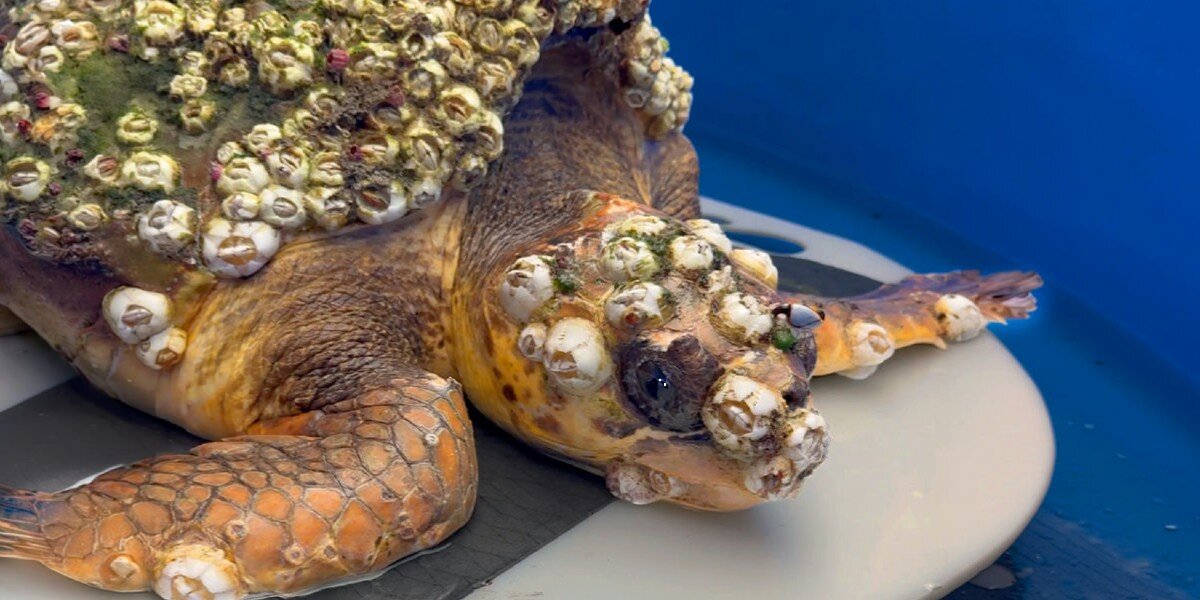
This past summer, off the coast of Florida, a boater spotted a loggerhead sea turtle who was completely covered in barnacles and algae. The turtle seemed to be having trouble swimming, so the concerned boater called rescuer Tabitha Siegfried for help.
Siegfried immediately got in a boat van with some volunteers and sped over to the turtle’s location. As soon as she spotted the animal, she could tell something was wrong.
 Tabitha Siegfried
“[She was] weak, disoriented and in critical condition,” Siegfried wrote on Instagram.
Siegfried jumped directly into the water to grab the sick turtle. The animal was so lethargic that she didn’t even fight back against Siegfried as she brought her to the boat.
Siegfried named the turtle Syrena and transported her back to her rescue facility. There, the staff and volunteers quickly determined that Syrena was suffering from debilitated turtle syndrome (DTS). There’s no one known specific cause of DTS, but Syrena was exhibiting the classic symptoms, including extreme emaciation and a weakened shell.
 Tabitha Siegfried
Of all the turtles Siegfried has treated for DTS, only about 25% have survived. Siegfried knew there was a long road ahead for Syrena, but she was determined to help.
“Her odds of survival are not in her favor, but we are going to try everything that we can to get her turned around,” Siegfried said in a video for The Dodo.
 Tabitha Siegfried
Siegfried got Syrena started on an intensive treatment plan, which included fluids, vitamin B, vitamin C and antibiotics. Slowly but surely, Syrena started to get stronger. She worked her way up to eating solid food and steadily gained weight.
“Syrena showed us what resilience looks like,” Siegfried wrote.
Once Syrena had regained a lot of her strength, it was time to remove all the barnacles that had been weighing her down. While it’s normal for sea turtles to have a few barnacles, being covered in barnacles is often a sign of DTS and is detrimental to the turtles’ health by damaging their shells. With each removed crustacean, Syrena seemed visibly relieved.
“It took 92 days for people to bring her back to life,” Siegfried said.
Finally, after three months, Syrena was fully recovered. She was unrecognizable from the weak, emaciated turtle Siegfried had rescued, so her caretakers knew she was ready to be released back into the ocean. Siegfried and the volunteers watched in awe as Syrena energetically crawled into the waves.
“She swam back into the Gulf with strength and attitude,” Siegfried wrote.
