
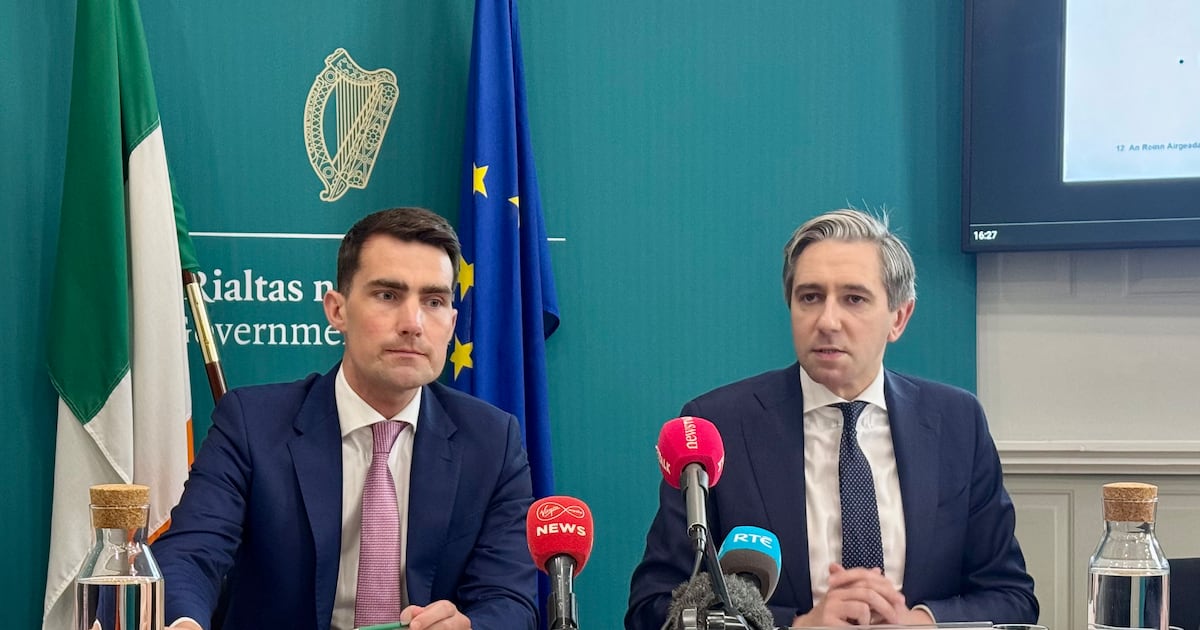
The quarterly press conferences in the Department of Finance have seen ministers reflect upon some grim moments over the past decade. They have furrowed their brows in anticipation of the potential economic fallout posed by Brexit, Trump, corporation tax reform, Covid, Ukraine, Trump again and now war in the Middle East.
Yet, despite all these potentially harrowing moments for the Irish public finances over the years, the money has kept rolling in and the show has remained on the road. Apart from a brief blip in corporation tax receipts in the late summer months of 2023, the Government has rarely had to worry about the content of the actual exchequer returns themselves.
On Tuesday, the geopolitical situation had again darkened considerably as Donald Trump’s deadline in the Gulf loomed over everything.
Speaking at the publication of the latest returns, Minister for Finance Simon Harris described it as a “grave moment” for the world. Hours later, the US president would agree to a temporary ceasefire – and the price of oil would plunge. Stock markets soared, borrowing costs eased.
Despite the world being roiled by Trump and Iran, the exchequer receipts for the first quarter look remarkably resilient. Overall tax revenues in the first three months were 3.4 per cent higher than in the first quarter of last year. Income tax returns increased by more than 6 per cent and VAT by over 5 per cent.
It would seem the economy has weathered the trade tensions and new tariffs of Trump 2.0 without significant damage.
On the corporation tax side, the department described a 3.1 per cent decline as being “down slightly” – but there was no sign of panic about what is a seasonally variable tax heading.
The upshot of it all: when Apple’s one-off tax payments are excluded, the State has collected €700 million more so far this year than it did in 2025.
“It is very early in the day, but income tax and VAT say the economy is doing fine,” says Conall Mac Coille, group chief economist at Bank of Ireland.
He, like others, keeps a close eye on corporation tax returns. The dip, when compared to last year, can’t be viewed as significant – “as the key months haven’t happened yet”.
Those positive headings can’t be viewed in isolation, says economist Austin Hughes: “The first three months don’t usually tell you a lot about what is happening in the economy but they were bound to be stronger than last year.”
Hughes says this is due to the fact that the Government made no concessions on income tax in the budget. In fact, many workers were made worse off on the tax side as indexation against rising wages did not take place.
At the same time, he says, overall inflation will have played a part in the boosted VAT returns, as goods and services are, in general, more expensive than they were at the same stage in 2025.
Hughes believes that trying to discern a direction of travel in the economy is made more difficult these days by two factors: the volatility of the overall economic situation, and “the inherent volatility of the public finances themselves”.
As proof of this he points out how the final Government surplus for 2025 of €11.6 billion ended up being several billion euro in excess of what was anticipated by the likes of the Central Bank and the ESRI.
“They are deep and dark pools, the public finances,” he says.
Despite the opacity of the exchequer position, Hughes views the general situation as “quite healthy”.
He contrasts the State’s general budgetary standing favourably with that of several European economies and that of the United States. A number of developed economies are facing sizeable deficits and are having to borrow heavily to plug the gaps.
“Look at the French,” he says. “They are struggling to get to a 6 per cent deficit this year. The Belgians too. And the Americans are in an extraordinary position.”
He refers to figures showing that more than a quarter of US federal revenues are eaten up by interest costs alone. “The Irish number is 2 per cent. It gives you a sense of a healthier position.”
Neither is he particularly bothered by the short-term prospects for corporation tax receipts.
“Although the corporation tax flow is going to be volatile, it is potentially volatile in both directions. There is a two-sided risk. Risks in the short term are probably to the upside more than the downside”.
The growth in tax revenues has enabled the Government to substantially expand the spending side of the ledger in the past few years.
As noted by the Irish Fiscal Advisory Council (Ifac), gross voted current spending increased by 6.2 per cent in the first quarter but this was in line with what had been budgeted for. The watchdog noted that health spending was running at 7.2 per cent – well above a budgeted forecast of 4.8 per cent. This is hardly unusual and health has accounted for the vast bulk of additional spending over the years.
However, this was counterbalanced in the first quarter by other departments being well behind on their forecasted spending growth. For example, Education, Children and Justice had growth of just 2.6 per cent – compared to the 6.8 per cent that had been expected on budget day.
Spending overruns have been the bane of Ifac’s existence.
Its chairman, Seamus Coffey, has repeatedly said that while budgets might appear balanced when published, the assumptions upon which they are based can quickly become redundant as individual departments are bailed out with extra money the following year.
The public finances are in a really good place, we have an extraordinary opportunity that we must make sure we don’t blow
— Austin Hughes
These overruns can easily become baked in and end up creating new baselines year after year. Coffey says it is very early in the year to get a sense of what might happen in 2026 but there are positive signs at least.
“It is hard to know as it is our first time seeing them [the spending figures], we don’t have profiles for the rest of the year,” he says.
“Growth in gross voted current spending is running at over 6 per cent, so spending is growing faster than revenue but that is in line with the annual totals set out in the budget. It would be a positive if they were to stay close to the budgeted amount – we haven’t seen that in recent years. Very significant supplementary estimates have been passed by the Dáil … €4 billion was put through last year – far, far higher than that set out in the budget.”
For Mac Coille, given that the budget allowed for overall spending growth this year of 7.5 per cent, the real question is whether such planning was prudent or not.
“Whether you are above or below that it is a little bit moot; it is very strong spending growth whatever way you look at it.”
He notes that many big voices have expressed their concerns, such as the Central Bank and the ESRI.
For Hughes, however, this should not be a big worry, and extra spending needs to happen.
“I don’t think we have budget constraints the way Ifac would be saying. Proper budgetary spending will address that,” he says.
There is money there that can be spent, he says, “but it has to be spent with purpose”.
“The public finances are in a really good place, we have an extraordinary opportunity that we must make sure we don’t blow.”
Hughes argues that, what he calls “social infrastructure” needs to be upgraded to “keep society relatively sweet”.
“You need to be able to show we are making progress on housing, progress on health. We need to show more ambition in those areas.”
If this doesn’t happen, he warns, “fractures in the economic and social fabric” could emerge. He says when this has happened elsewhere – such as in France – it has made running the public purse “practically impossible”.
While Coffey and others will be keeping a watching brief on current spending, the Ifac chairman says Tuesday’s figures were a positive marker on the overall state of the Republic’s economy.
Like Hughes, he says the impact of inflation will have fed into the income tax and VAT numbers – but both “point to some strength in earnings and spending”.
The trajectory for the rest of the year hinges in no small part on the path taken by the warring parties in the Middle East.
The outworking of discussions between the US and Iran over the next fortnight will go a long way in determining the extent to which oil and energy prices impact on inflation.
Iran is seeking to toll tankers passing through the Strait of Hormuz in order to rebuild its smashed economy and infrastructure. This could conceivably keep the price of oil significantly higher than it was pre-war. And there is the prospect that hostilities could resume and the Strait will effectively be closed to western shipping.
Despite the large relief rally that swept through stocks and bond markets on Tuesday night, the price of oil nudged up again on Thursday as tensions continued, and Israel continued its war in Lebanon.
At the end of February, a barrel of Brent Crude was trading at $70 on the futures market. After the ceasefire announcement and apparent efforts to draw a line under the conflict, it has settled at close to $100.
Likewise, gas prices remain high and gas futures are still some distance from the sort of lows seen at the start of the year.
Traders are still assessing whether oil and gas tankers will be able to safely exit the Strait of Hormuz in the sort of numbers they were previously accustomed to, and the extent of the damage wrought on energy infrastructure in the likes of Saudi Arabia, Qatar, Kuwait and the United Arab Emirates.
But it seems certain that, no matter what now happens politically and militarily in the region, consumer prices in Ireland are going to rise well above what was expected at the start of the year.
The pressure on the Government to spend some more of its tax surplus is unlikely to abate while petrol, diesel and home heating prices remain elevated. The fuel protests that have snarled up so much of the road network this week – and blocked access to oil facilities – are evidence of a fraught climate.
[ Recent fuel price increases ‘not in breach of any law’, consumer watchdog findsOpens in new window ]
Based on these latest exchequer returns, how much leeway has the Government got to deal with an ongoing shock?
“It depends,” says Coffey. “The situation is highly volatile and reductions in the oil price today could be reversed very quickly.
“When it comes to the energy price shock, the Government cannot protect the whole country from the rise in prices. Whatever a barrel of oil costs, that is what we have to pay.
“But it can look at the distribution of that increase. What you would like to see happen are targeted measures – to those that need it most – not blanket measures like we have seen with reductions in excise, which benefit everybody.”
For Hughes, the focus should remain on dealing with the longer-term threats to the economy.
“A huge infrastructure spend is needed over the next couple of years that will whittle away those surpluses. I would be happier than some other economists to see them whittled away,” he says.
“Our problems with infrastructure – even if we include Mr Trump – is probably the main area where things could go badly astray. We are relatively resilient to international matters.”