

Physics has long operated under two frameworks that refuse to get along. Einstein’s General Theory of Relativity governs the large-scale mechanics of the cosmos, describing gravity as the curvature of spacetime caused by mass and energy.
Quantum mechanics, on the other hand, rules the subatomic world, and within it, gravity is hypothesized to be mediated by a theoretical force carrier called the graviton. Despite decades of effort, no experiment has ever managed to unite these two frameworks into a coherent whole. The nature of gravity remains, in a sense, the universe’s most stubborn riddle.
What makes this new result particularly significant is not just the confirmation of entanglement itself, scientists have known about atom entanglement and photon momentum entanglement for years, but the fact that atoms carry mass. That seemingly simple distinction opens a door that was previously shut: the possibility of studying quantum effects and gravitational forces within the same experiment, simultaneously.
A Long-Sought Experimental Confirmation
The research was conducted by a team spanning three institutions; the Australian National University (ANU) in Canberra, the University of Queensland, and the University of Oklahoma. At the heart of the experiment were three clouds of cold helium atoms, held in place by a magnetic trap. Once the magnets were switched off, the atoms fell under gravity and passed through a series of grating laser pulses that created multiple paths along which the atoms could travel with equal probability.
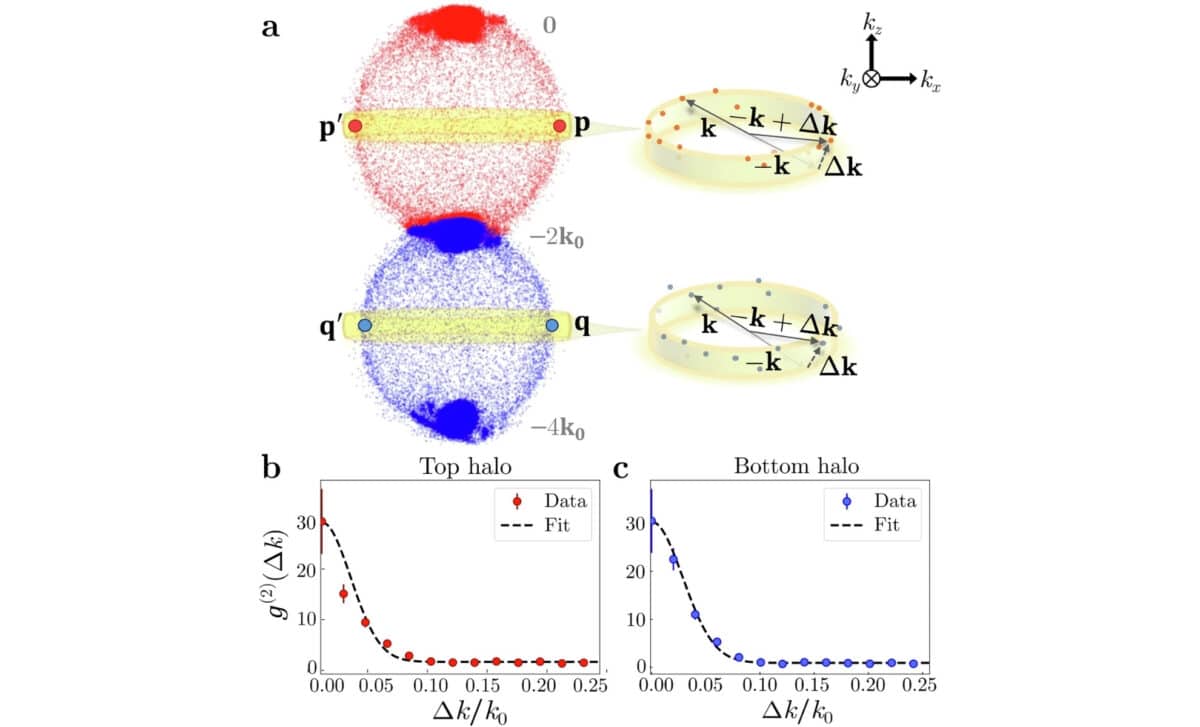 Schematic of the experimental procedure in momentum space – © Nature Communications
This setup constitutes what physicists call a Rarity-Tapster Interferometer, an optical device specifically engineered to measure non-locality, or entanglement. It operated within what is known as a Bell inequality-test framework, which probes the non-local nature of particles, in direct contrast to Einstein’s principle of local realism. The framework is considered one of the most rigorous ways to confirm genuine quantum entanglement rather than classical correlation.
According to Yogesh Sridhar, lead author of the study and a Ph.D. student at ANU, the team demonstrated “nonlocality in the external motion of atoms, rather than internal degrees of freedom such as spin.” In a press statement, he added that the results “strengthen our confidence and understanding in quantum theory and also pave the way to testing quantum mechanical theories with even larger real-world objects.”
Spooky Action, Now With Mass
The phrase “spooky action at a distance“, Einstein’s famously skeptical description of quantum entanglement, takes on new weight here, quite literally. Entanglement, as a phenomenon, holds that two particles, once linked, will instantly affect one another regardless of the physical distance separating them. Change one, and the other responds, instantaneously, and without any apparent signal passing between them.
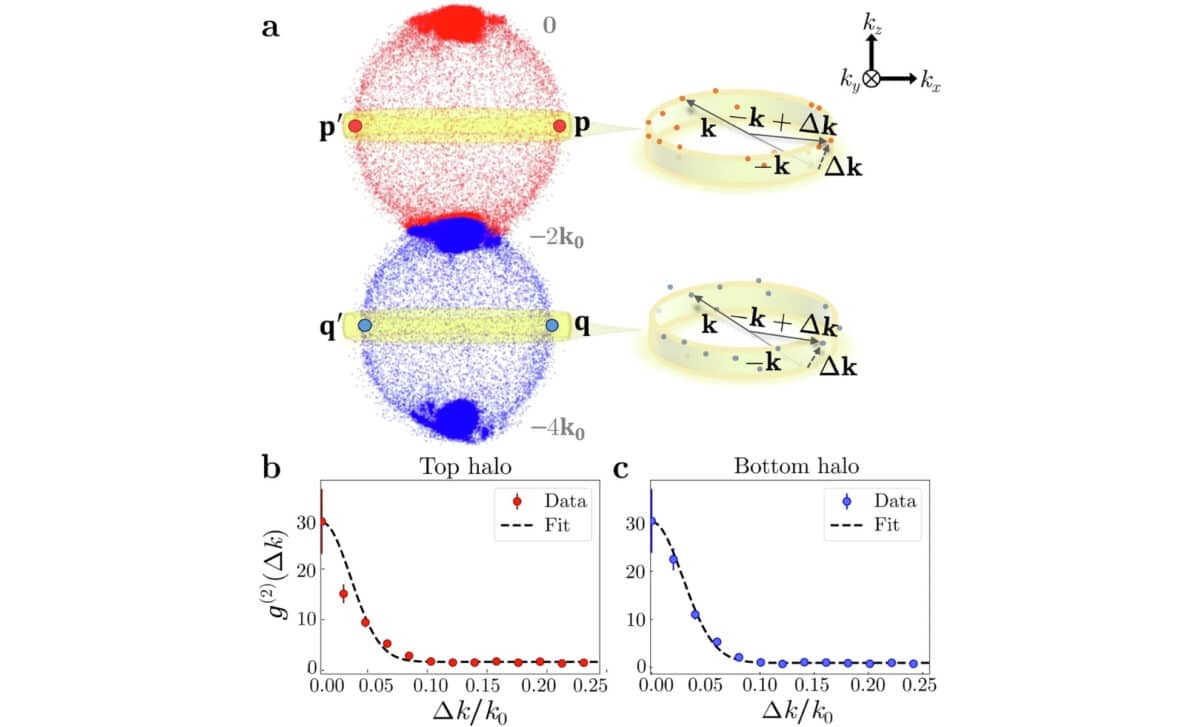 Two-particle momentum correlations in scattering halos – © Nature Communications
“For two separated atoms that are entangled, if you change one of them, it will instantly affect the other,” said Sean Hodgman, lead researcher and also from ANU, in a press statement. “It’s kind of crazy to think that this is how the world works, but we’ve shown that it’s the nature of reality.”
What had long remained theoretical for atoms in motion has now been placed on firm experimental ground. It is worth noting that this was only made possible in recent years, according to Popular Mechanics, because of significant advances in the methods scientists use to control and measure individual atoms, a technical threshold that had previously kept these experiments out of reach.
A Gateway to Quantum Gravity
The deeper implication of this result lies in what it might make possible next. Because atoms have mass, their paths through space are subject to gravitational effects. And because quantum mechanics holds that atoms can travel multiple paths simultaneously, the intersection of the two theories — relativity and quantum mechanics, becomes, for the first time, something that might be experimentally probed rather than merely theorized about.
“Imagine atoms moving through different paths in space, they can experience different gravitational effects. However, quantum mechanics says that atoms can take multiple paths simultaneously,” Hodgman said in a press statement. “So the fact that we can now show that these sort of systems are entangled means that we could then think about potentially looking at some gravitational effects that we could test with them.”
Whether this ultimately leads toward the long-sought Unified Theory of Everything remains an open question, one that physicists have been circling for nearly a hundred years. But what this experiment does, with unusual clarity, is confirm that the quantum world behaves in ways that are not merely strange in theory. They are strange in practice, and now, demonstrably, in atoms that have weight.