
By ITV News Producer Hannah Ward-Glenton
Over the last 10 days, the Artemis II mission has captured the world’s attention.
People have closely followed the mission around the moon, marvelling at the footage captured by the team and shared by Nasa, widely regarded as the world’s leading space exploration organisation.
But not all of the responses have been positive.
Photos, videos, and news coverage of the space mission have received hundreds, if not thousands, of skeptical comments online suggesting the content is fake. In more extreme cases, people have even claimed the mission itself is staged.
Here, ITV News looks at why Artemis II has triggered a flurry of conspiracy theories.
What are the conspiracy theories around Artemis II?
One of the most common conspiracy theories around the Artemis II mission is that it did not happen at all, and may have been staged using green screens.
One video, which has been viewed over one million times, shows the astronauts suspended by wires in front of a prop space capsule, as if a studio is trying to recreate the look of weightlessness in space.
The footage is AI-generated, created using Google AI, according to the company’s SynthID watermark check tool.
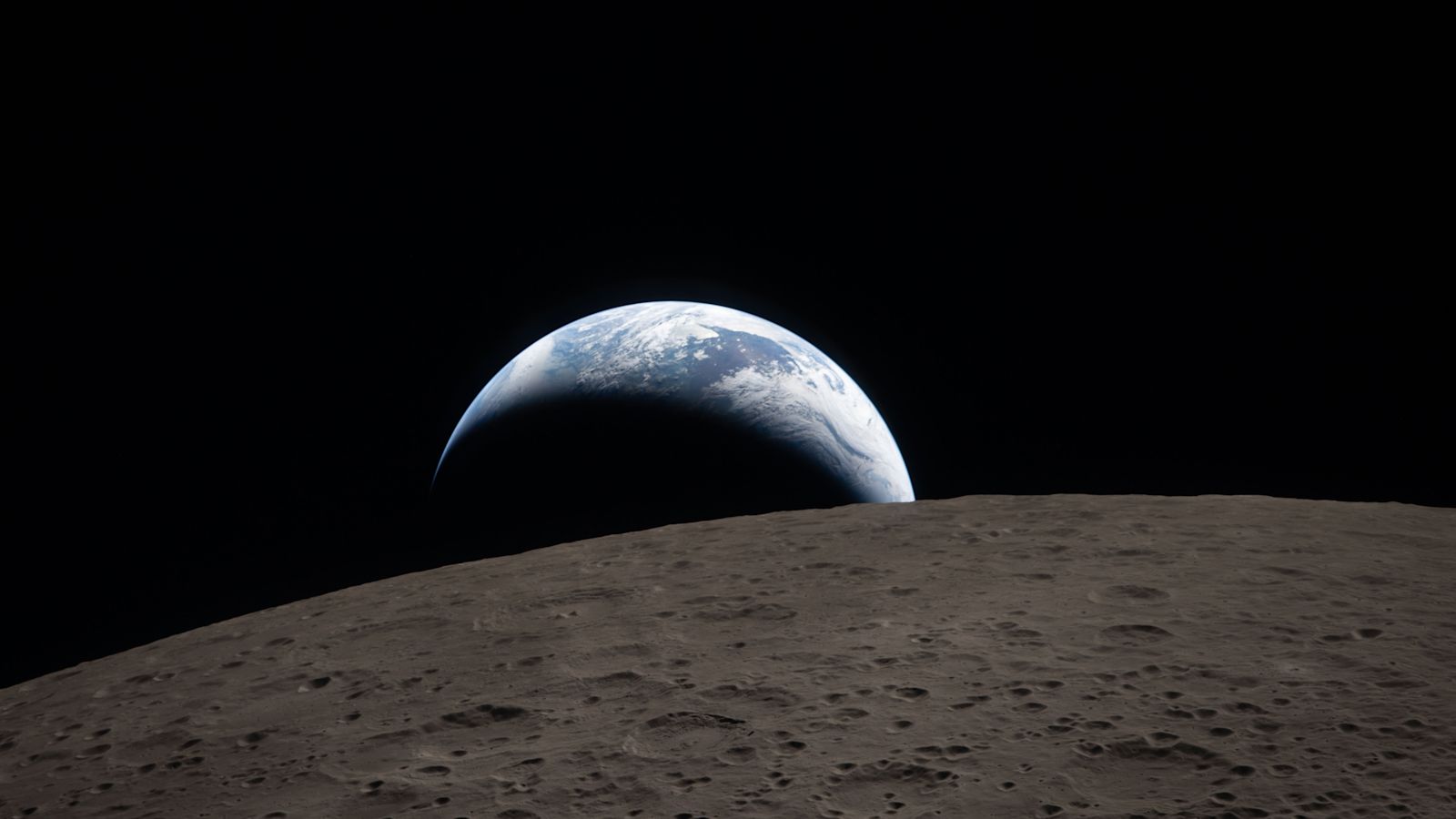
The Artemis II crew captures a faint view of a crescent Earth above the horizon on the moon’s far side. Credit: Nasa
Other conspiracy theories revolve around how photographs Nasa shared of the far side of the moon. They claim the images must be fake because there is light in the photos.
But Nasa explained the reason behind the light in a statement on April 3, saying: “During the six-hour lunar science observation period, the Sun, Moon, and the Orion spacecraft will be aligned such that the crew will see about 20% of the Moon’s far side, the hemisphere not visible from Earth, lit by the Sun”.
Subscribe free to our weekly newsletter for exclusive and original coverage from ITV News. Direct to your inbox every Friday morning.
There were also questions over details in some TV coverage of in-space press conferences, which appeared to show a random logo projected onto a plush toy in the capsule.
This was widely quashed as a technical error by the TV station rather than proof of the mission being faked.
Conspiracy theories around Artemis II have been perpetuated and elevated by well-known people.
Former British MP Andrew Bridgen, for example, shared two photos with his 361,000 followers, claiming one was from the Apollo 8 mission in 1968 and one was Artemis II.
“It’s a remarkable coincidence that the Earth was exactly the same orientation to the moon with exactly the same cloud coverage when these two pictures were taken 68 years apart. Am I now a coincidence theorist ?” he wrote on X.
Social media users quickly noted that the second image was not from the Artemis II mission at all.
Where do space conspiracy theories come from?
Doubts around the Artemis II mission are by no means the first conspiracy theories around space travel.
Hoax rumours around the moon landings in 1969 weren’t uncommon at the time, and they have continued to circulate in the decades since then.
There were, and still are, beliefs that the Apollo moon landings were a Hollywood production, designed to suggest the US had won the Space Race.
There have been doubts cast over shadows in the photos, whether humans could survive Earth’s radiation field, a lack of stars in photos, and why humans haven’t yet returned to the moon – all of which have been rigorously debunked multiple times by scientists.
Why has Artemis II triggered conspiracy theories?
While there has been a wave of Artemis II disinformation circulating in the last 10 days, all major events tend to generate conspiracy theories, according to Professor Peter Knight, who researches conspiracy theories at the University of Manchester.
“It’s no surprise that the first manned orbit of the moon for half a century has led to a resurgence of moon landing conspiracy theories. None of this is new, but what has changed is that conspiracy theories are now far more visible to ordinary people,” he said.
With people spending hours online, the level of exposure to material circulating on social media is inevitably greater.
Buzz Aldrin Jr. poses for a photograph beside the US flag on the moon during the Apollo 11 mission on July 20, 1969. Credit: AP
The context around the Artemis II conspiracy theories is also very similar to the narrative around the first moon landing being a hoax, according to Dr Ilya Yablokov, Lecturer in Digital Journalism and Disinformation and co-lead of the Disinformation Research Cluster at the University of Sheffield.
Mr Yablokov said these theories are often rooted in a broader distrust of powerful institutions and their motives.
They also include the idea that nations – particularly the United States and China – are attempting to “weaponise space”, reinforcing the suspicion that these missions serve hidden agendas rather than the advancement of humanity.
“In that sense, what we saw 50 years ago with the Apollo moon landing, we see today. Because in a sense these are very similar triggers and factors that help these conspiracy theories to proliferate,” he added.
Distrust of experts, institutions, and the government has been increasing since the 1970s, according to Professor Knight, and is fundamental to the dissemination of conspiracy theories.
“The original moon landing conspiracy theories were in part a response to a loss of trust in the American government in the wake of the political assassinations of the 1960s, the Vietnam War, and Watergate. Now, the distrust of experts and institutions is even more widespread,” he told ITV News.
“They can spring from genuine feelings of resentment or distrust that can’t simply be dismissed as paranoid delusions,” he added.
Nasa’s Artemis II moon rocket lifts off from the Kennedy Space Center. Credit: AP
There are also people “cynically jumping on the bandwagon to help promote their social media feed” and using conspiracy theories to do that, he added.
Has AI changed how conspiracy theories work?
While artificial intelligence has been used to create fake content around the Artemis II mission, it has also made people more distrustful of genuine footage.
“This time round, there’s often the suggestion that it’s all AI-generated… It’s not that people believe in crazy things that aren’t true; instead, they refuse to believe in things that are actually real, insisting instead that it’s all fake news or AI-generated,” Professor Knight said.
What are the consequences?
The spread of conspiracy theories doesn’t necessarily have huge consequences for an individual, Dr Yablokov said, but there can be huge knock-on effects at an institutional level.
This can be especially problematic if a person who, for example, didn’t believe that humans have landed on the moon is put in a position of power.
The Artemis II crew uses eclipse viewers to protect their eyes during the solar eclipse they experienced during their lunar flyby. Credit: Nasa
“So imagine this person says, oh, look, I don’t think it’s important. I don’t think we should waste our money on that. That would put missions under threat.
“If those beliefs are weaponised or endorsed by influential people, then that would be a problem. It would become a problem for societies, for our race to explore the universe,” he added.
Should, and can, conspiracy theories be stopped?
Conspiracy theories have always been around, and “will stay around”, Dr Yablokov said.
Social media just allows for any person’s beliefs to be amplified, and it does not discriminate based on whether or not the person posting knows anything about the subject matter.
“It’s a long-term game. We simply need to do whatever we can … We need to make sure that people understand the value of [space programmes].”
Professor Knight added that a sense of trust and democratic buy-in for science and scientific institutions would be one of the only ways to fully disprove conspiracy theories.
And that, he said, “is long, slow, hard work”.
Reporting History sees journalists join News At Ten anchor Tom Bradby to revisit their remarkable on-the-day reports of the defining events of the modern age. Listen to the episodes below…