
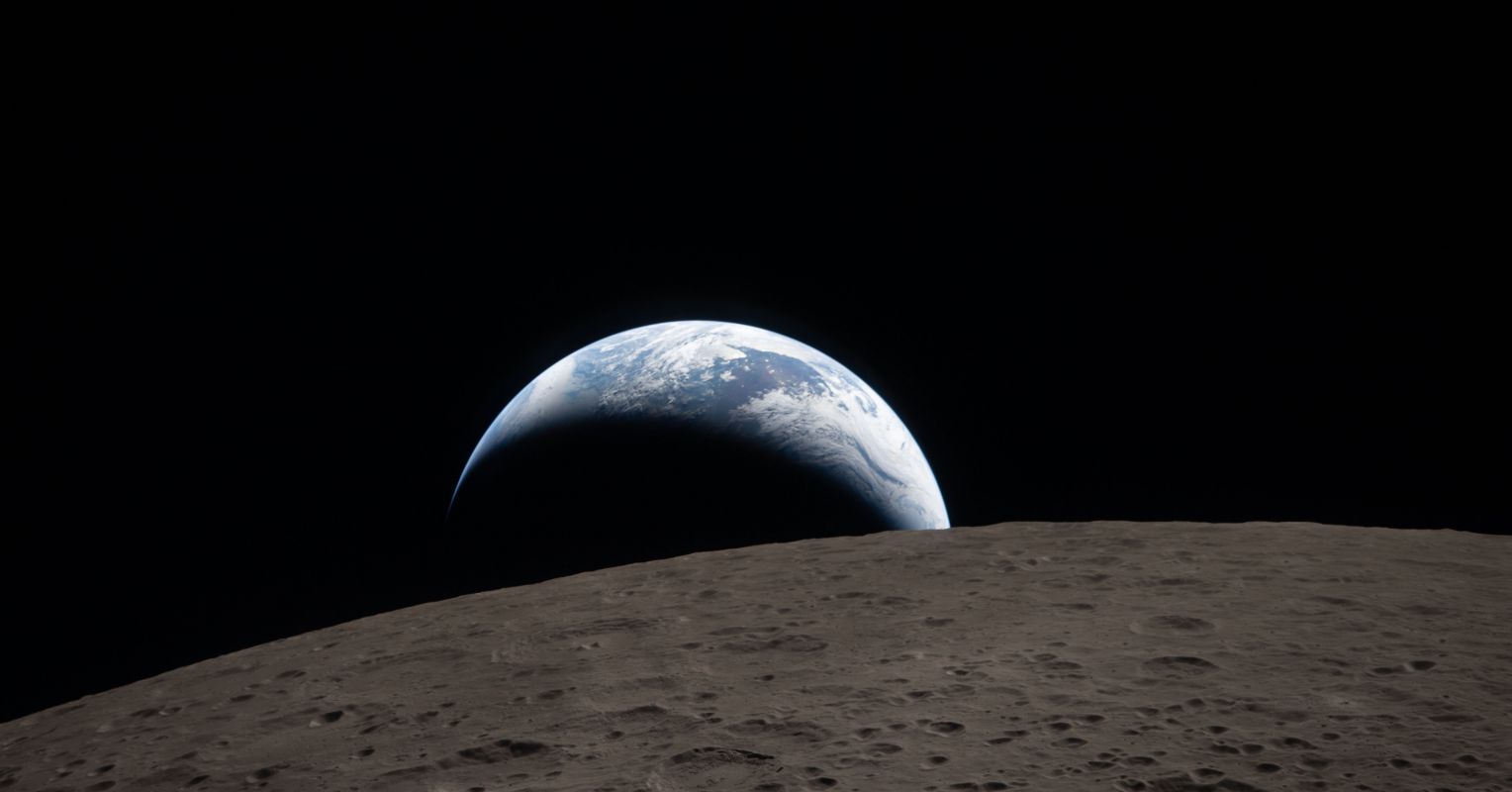
“You have this amazing place, this spaceship. You guys are talking to us because we’re in a spaceship really far from Earth. But you are on a spaceship called Earth that was created to give us a place to live in the universe, in the cosmos. […] You are special in all of this emptiness. This is a whole bunch of nothing. This thing we call the universe. You have this oasis, this beautiful place that we get to exist in together.”
Astronaut Victor Glover of the Artemis II mission nicely described what many astronauts have described when gazing back at planet Earth from space, what has been known as the “overview effect,” viewing Earth from outside the atmosphere, yielding a combination of both the beauty of planet Earth and the hostility and magnitude of space. When planet Earth comes into view, the aesthetic experience of the blue marble in contrast to the hostile darkness of space is considered an intense, and perhaps the most intense, experience of awe. It often leaves these astronauts with a lasting impact on how they view humanity.
A few hundred astronauts who traveled to space had the opportunity to witness Earth from orbit, allowing them to experience the overview effect. How could we let others—those who do not belong to the lucky few who are able to travel to space—experience the overview effect and its lasting consequences? This question the non-profit organization SpaceBuzz aimed to answer with an actual rocket ship that would launch 11-year-olds at primary schools across the world.
Over the last few years, more than 140,000 school children have experienced the overview effect. As part of an education program by the non-profit organization SpaceBuzz, spearheaded by two-time European Space Agency astronaut André Kuipers, children apply to become an astronaut at their school. They go through a series of fun exercises to ultimately pass the astronaut training, and when they graduate as astronauts, an actual rocket ship drives up in their school yard. Seated in hydraulic chairs and dunned with a virtual reality headset, they are launched into space and enter into an orbit around planet Earth. Guided by Kuipers as a virtual human, they are told about viewing the blue marble from space, a planet without borders, a planet in the vastness of space. When the young astronauts return to Earth, they give press conferences to friends and family, just like real astronauts.
The SpaceBuzz VR simulation aims to simulate the overview effect, has attracted enthusiastic responses from children, teachers, and parents alike. But does the simulation actually simulate the overview effect? Is that special emotion of awe actually triggered by the VR simulation?
A recent study aimed to answer this question by monitoring physiological responses in participants who experienced the SpaceBuzz VR simulation, and particularly monitored when planet Earth came into view in the vastness of space. Participants wore gel-covered sensors one below the collar bones and one below the heart on the chest to create an electrocardiogram (ECG) measuring their heart rate and heart rate variability. They wore electrodes on the index and middle fingers to measure changes in their skin conductivity. And they wore a band around their upper body to monitor their respiration. All three signals—heart rate, skin conductance, and respiration—at different instances during the VR simulation were compared with the moment in the VR simulation that was supposed to create the overview effect. Respiration did not show much; people were hardly holding their breath at that specific moment. Heart rate showed an interesting spike with an increase in beats per minute (BPM) at the moment of the overview effect, a spike that could not be explained by anything other than that moment in the VR experience. Heart rate variability showed a similar spike, but one that was downward. But most prominent was the skin conductance responses that showed a major spike, a brief burst of emotional activation exactly at the time of the overview effect.
Obviously, it is tempting to question these findings. Does the physiological response really come from the overview effect? Is it not just a matter of being in a VR simulation when physiology changes over time due to an immersive effect? The study investigated these questions extensively. Findings could simply not be explained by changes over time. The spikes that were detected were really spikes, and they really happened around the overview effect, significantly more (or less, as was the case for heart rate variability) than before or after the overview effect scenes or other scenes in the VR simulation.
These findings demonstrate what an earlier study on brain imaging also showed. Changes in frequency bands in the brain during an electroencephalogram (EEG) study, as well as spikes in physiological responses, were found during the VR simulation that could only be attributed to something known as the overview effect.
The findings of these studies tell us more about neurophysiological responses to the overview effect, they tell us something how the overview effect can be triggered in VR simulations, but perhaps most importantly, they provide empirical evidence for allowing the overview effect and the lasting impact on how they view humanity be experienced to young ambassadors of planet Earth.