
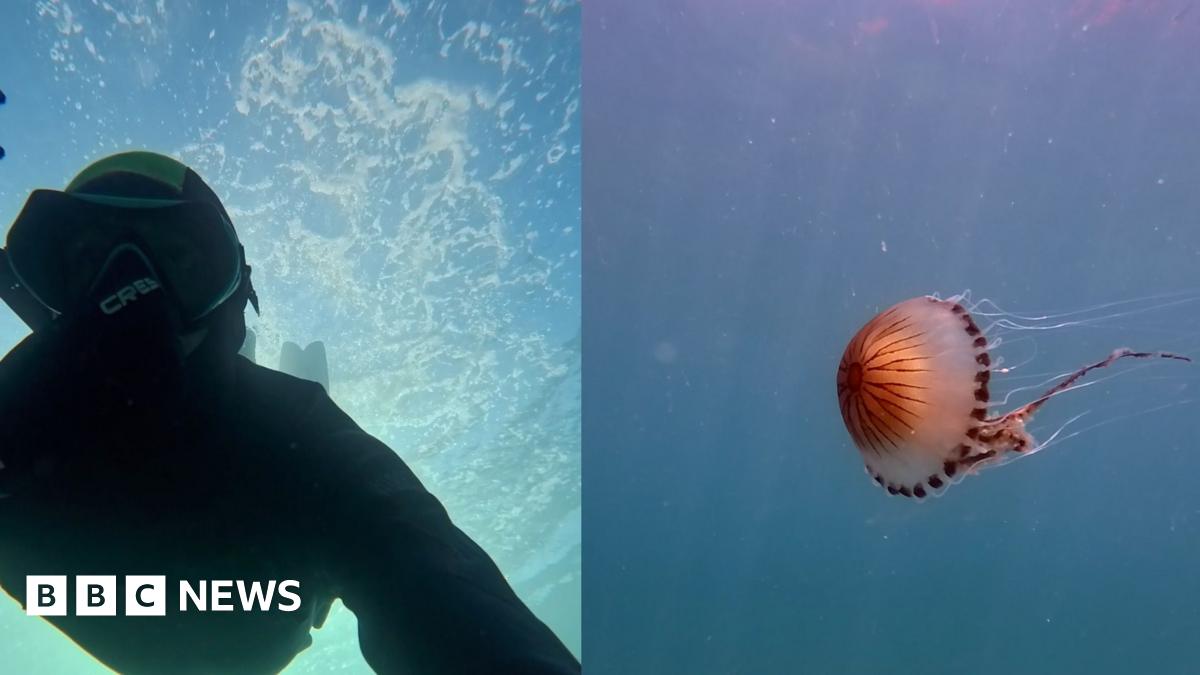
Iestyn said he saw thousands of mauve stingers on a dive in the summer – a small but venomous jellyfish typically seen in the Mediterranean.
“I can’t express how many there were. I had to get out because I couldn’t see, there were so many.”
He described it as a “telltale sign” of climate change.
Average sea temperatures around the UK and Ireland range from 6-10C (43 – 50F) in the winter to 15-20C (59 – 68F) in the summer, according to the Met Office, external.
But a marine heatwave in summer 2025 saw sea temperatures in parts of the UK up to 3C (37.4F) above normal at times.
Fuelled by climate change, BBC analysis found that the world’s oceans broke temperature records every single day over the year of 2024.
“While it’s cool for me as I get to see these cool encounters as we have new species that we wouldn’t necessarily have before, it is a concern looking forward,” said Iestyn.
“In my night dives I see squid all the time, obviously I haven’t been doing this for years so I can’t say just how common they were before.
“But the sheer amount of squid I’ve been seeing does suggest the warm waters are having an impact.
“Everybody is going to be affected… I don’t think it’s talked about enough, it’s become a normality.
“I think if we can shift away from that and have discussions about how big of a problem it is, that could be really important.”