
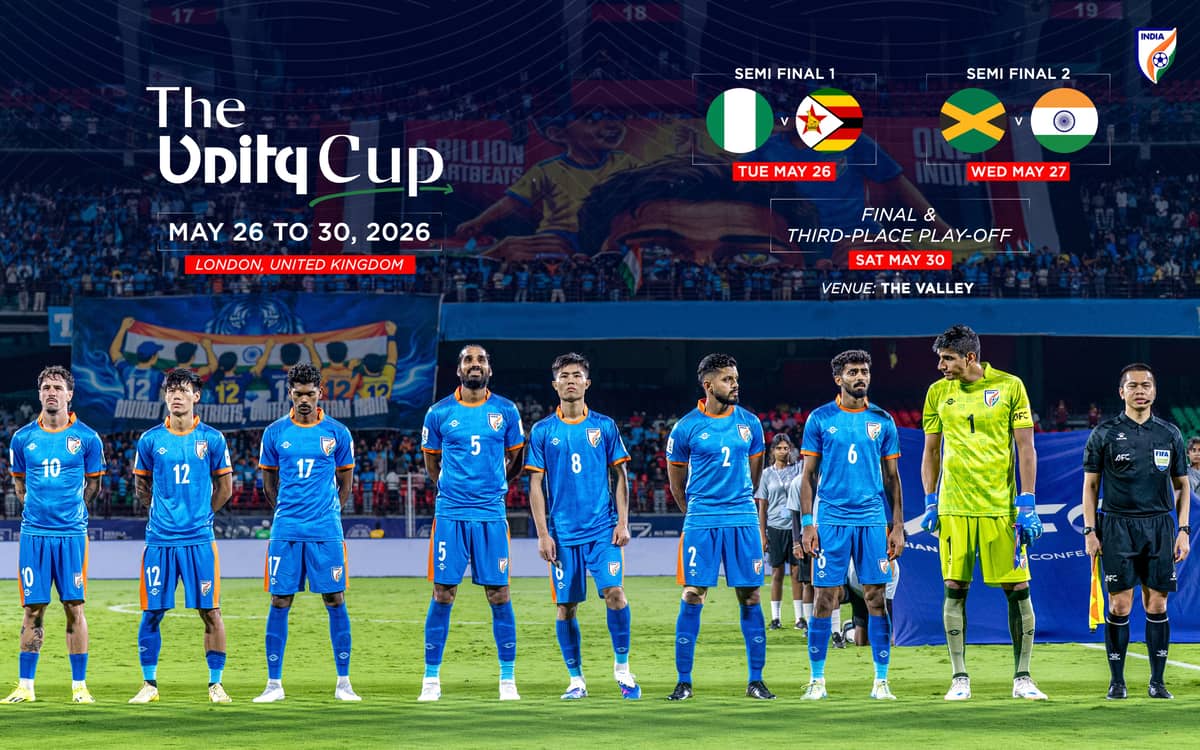
The Indian men’s national football team is set to make its return to the United Kingdom after a gap of 24 years, as it prepares to participate in the Unity Cup 2026, a four-nation friendly tournament scheduled to be held in London from May 26 to May 30.
The tournament will feature India alongside Nigeria, Jamaica, and Zimbabwe, and will be played at The Valley, the home stadium of Charlton Athletic FC. The competition is designed as a short-format international friendly event, bringing together teams from different footballing regions in a compact and competitive structure.
India will begin its campaign against Jamaica in the second semifinal, which is scheduled for May 27. The opening semifinal will take place a day earlier, on May 26, between Nigeria and Zimbabwe. The winners of both semifinals will advance to the final, which is set for May 30, while the losing sides will compete in the third-place play-off on the same day.
The Unity Cup 2026 holds added significance for Indian football as it marks the national team’s return to international action in the United Kingdom after more than two decades. India last played in the UK in 2002, when it faced Jamaica in a set of friendly matches. On that tour, India suffered a 0-3 defeat in Watford and managed a 0-0 draw in Wolverhampton, marking a challenging but valuable exposure trip at the time.
Notably, India has never played against Nigeria or Zimbabwe at the senior men’s international level, making this tournament an opportunity to face unfamiliar opposition. The match against Jamaica also revives a past international encounter, although under very different circumstances given the long gap and evolving nature of both teams.
In terms of global standing, the latest FIFA Men’s World Rankings place India at 136th in the world. Among the participating nations, Nigeria holds the highest ranking at 26th, followed by Jamaica at 71st, and Zimbabwe at 130th. The rankings highlight the competitive gap India will face in the tournament, especially against a significantly higher-ranked Nigerian side.
The Unity Cup will provide India with an important platform to test its squad against diverse playing styles. Nigeria, known for its physicality and pace, is one of Africa’s strongest football nations and regularly competes at the highest international level. Jamaica, meanwhile, brings Caribbean flair and athleticism, while Zimbabwe offers a disciplined and structured approach typical of Southern African teams.
For India, the tournament is expected to serve as a key preparatory event in its international calendar, offering valuable match experience against teams outside its usual Asian circuit. Playing in London also adds exposure in a high-visibility football environment, with the UK being home to a large South Asian diaspora and a global football audience.
The compact nature of the tournament ensures a high-intensity schedule, with minimal recovery time between fixtures. India’s semifinal against Jamaica on May 27 will be crucial, as a win would secure a place in the final just three days later. A loss would still offer a chance to compete for third place, ensuring two matches for each team over the course of the tournament.
Unity Cup 2026 Schedule:
Nigeria v Zimbabwe (Semifinal 1): Tuesday, May 26, 19:30 BST (00:00 IST, May 27)
Jamaica v India (Semifinal 2): Wednesday, May 27, 19:30 BST (00:00 IST, May 28)
Final and Third-place Play-off: Saturday, May 30
With India ranked 136th in the world, the Unity Cup presents both a challenge and an opportunity. Competing against higher-ranked opponents such as Nigeria, along with similarly ranked teams like Zimbabwe and Jamaica, will test India’s tactical depth and squad strength. As the Blue Tigers step back onto English soil after 24 years, the tournament is set to be a significant moment in the team’s recent international journey.
!function (f, b, e, v, n, t, s) {
if (f.fbq) return; n = f.fbq = function () {
n.callMethod ?
n.callMethod.apply(n, arguments) : n.queue.push(arguments)
};
if (!f._fbq) f._fbq = n; n.push = n; n.loaded = !0; n.version = ‘2.0’;
n.queue = []; t = b.createElement(e); t.async = !0;
t.src = v; s = b.getElementsByTagName(e)[0];
s.parentNode.insertBefore(t, s)
}(window, document, ‘script’,
‘https://connect.facebook.net/en_US/fbevents.js’);
fbq(‘init’, ‘877586283401283’);
fbq(‘track’, ‘PageView’);