
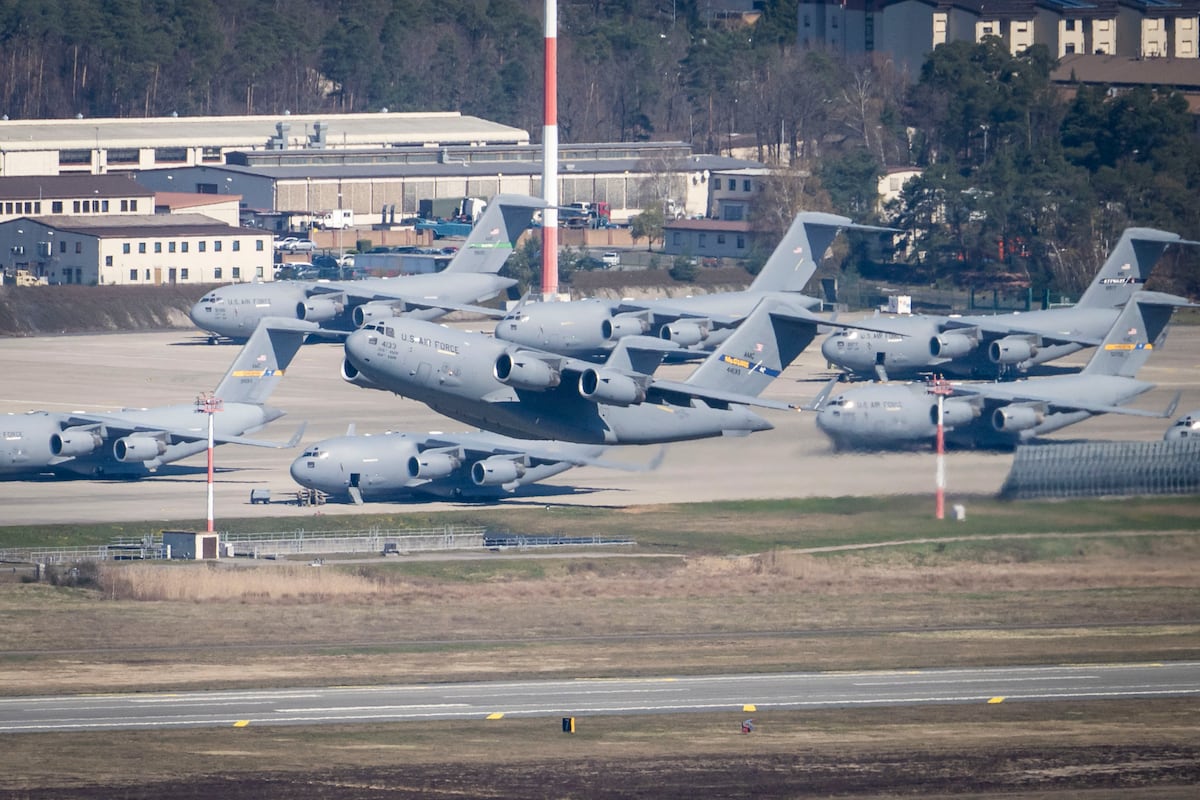
The world is beginning to lose count of the times Donald Trump has threatened in recent days to abandon NATO and leave his European allies in the lurch for refusing to follow him in his poorly planned military adventure in Iran. This is especially true because they have restricted the use of military bases on European soil — not only Spain, but also France, the United Kingdom, and even Italy have placed limits or conditions on the use of these facilities or prohibited military aircraft from flying over their airspace en route to the Middle East — for a war about which they weren’t even warned. The U.S. president’s threats have been so numerous that his French counterpart, Emmanuel Macron, warned him this week: “If the commitment is questioned every day, it loses its meaning.”
Although this is by no means the first time Trump has questioned or pressured Europe to invest more heavily in defense — as with his imposition of 5% of GDP spending by 2035, agreed through forced smiles at the NATO summit in The Hague — it is clear that there is unease on the eastern shores of the Atlantic about the constant questioning of the largest defense alliance in history by its most powerful and, in the short term, irreplaceable member.
Threats and claims that the Alliance is nothing more than a “paper tiger” undermine the unity and credibility necessary for NATO to continue fulfilling its primary function of deterrence, warn senior European security and defense officials. They also revive concerns about Trump’s currently suppressed — but never extinguished — designs on the Danish island of Greenland, which brought the Alliance to the brink of collapse earlier this year. “The fact that European allies have limited the purposes for which the United States can use their bases — protecting Gulf allies, not attacking Iran — has infuriated Trump and could reinforce his conviction that the United States has to ‘own things’ [in this case, Greenland] if it truly wants to protect itself,” warns Mujtaba Rahman, director for Europe at the geostrategic consultancy Eurasia.
The main beneficiary of all this, analysts and politicians agree, is Vladimir Putin’s Russia, unanimously identified — and recognized as such by NATO itself — as the primary threat to Europe. Meanwhile, China, which discreetly but persistently seeks to expand its sphere of influence, is also rubbing its hands in anticipation, experts warn.
However — or perhaps precisely because of all this — there is a shared awareness among the allies that an American withdrawal from Europe, where the U.S. maintains dozens of bases and strategic positions crucial to Washington’s global interests, is not on the immediate horizon, despite the White House’s bluster. Because it would likely be as damaging to the United States as it would be to the Old Continent. And this is well known on the other side of the Atlantic, including by the current administration, regardless of what Trump says.
“The Trump administration is fully aware of the crucial importance of European bases,” says Daniel Kochis, senior fellow at the Hudson Institute’s Center for Europe and Eurasia.
After EL PAÍS reported that Spain had closed its airspace to flights involved in Operation Epic Fury against Iran, and had also prohibited the use of the Rota and Morón de la Frontera air bases in the south of the country for fighter jets or refueling, Secretary of State Marco Rubio questioned the relevance of these facilities. “What is in it for the United States?” he asked. Kochis’s response is emphatic: “Access to such robust facilities is an advantage that no other country in the world enjoys to the same extent, certainly not China or Russia,” the transatlantic security specialist explained via email.
The European bases “fulfill the obvious function of deterrent bulwarks against Russia, but also allow the projection of power beyond Europe, towards the Middle East and North Africa,” adds Kochis, who, in an analysis of how “reducing the U.S. presence in Europe would weaken American interests,” highlights another key to remaining in Europe: the ability to respond more “quickly and effectively” to threats to American interests in those regions.
Europe is “the first line of defense of our homeland,” declared General Christopher G. Cavoli before the U.S. Congress shortly before retiring as NATO’s Supreme Allied Commander Europe (SACEUR) last summer. “The U.S. cannot be defended solely from Texas, North Carolina, or Florida; a forward presence is needed to project air, sea, and land power not only in Europe, but also in Africa, the Middle East, and the Arctic,” concurred Ben Hodges, former commander of U.S. Army Europe (2014-2017), in statements made around the same time to the Center for European Policy Analysis (CEPA).
The presence of U.S. troops in Europe and the use of military bases on European soil have been a constant since the end of World War II. Washington deployed nearly half a million soldiers during the height of the Cold War, although after the fall of the Berlin Wall, it considerably reduced the contingent, reaching lows of just over 60,000 troops during the administrations of George W. Bush and Barack Obama.
Russia’s war against Ukraine forced Washington to reinforce its forces in Europe again starting in 2022, to around 84,000 troops by the end of 2025. Of these, the vast majority, some 68,000, are permanently stationed at bases in various countries: about 36,400 in Germany, the main U.S. stronghold in Europe; 12,600 more in Italy; another 10,000 in the United Kingdom; and almost 4,000 in Spain, according to official figures from December. These are joined by thousands more troops deployed on rotational assignments — such as the 10,000 in Poland or 1,700 in Romania — or for temporary missions, according to the U.S. Department of Defense.
In total, the U.S. has 31 “persistent” military bases — which it has used continuously for at least 15 years and over which it exercises some degree of operational control — in Europe (mostly in Germany, Italy, and the UK), and another 19 facilities to which the U.S. Department of Defense — renamed the Department of War by Trump — has “access” on the continent. Most of these are interoperable with NATO operations and needs.
These include air bases, naval bases, army garrisons, missile defense systems, and surveillance centers that allow Washington to maintain ground units, naval warships (including destroyers and an amphibious command ship, based in Spain and Italy), and aircraft from the Army, Navy, and Air Force (including helicopters, fighter jets, electronic attack aircraft, bombers, transport and tanker aircraft, and other types of aircraft) on European soil. The U.S. military command center, EUCOM, is headquartered in Stuttgart, Germany.
U.S. forces in Europe are also responsible for managing the American nuclear arsenal deployed on the continent during the Cold War as a deterrent against the Soviet Union, but also to prevent the proliferation of nuclear weapons among NATO allies, the Council on Foreign Relations notes in a report on the state of U.S. forces in Europe. The U.S. once possessed nearly 7,000 nuclear weapons in Europe. Currently, it is estimated to maintain around 100 B61 gravity bombs at bases in Belgium — specifically at Kleine-Brogel, which experienced several incidents involving suspicious drones flying over its airspace late last year — Italy, the Netherlands, Germany, and Turkey. None of these countries can use these weapons without Washington’s permission.
“The U.S., after having abandoned Nato/Europe, would be reduced to what exactly — a Western hemisphere power, a regional power, being surpassed by China in all strategic categories?” asked Wolfgang Ischinger, president of the Munich Security Conference, the setting for many of Trump’s threats to Europe after his return to the White House, this week.
Focus on other scenarios
Washington has made no secret of its interest in reducing the size of its deployment in Europe, arguing that European allies should focus more on their own conventional defense so that the U.S. can concentrate on other theaters, especially Asia. But even if he wanted to push his threats to the limit, the Republican’s hands are quite tied: in the National Defense Authorization Act passed last year — in anticipation of the possibility that Trump might unilaterally order a withdrawal of U.S. troops from Europe — lawmakers, in a clear statement of principles, included a series of clauses prohibiting the president from reducing the number of those troops to below 76,000. That same law prevents him from relinquishing the position of supreme allied commander, historically also held by an American, unless Secretary of Defense Pete Hegseth certifies to Congress that it is a decision agreed upon with the European partners.
Kochis adds an economic point to the legal constraints: “From a financial point of view, the United States’ allies contribute to covering the costs of the American presence in Europe, costs that would have to be borne entirely by the American taxpayer if those troops were to return home.”
And beyond the fact that it’s an unpopular move in a midterm election year for Congress and the Senate — support for NATO among the American public exceeds 60% year after year, while public outrage grows over the cost of the Iran war — Trump would not find it easy to carry out his threat to withdraw completely from the Alliance. The aforementioned law — which Rubio co-authored when he was still a senator from Florida — prohibits the president from a unilateral withdrawal unless Congress passes legislation to that effect or a two-thirds supermajority in the Senate (100 seats) votes in favor.
Something that doesn’t seem easy to achieve, even with the power Trump currently wields over the Republican-majority legislature, a power that could diminish after the November elections. The chairs of the bipartisan NATO observer group in the Senate, Democrat Jeanne Shaheen and Republican Thom Tillis, made it clear this week that “Congress will not allow the United States to withdraw from NATO.” The law that Rubio helped draft, prohibiting the president from unilaterally deciding to withdraw from the Alliance, “clearly states that only Congress can authorize the President to withdraw the U.S. from NATO. That will not happen,” the senators emphasized in a statement. The signal also came from the Senate itself, through Republican Mitch McConnell and Democrat Chris Coons: “The United States joined NATO in 1949 when the Senate voted to ratify the NATO treaty, and the United States will remain in it. The Senate will continue to support the alliance for the peace and protection it provides America, Europe, and the world.”
Iulia-Sabina Joja, former deputy project manager at NATO’s Transformation Command, believes Trump’s threats must be put into context. “We know he uses these kinds of statements to pressure allies, whether European or not,” she noted in a videoconference organized by the Middle East Institute in response to the looming new Atlantic crisis. “I think there is ample room for negotiation so that — from NATO’s perspective — we can emerge from this situation with a stronger and more sustainable Alliance for both sides of the Atlantic.”
For Fabrice Pothier, CEO of the geopolitical consultancy Rasmussen Global and former NATO policy planning director, Trump “is facing the consequences of his unilateralism and taking Europe’s support for granted.” The key in this standoff, he tells this newspaper, is “for European allies to stand united in the face of the fallout from Trump’s anger.”
Sign up for our weekly newsletter to get more English-language news coverage from EL PAÍS USA Edition