
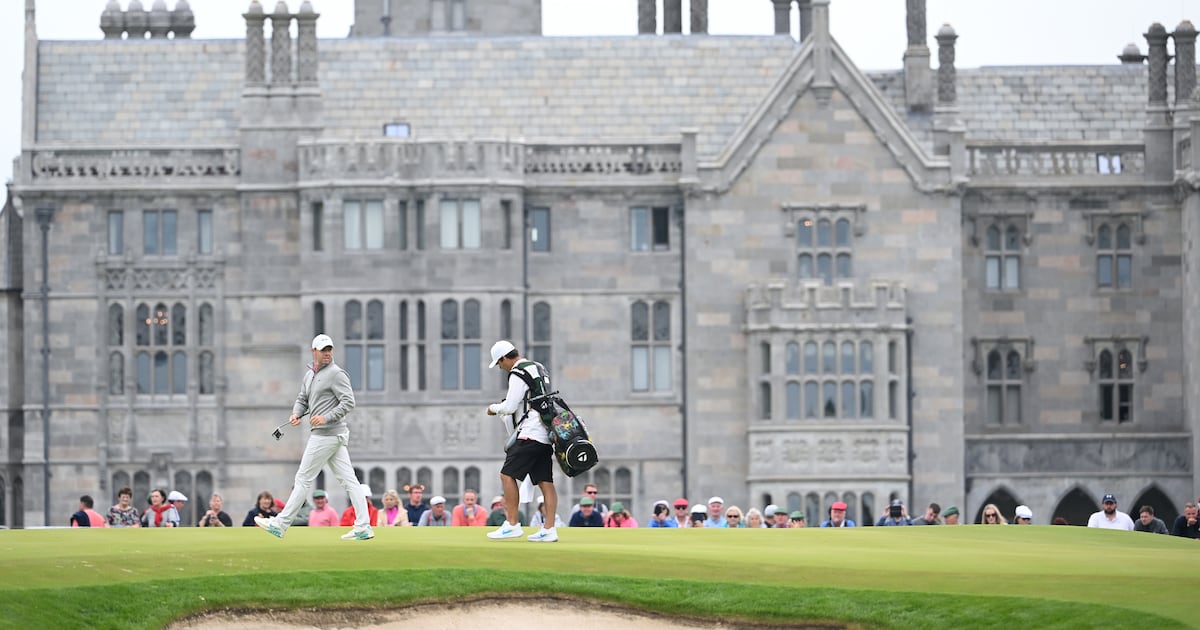
With just 16 months to go, it’s officially Ryder Cup season on Overheard’s custom calendar we use to track the movements of bulging tourist wallets. And many near – or semi-near – Adare Manor, the event’s Limerick home for the September 2027 outing of the biennial tournament between Europe and the United States, certainly have dollar signs in their eyes.
For a mere €40,000, golf-mad visitors can situate themselves in a fairly standard-looking four-bed bungalow in Nenagh, Co Tipperary, about an hour away. “Nenagh offers a range of essential amenities including supermarkets, restaurants, cafes, and pubs,” the ad reads. Ideal.
Visitors used to driving for ages to get anywhere might choose to spend €45,000 for a week in a four-bedroom holiday cottage outside Baile an Fheirtéaraigh on the Dingle peninsula, where many high-end golf courses are nearby, although the commute to the actual event is more than two hours.
All of these and many more are available on Accommodation for the Event, a golf-focused site that links short-stay accommodation providers with people who have temporarily lost their understanding of money.
Other options that are objectively miles away include several in Tuam, Co Galway (1½ hours); Kilcullen, Co Kildare (two hours); Caherdaniel, Co Kerry (2½ hours); and a boat on the Shannon based in Banagher, Co Offaly, which recommends cruising downstream to Killaloe to cut the commute distance.
Considering conventional booking websites this week still had options for less than €400 in nearby Co Clare, and in Nenagh on Lough Derg for less than €500 for the long weekend of the tournament, only those immune to bargains will be looking at the costly options.
The Government expects “in excess of €300 million” of economic benefits from the tournament. We hope they shopped around on their accommodation estimates.
No Cú Chulainn for Narrow Water
Many of the State’s most provocative and perplexing public sculptures have their roots in the Per Cent For Art scheme. The initiative, first introduced in 1978, ringfences a chunk of the budget for any publicly funded building or infrastructure to buy some artwork. Thus, the various horses, mythological figures and Luke Kelly heads that dot the country.
But many members of the public are not aware that you don’t actually have to land a monumental sculpture off the hard shoulder in order to build a bypass. A new tender request related to the Narrow Water Bridge between Co Louth and Co Down, a €100 million project to span the very sea just to bypass Newry, proves the point.
Instead of a monumental Cú Chulainn or a bonus brown bull of Cuailgne, the project planners are seeking a multimedia film-maker to make a documentary about the construction of the bridge itself. If a bridge is built and there isn’t a multimedia film-maker there to film it, did it even happen?
The request for tenders says the film will constitute the Per Cent For Art requirement for Louth County Council, and notes that “particular attention will be paid to” such features as “the construction and erection methodologies of both the fixed span element and bascule” and the fabrication of bridge components in Ghent. We can’t wait.
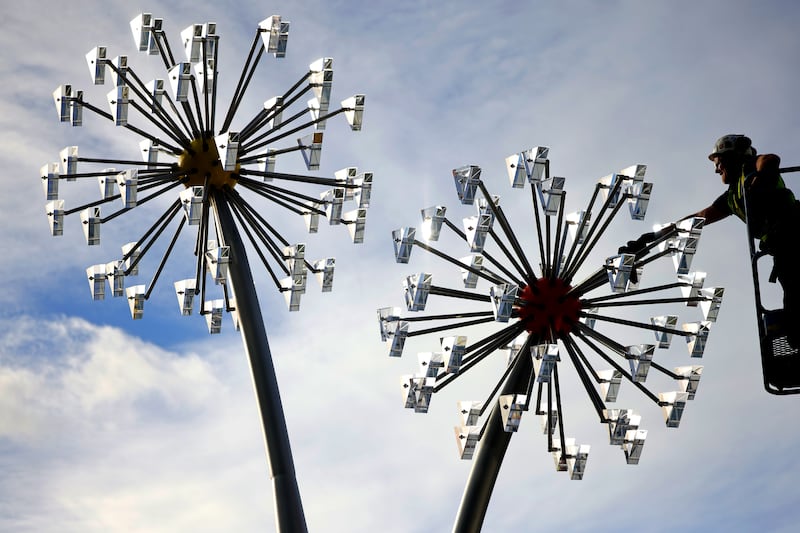 The finishing touches are made on the Dandelion Clocks sculptures by artist Remco de Fouw at the new national children’s hospital in Dublin. Photograph: Chris Maddaloni
As an addendum, Overheard was curious about whether the national children’s hospital, which is set to cost more than €1.43 billion, according to the latest estimates, will have to buy a Picasso to fulfil its art obligations.
Not the case, it turns out: there’s a €500,000 limit, no matter how big the project, and Remco de Fouw’s Dandelion Clocks already stand at the entrance, providing at least some public amenity from the monumental project in 2026.
All aboard
Readers seeking to bolster their income at a time of global instability will be cheered to hear that several State boards are hiring members to help steward their oversight of various matters.
For high flyers, the Dublin Airport Authority, which insists the all-lower case pseudo-acronym “daa” is its actual name, will stump up €15,750 a year (plus travel and subsistence expenses) for eight board meetings and potentially some subcommittees, amounting to 25 to 30 days of work per year.
For the more grounded, Córas Iompair Éireann, which goes by the actual acronym CIÉ, are offering the same amount for seven board meetings and possibly slightly more subcommittee activity, also coming to 25 to 30 days per year.
[ Directors cite ‘reputational risk’ as main deterrent to sitting on State boardsOpens in new window ]
The Valuation Tribunal, which unfashionably lacks both Gaeilge and acronym and decides how much properties are worth for rates purposes, wants an experienced barrister or quantity surveyor to show up 48 days a year, on a flexible schedule, to decide appeals. Like any work carried out by a barrister, the fees are complicated and difficult to estimate exactly, but it’s €650 for a day of cogitation and €1,500 for drafting a complex judgment, so we assume it adds up.
The most fascinating part-time gig on the market at the moment, however, is the role of ordinary member of the board of Rásaíocht Con Éireann, the greyhound racing board, which offers €8,100 for 11 half-day board meetings and some subcommittee days.
What’s interesting is not the money, though. Eligible candidates must be experienced vets, and it’s desirable that they have “knowledge of doping and medication controls in the industry”.
The Government allocated €19.8 million to the greyhound racing industry in the most recent budget, an example of statutory funding it has received since 2001. Good to keep things clean.
Meals in space
A late-breaking Irish connection to the Artemis II mission was unearthed by The Kerryman this week in the form of Michael Slintak, a Florida chef dubbed “the Artemis II chef” in its headline.
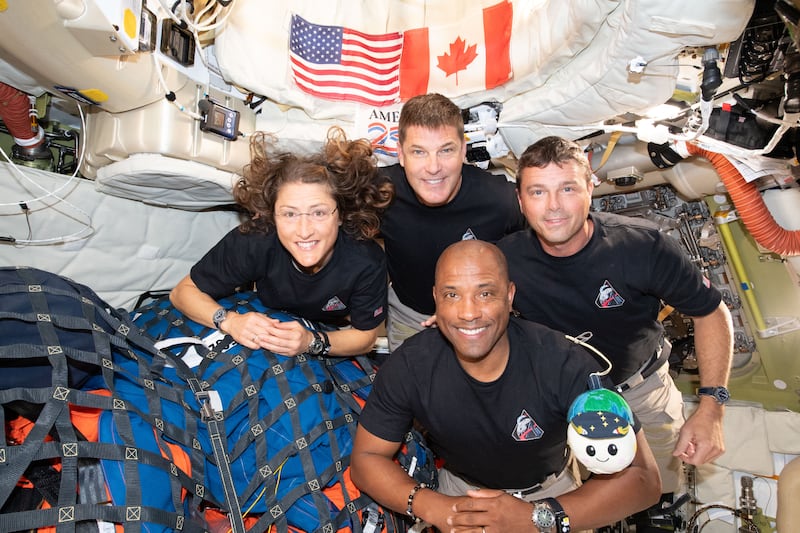 The crew of the Artemis II mission, clockwise from left: Christina Koch, Jeremy Hansen, Reid Wiseman and Victor Glover. Photograph: Nasa via New York Times
Slintak himself did not slingshot around the moon as part of the crew of four. But he is, we are informed, a subcontractor who provides meals to Nasa as part of his job. As a result, he feeds hungry astronauts before they launch forth out of the stratosphere with only space rations for sustenance in the zero-gravity environment.
The Irish connection? He loves visiting Kerry. “His first cousin, Sherry, was the late wife of the owner of O’Connor’s Guesthouse in Cloghane near Brandon, Micheál O’Dowd, and he has been visiting Kerry since back in the ‘90s,” The Kerryman tells us. He tries to come every second summer.
[ Fawning focus on the Artemis II mission reveals a disturbing arroganceOpens in new window ]
This unexpected Irish angle adds to the nation’s space roll of honour alongside the distantly Cork-rooted Michael Collins, who kept an eye on Apollo 13 while Neil Armstrong took one small step for man, and Cady Coleman, another Irish American who brought Matt Molloy’s E-flat flute to the International Space Station in 2010.
Norah Patten, from Ballina, Co Mayo, could be about to pip the lot of them, however: she’s due in space in 2026 as part of a research mission with the International Institute for Astronautical Sciences.