
As the world celebrates the successful Artemis II mission, Simon Driver is contemplating whether or not to fly to Europe to discuss a $600 million telescope and Australia’s position in a new era of space exploration.
At the same time Artemis II launched shortly before Easter, the Australian government announced it would not renew a 10-year strategic partnership nor pursue a partnership with the European Southern Observatory (ESO) after the current agreement wraps up next year.
Professor Driver, an astronomer at the University of Western Australia, said Australia had been near the front of the line for lucrative contracts to build instruments for the ESO.
“Now I’m wondering whether I still get on that plane.”
Axing of the partnership means Australian astronomers, like Professor Driver, will have limited access to ESO’s powerful optical telescopes in Chile for research and no local equivalent to fall back on.
Australian engineering teams will also be unable to bid for contracts to build the next generation of ESO equipment.
Astronomers are calling the decision short-sighted, warning it could affect the development of “world-first” communications technology like that tested on the Artemis II mission, as well as hinder Australian innovation in realms far beyond the booming international space industry.
“No doubt that we will lose some of our top engineers and some of our brightest young minds because of this,” Professor Driver said.ESO’s powerful eyes to the universe
The ESO is an astronomy organisation with 16 current member states, all European countries.
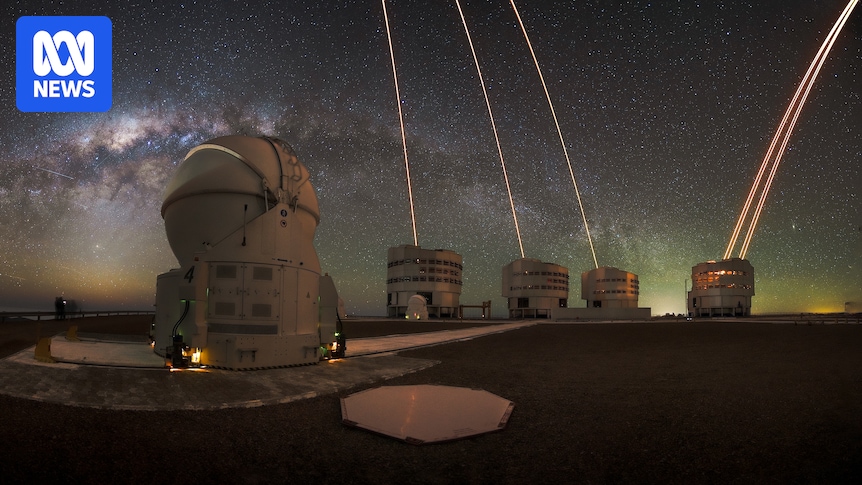
It pools resources from these countries to build some of the world’s most powerful telescopes, including the operational Very Large Telescope and under construction Extremely Large Telescope.
These telescopes are based in Chile, where they take advantage of high Andean altitudes and low light pollution to get clear views of the night sky.
The telescope pushing the limits of engineering
Virginia Kilborn, chief scientist at Swinburne University of Technology, said Australia’s wide and flat geography made it unable to host similar optical telescopes.
Australia entered a 10-year strategic partnership with ESO in 2017, which allowed greater access to ESO’s telescopes and the ability to bid for instrument contracts.
The partnership, which cost the government $130 million, opened the path for full membership in the ESO at its conclusion.
But the cost of full membership would likely run to more than $500 million over a decade.
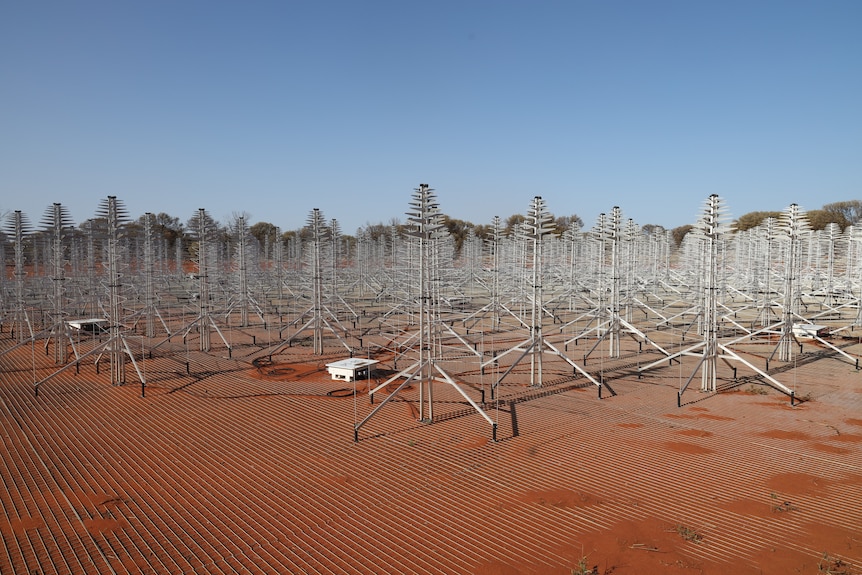
While Australia hosts powerful radio telescopes like the SKA-Low, researchers say large optical telescopes with mirrors aren’t feasible here. (ABC News: Tom Hartley)
Professor Kilborn, who led the development of a decadal plan for astronomy published last year, said the end of the partnership would limit Australians’ access to these telescopes.
“It’s not what we would have hoped for and what we recommended in our decadal plan,” she said.
“I understand that there’s priorities within government, but it seems like a missed opportunity.”
Risking technical breakthroughs
With the loss of the ability to bid for ESO contracts, there are now fears of an engineering brain drain from Australia after years of creating a local industry.
“We’ve built up around 100 or more engineers in Australia working on astronomy projects, and multiple companies that have spun out from astronomy opportunities,” Professor Kilborn said.
Without ongoing contracts, Professor Driver feared Australian instrument building groups would become unsustainable.
“The obvious thing is that the brightest people in those groups will see the writing on the wall,” he said.
“Especially the younger ones, they’ll move to instrument building groups in Europe and we’ll lose that competitive edge.”
This could mean we miss out on more than just innovations that support telescopes, Professor Driver said.
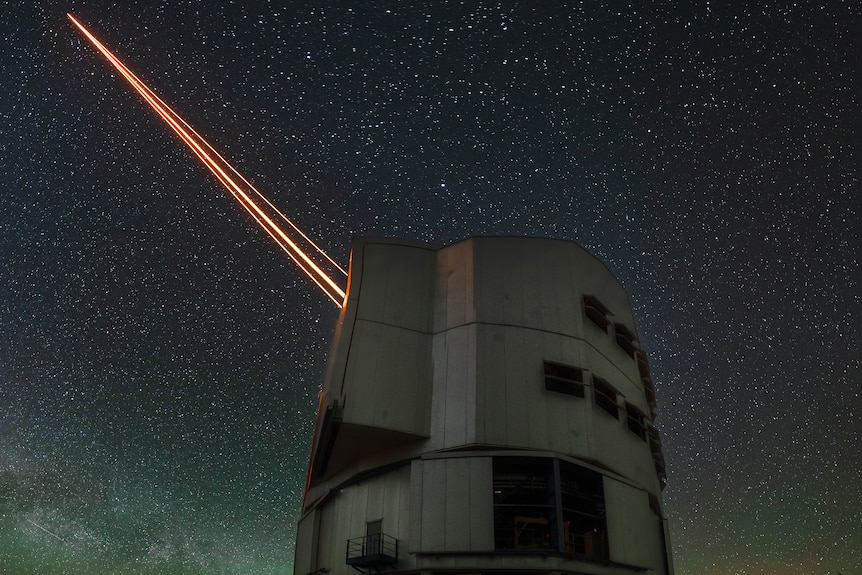
Australian engineers are currently creating a highly complex instrument called MAVIS, which will be installed on the VLT. (Supplied: ESO/A. Trigo)
Wi-fi was originally spun out of Australian radio astronomy research, and newer astronomy work has also helped to develop better communications systems, particularly between satellites and Earth.
“An awful lot of what’s going on is trying to work out how we can look through the atmosphere, which distorts our images, and how we can correct for that. That’s one of the areas that we’re experts in,” Professor Driver said.
Matthew Colless, an astronomer at the Australian National University, pointed out this technical expertise has been used to support the Artemis II mission around the Moon.
“One of the few international engagements outside North America on the Artemis mission is the quantum optical ground station here at Mount Stromlo,” Professor Colless said.
The station uses lasers rather than radio to communicate with objects in space, which allows much more information to be transmitted.
Australia aids Artemis II as NASA returns to the Moon
This could dramatically reduce the cost of satellite missions, because spacecraft wouldn’t need to carry expensive equipment to process the data they’re collecting.
“You can dump everything that the spacecraft learns back to Earth and put the expensive computing power on Earth,” Professor Colless said.
“It’s a really valuable example of something that comes out of astronomy, which is going to have huge commercial implications.”
A workforce that feeds STEM areas
Without the demand for skilled astronomy graduates, other sectors in Australia’s innovation economy may suffer.
“Around half of our PhD students go on to highly skilled jobs in other fields,” Professor Kilborn said.
She said many of them ended up in data science and the expanding AI and machine learning sector.
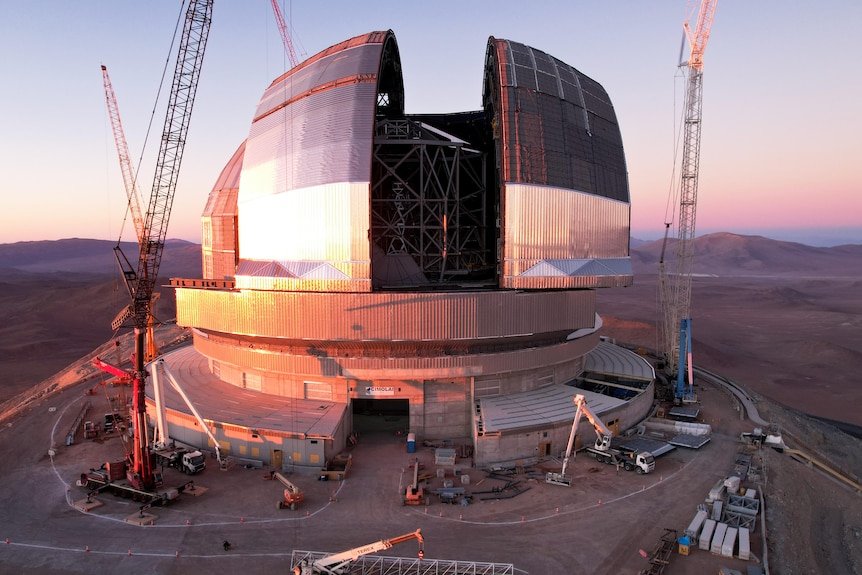
Once completed, which is scheduled to happen in 2030, the Extremely Large Telescope will be the world’s biggest visible and infrared telescope. (Supplied: ESO/G. Vecchia)
Professor Colless added that graduates from Stromlo now worked at the Civil Aviation Authority, in hydrological modelling on the Murray-Darling Basin Authority, and the finance and banking sector.
“There are many different ways to train people usefully. Astronomy is a good one because we deal in both hard science and in big datasets,” he said.
“We work with complicated equipment, we work with high powered computing, we train people to deal with things where they don’t have control.”
Richard McDermid, an astronomer at Macquarie University and director of Australian Astronomical Optics, said astronomy was a powerful attractor for prospective STEM students.
“Astronomy has a special place in society. I think we’ve seen that in the past week with engagement around the Artemis mission,” Professor McDermid said.
“Astronomy is a great science to bring young people into STEM-based careers — whether they go on to do astronomy is not important.”
Looking for other telescopes
Emily Wisnioski, an astronomer at ANU, said there were other partnerships that could be pursued in lieu of ESO membership.
She suggested partnering with the USA or Japan, which have their own large telescope projects.
“We really just need to see that signal from the government that they want to keep Australian astronomy alive.”
But Professor Colless said that ESO membership, while expensive, was still the best value for money.
“All the plan Bs that we have been looking at are both less good in absolute terms and less good in terms of value for money per dollar spent,” he said.
“One of the sad things is that the government announced this decision without having a plan B ready.
“In fact, they’re not even guaranteeing there is a plan B.”
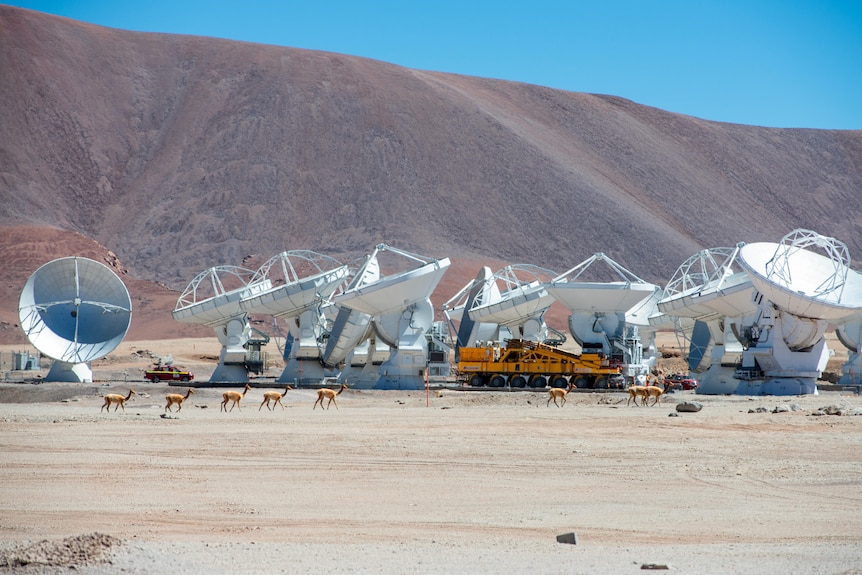
Chile has the high altitudes and clear skies necessary to host large optical telescopes, including the Atacama Large Millimetre/submillimetre Array (ALMA) in which ESO is a partner. (Supplied: S. Otarola/ESO)
A spokesperson for Tim Ayres, the federal minister for science, acknowledged the decision to abandon ESO membership would be “difficult to hear for researchers, scientists and engineers who may be impacted”.
“The Australian government is focused on making sure every dollar of research and development investment delivers maximum possible value for Australians,” the spokesperson said.
“That means prioritising investments that generate new opportunities for the research sector as a whole.”
The spokesperson highlighted treaty negotiations with the EU’s Horizon Europe program in particular as a future opportunity.
But Dr Wisnioski said access to the Horizon Europe was not the same as having access to infrastructure for research.
“To really reach back in time to look at the earliest parts of the universe, or try to find planets with the right signatures for life — that requires mega-facilities that take a long time to build,” she said.
“You can’t just join them at the last minute and expect to do the frontline science unless you’re a partner from the start.”