
Goldman Sachs has reported its best quarterly results in five years, with high market volatility stemming from the Middle East conflict pushing profits up 19 per cent.
Net first-quarter profits at the US investment bank jumped to $5.63 billion, with net revenue rising to $17.23 billion, 14 per cent higher than the first quarter of 2025 and 28 per cent up on the fourth quarter.
Goldman Sachs traders generated a record $5.33 billion of revenue as they benefited from volatility fuelled by the Iran war. Sales at the division responsible for trading equities for institutional and corporate clients leapt by 27 per cent year-on-year, beating a previous quarterly record of $4.31 billion achieved in the final three months of 2025.
Trading activities have been powered by artificial intelligence developments sparking a sell-off in software stocks and the Iran war leading to volatility in the price of oil and commodities, as well as the stocks exposed to those assets.
An improvement in initial public offerings (IPOs) lifted investment banking fees by 48 per cent year-on-year to $2.84 billion. The bank is advising on Unilever’s planned merger of its food business with McCormick, the US spice maker, to create a $65 billion company, and on Equitable’s proposed tie-up with Corebridge to form a $22 billion insurer.
Goldman Sachs is also advising on listing plans for Kraken Technologies, spun out of Britain’s Octopus Energy after a deal to sell a stake in the platform valued it at $8.65 billion, and Discord, the US gaming chat platform.
Net revenues in asset and wealth management at the bank were $4.08 billion, 10 per cent higher than the first quarter of 2025, with higher management and other fees. Assets under management rose to $3.7 trillion, from $3.6 trillion at the end of last year.
However, net revenues in fixed income, currency and commodities dropped 10 per cent to $4.01 billion compared with the first quarter last year, missing analysts’ expectations for an increase of 10 per cent.
Goldman Sachs shares closed down $17.17, or 1.9 per cent, at $890.63 in New York on Monday night.
Business newsletter
The business editor’s exclusive analysis of all the latest financial and economic news.
Sign up with one click
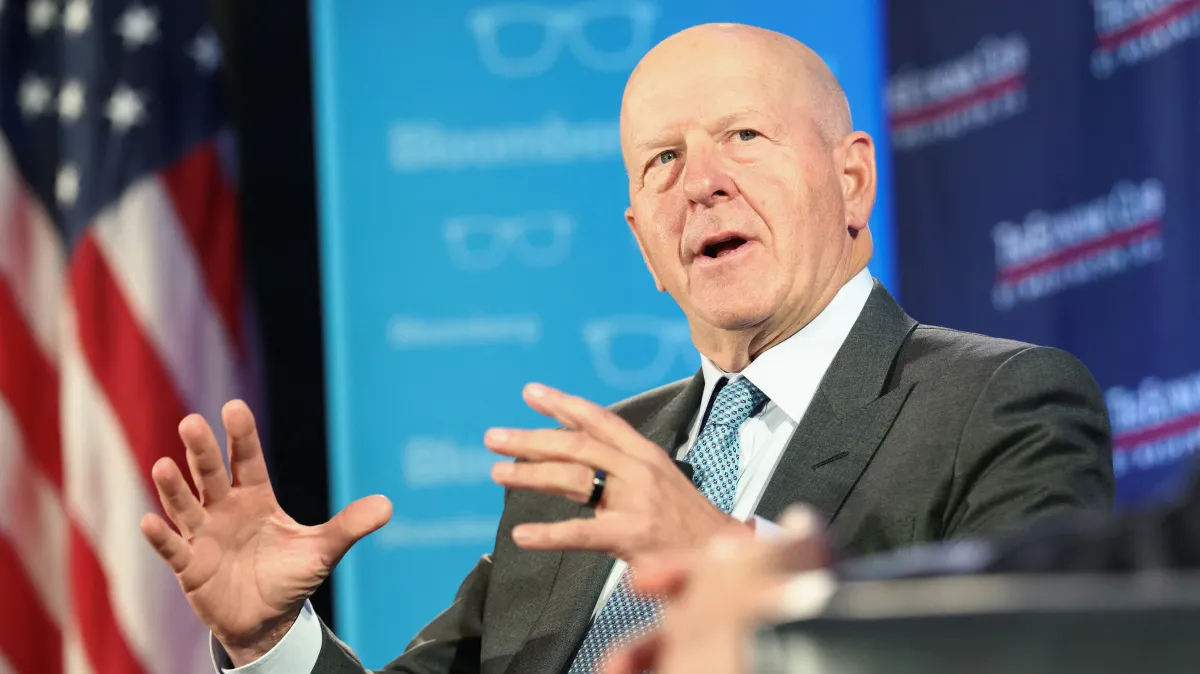
David Solomon, chief executive, said: “The level of uncertainty is higher; we have to watch that carefully. Certainly, talking actively to CEOs, they are looking carefully at what is going on, particularly with commodity prices, and if that is translating into the economy and into consumer demand.
“It’s fair to say that people did not see that really translating through in the first quarter, but that doesn’t mean people aren’t extremely cautious about whether or not it will translate through in the second quarter. My guess is that, to the degree that energy prices remain high, you will see that translate through a little bit. But at this point, the underlying economy still remains relatively robust.”
He added: “But if the resolution of the conflict drags, that will probably be a headwind in some of these areas, particularly inflation trends, as we get into the second and third quarter.”
The IPO market has been hit by renewed uncertainty fuelled by geopolitical tensions that have hurt risk appetite in equities. Some companies, however, especially those in industrials and defence, have pressed ahead with their listing plans.
Goldman Sachs has secured a spot as one of the lead banks managing SpaceX’s blockbuster IPO, expected in June. The Elon Musk-led firm could raise $75 billion at a valuation of $1.75 trillion. The listing is expected to set the stage for a flurry of bumper offerings this year, including the potential IPOs of the tech firms OpenAI and Anthropic.