
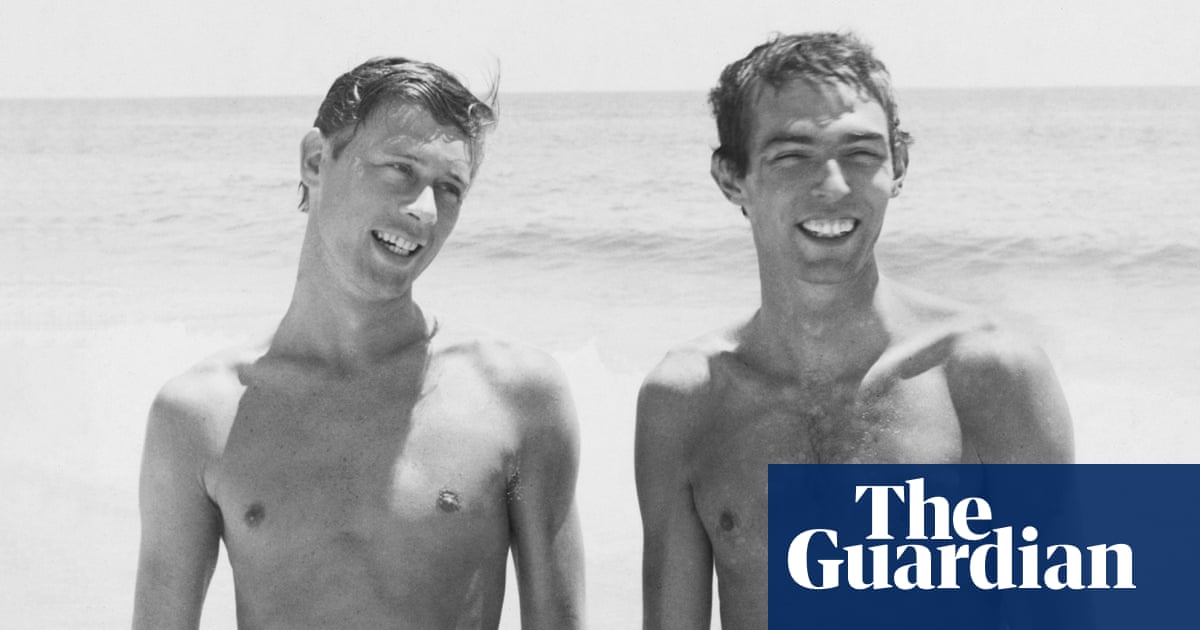
Andrew Durbin, author and editor-in-chief of Frieze Magazine, spent almost five years writing The Wonderful World That Almost Was. This dual biography of photographer Peter Hujar and sculptor Paul Thek, two gay artists who made extraordinary work in the years before and during Aids, focuses on their friendship, creativity and collaboration spanning more than 30 years. They died within a year of each other, in 1987 and 1988, both from complications from Aids.
The work and lives of Thek and Hujar have come storming back into the cultural conversation in recent years. Hujar was played by Ben Whishaw in Ira Sachs’s poetic 2025 film, Peter Hujar’s Day, and his images have been used as cover art for an Anohni and the Johnsons album and Hanya Yanagihara’s bestseller A Little Life. Thek’s equivalent moment has been slower; his most important works were large-scale installations in Europe, all lost, and which, as Durbin tells me, “everyone loved, but few could experience. And when they were finished, there wasn’t much left to sell. But I think his moment is about to come.”
When I meet Durbin in Berlin in late March, he says he hasn’t slept much in the lead-up to the book’s release. After we chat, he’ll speak at local gallery Gropius Bau, where an exhibit of Peter Hujar’s photography is running through 28 June. This is the first stop of his book tour, and he seems relieved to finally be talking about it. “I wanted to show that they truly lived,” he says of Hujar and Thek. “They accomplished so much, even as they were dying.”
The Wonderful World That Almost Was is an important piece of literary recovery in queer art. To write it, Durbin had to race against the clock: many sources passed during the book’s completion, including the executors of Thek’s and Hujar’s estates.
Among the many cruelties of Aids was the second erasure: families claiming their sons died of another illness, stripping their queerness from the record. The collections of many artists – even ones celebrated in their time – were scattered and lost. Such a fate might have happened to Hujar and Thek, too, if not for the people Durbin interviewed. His book extends that work, capturing the intimacy of a groundbreaking couple in 20th-century art.
“The lives of the artists who died of Aids have often been read backwards, through the lens of the disease,” Durbin writes in the book’s introduction. “They are seen as tragic, twilight figures.” Working against that, the book centers their lives from 1954 to 1975, with their deaths in the epilogue. The result is a love story that feels messy and real.
The cover of The Wonderful World That Almost Was: A Life of Peter Hujar and Paul Thek. Photograph: Farrar, Straus and Giroux
Hujar first photographed Thek in Coral Gables, Florida, in about 1956 or 57, when they were in their early 20s. By 1960, they were neighbors on the Lower East Side of Manhattan, and in love. When I ask Durbin about Thek’s legendary magnetism (Tennessee Williams and Gore Vidal were among those who fell for him), he says: “Paul was like a child. He was excited about the world. He was funny, he was playful, he made you laugh. He made you want to take care of him.”
A postcard sent to Hujar from Fire Island: a crowded beach with a single figure circled by Thek’s pen. On the back is written: “A photograph of happy persons, except me, I am seen looking everywhere for you.”
While on holiday in Sicily in 1963, they descended into Palermo’s Capuchin Catacombs, where photography was forbidden. Hujar, with his camera, ignored the rule. Paul reached into one glass coffin and picked up what he thought was a piece of paper. It was a bit of dried human thigh. “I felt strangely relieved and free,” he later said in a 1966 interview for Artnews. “It delighted me that bodies could be used to decorate a room, like flowers.” Hujar’s catacomb photographs would become Portraits in Life and Death (1976), the only book he published in his lifetime.
For Thek, the afternoon seeded his “meat pieces”: eerie sculptures of wax flesh in glass-and-metal cases that evoked Christian reliquaries. These made him, almost overnight, the art world’s unsettling new star.
Both men resisted being fixed in place. Thek often destroyed his work, intentionally misdating paintings and building fragile, ephemeral installations that left no saleable object behind. Hujar “didn’t want to be known as just a gay photographer”, Durbin tells me. Even as he tackled explicitly gay subjects like “the cruising grounds of the West Side, the parks at night, lovers, drag queens, out-and-open friends and artists”, Durbin writes, Hujar felt that “laying claim to homosexuality meant binning your work in a subcategory most museums and serious critics would not touch”. When he did photograph male nudes, including a series of erotic images of David Wojnarowicz, he released them under an anagram of his name, Jute Harper, part of his longtime search for a good alias. Even so, his camera kept returning to iconic queer subjects like Candy Darling, Susan Sontag, Fran Lebowitz, Wojnarowicz, Jackie Curtis and John Waters.
Peter Hujar, Candy Darling on Her Deathbed, from 1973. Photograph: The Peter Hujar Archive/VG Bild-Kunst, Bonn 2026
In August 1975, Thek sat for what would be his last photo sessions with Hujar. Their relationship had been fracturing. “There isn’t a single moment when it began,” Durbin tells me of their falling out. “It’s a spectrum of experiences. A book can’t capture that.” The sessions resulted in some of Hujar’s greatest portraits. “In the second session,” Durbin writes, “Paul’s face wheels through all his feelings for Peter – his love, his envy, his dismissal, his misunderstandings, his wanting to forget, his wanting to forgive.”
The last letter Thek wrote to Hujar is full of ideas and suggested photographs for Portraits in Life and Death, then in progress: “A bush, a door, a gate, a road, a tunnel, pearls.” He writes as if they are at the beginning of something, not the end. The last line: “Any time you want to make love,” he said, “just ask me.”
For queer readers who came after Aids killed a generation and buried how those men loved, worked and made things, The Wonderful World That Almost Was offers something rare: proof. “I would love for them to read this,” Durbin says of younger readers, “and realise they can make art however they want.”
“It’s less possible now to have the careers Peter and Paul had,” Durbin acknowledges. “Few can live in [New York’s East] Village now and be a photographer. The urban bohemia is gone. But some have living memory of it, and it is an acute, painful loss. We want a world where Candy Darling and Jackie Curtis are our neighbors. This is the New York we want and miss. We want those bars where really cool people sit and drink beer.”
Linda Rosenkrantz, now 91 and one of the last surviving members of Hujar’s inner circle, says that Durbin’s book shines new light on the photographer’s private life: “I don’t think I realized how major the relationship [with Thek] was in Peter’s life,” she writes. “I suppose it was obscured even by me until Andrew [Durbin] explored it so fully.”
That reckoning is now at full speed: in New York there’s a Moma screening series running this month, Durbin’s own exhibition opens this week at Ortuzar Projects while Galerie Buchholz opens a Thek show on 13 May with a major exhibition also planned at the Watermill Center later this year. “This is a big success in terms of an estate and legacy,” says Noah Khoshbin, president of the Paul Thek Foundation. “This is an artist who did not have a single work in an American institution when he died.”
In 1975, Thek wrote to Hujar: “ … all we wanted to do, want to do, is also add our names, almost like the lists of names on the tombs for the unknown millions, soldiers, etc, we’d wanted to say I WAS HERE TOO!”
The spirit of The Wonderful World That Almost Was is a loud call for these artists to receive the recognition they deserved. “I will love these artists until I die,” Durbin tells me. “And I’m sure I’ll be talking about Peter Hujar and Paul Thek for the rest of my life.”
The Wonderful World That Almost Was by Andrew Durbin will be published by Farrar, Straus and Giroux on 14 April in the US and Australia and by Granta on 23 April in the UK. Peter Hujar/Liz Deschenes: Persistence of Vision is showing at Gropius Bau, Berlin, until 23 August