
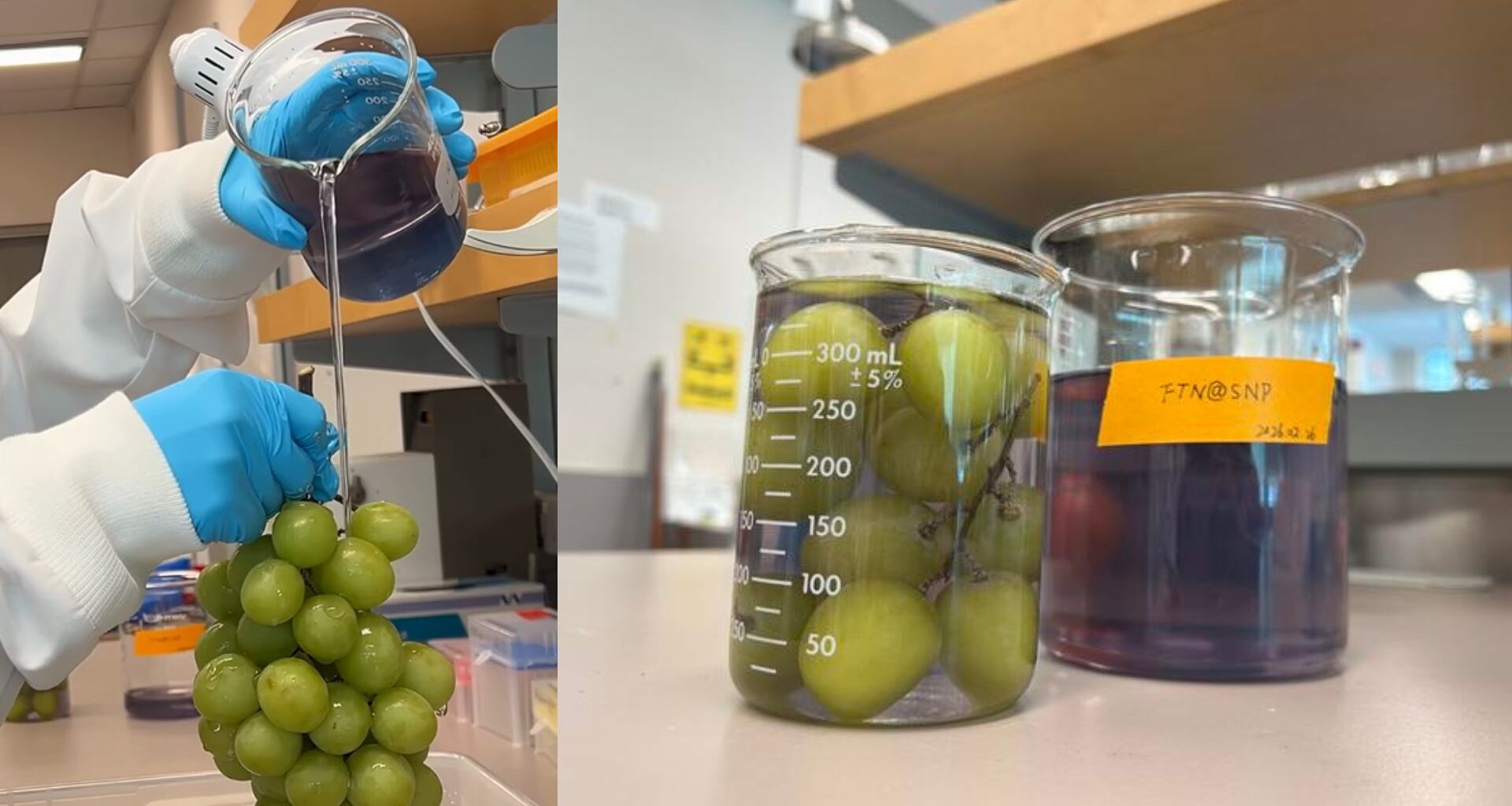
A team of engineers in Canada has developed a biodegradable fruit wash that tackles two persistent problems at once – pesticide residue and food spoilage.
The solution removes most surface chemicals and helps fruit stay fresh for longer, offering a potential win for both food safety and household budgets in the United States.
The research shows the wash removed more than 86 percent of pesticide residue in lab tests.
It also slowed browning and moisture loss, extending the shelf life of treated fruit.
“Our goal was to create a simple, safe and affordable wash that improves both food safety and food quality,” said senior author Dr. Tianxi Yang, an assistant professor in UBC’s faculty of land and food systems.
“People shouldn’t have to choose between eating fresh produce and worrying about what’s on it.”
Even after rinsing, fruits and vegetables often carry trace pesticide residues.
Regulators limit these levels, but repeated exposure remains a concern for frequent consumers.
That concern drove the research. Dr. Yang began exploring alternatives after noticing her son’s preference for large portions of fresh berries.
The team designed the wash using starch-based particles from crops like corn and potatoes.
They combined these with iron and tannic acid, a compound commonly found in tea and wine.
This combination creates sticky, sponge-like structures. These structures bind to pesticide molecules and pull them off the fruit surface.
Researchers tested the solution on apples coated with three common pesticides at real-world levels.
The wash removed between 86 and 94 percent of residues.
Standard methods like tap water, baking soda, or plain starch removed far less.
Coating locks in freshness
The process includes a second step that forms a thin, edible coating on the fruit.
This layer works as a breathable barrier.
It slows down oxidation and reduces water loss while allowing the fruit to respire naturally.
Fresh-cut apples treated with the coating showed slower browning over two days in the refrigerator.
Grapes stayed firm and plump for up to 15 days at room temperature. Untreated grapes shriveled much earlier.
“The coating acts like a breathable second skin. Measures of food quality like acidity and soluble sugars also remained higher in coated fruit,” said Dr. Yang.
The coating also showed antimicrobial effects, helping limit the growth of harmful bacteria.
Researchers found that the process introduces only small amounts of iron.
These levels remain well within daily intake limits set by North American health authorities.
“Beyond safety and shelf life, our formulation uses micronutrients like iron and phenolic compounds that offer additional health benefits,” said Dr. Yang.
“It doesn’t just reduce risk—it can also add nutritional value.”
Scaling beyond the lab
The team designed the solution for real-world use.
The ingredients are low-cost and mix easily in water, making the process suitable for commercial food systems.
Early estimates put the cost at about three cents per apple.
That matches existing commercial coatings while adding pesticide removal.
Researchers are now refining the formula for large-scale processing.
They are also testing how it performs across different fruits and handling conditions.
The team sees potential for a home version as well.
“Imagine a spray or tablet you could add to water right before washing your fruit,” said Dr. Yang.
Further testing and regulatory approval will be required before consumer rollout.
“Our hope,” said Dr. Yang, “is to help people feel confident about the produce they bring home—knowing it’s safer, lasts longer and creates less waste.”