
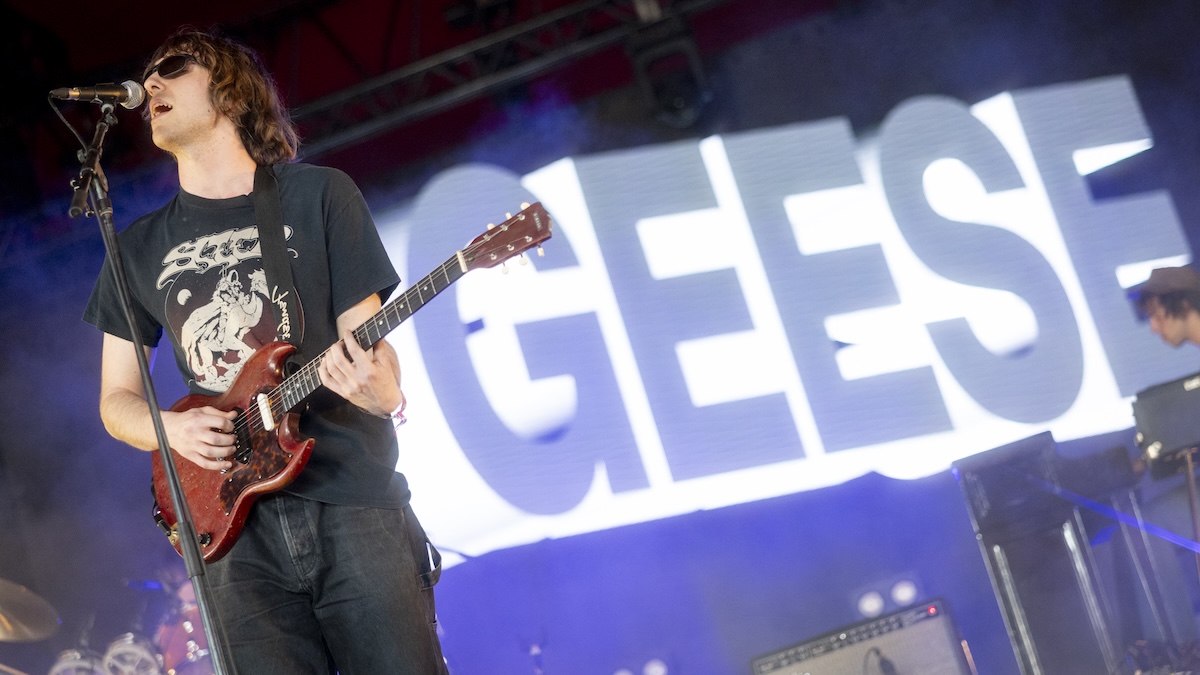
I am calling for a ban on the terms “psy-op,” “industry plant,” and while we’re at it, “Geese,” at least until we can figure out what the hell is wrong with music fans.
The latest deranged discourse comes courtesy of a new article in Wired, “The Fanfare Around Geese Actually Was a Psy-Op.” The article accurately describes a bunch of industry practices — and to be clear, these practices won’t be a surprise to anyone paying attention — but under a misleading headline. As an editor myself, I know that writers don’t get to choose their headlines, and that editors, charged with keeping the lights on in an unbelievably bleak media landscape, will sometimes opt for the strongest version of the headline they can justify. But this isn’t justified. What the article describes is not a psy-op, but a marketing budget.
Granted, the way artists and labels use marketing budgets might seem out of pocket if you haven’t updated your priors since the heyday of glossy magazines. So what did Geese do? The simple answer is that they tried to reach more listeners. The longer answer involves platforms, algorithms, and the games they demand we play.
Related Video
Geese hired a group called Chaotic Good, which specializes in playing those games. According to co-founder Adam Tarsia, the firm’s work with Geese and frontman Cameron Winter mostly consisted of distributing performance clips and interview footage across TikTok. Chaotic Good operates networks of social media accounts, seeds content into algorithmic recommendation flows, and — in the parlance of their own co-founder — engages in “trend simulation.” The goal is to push artist content high enough in the algorithmic rankings that real humans discover it. In other words: marketing. On a platform that has made marketing feel like committing a crime, mostly because the platform itself already feels like one.
I want to concede something up front, because I think it matters: trend simulation is a depressing phrase. A firm with “thousands of pages” manufacturing the appearance of grassroots enthusiasm so that a genuinely good band can get heard, that’s grim. I’m not going to pretend it isn’t. But grim and fraudulent are different things, and the entire discourse around Geese has been an exercise in confusing the two.
As I’ve written about before, TikTok is a genuinely shitty music discovery platform. Its algorithm privileges easily digestible emotional hooks over quality, reportedly penalizes creators it deems insufficiently attractive, and long ago completed the enshittification cycle: courting creators with growth, then rug-pulling them in favor of TikTok Shop and whatever dropshipped phone case is trending this week. The platform occasionally surfaces a deep cut from the ’90s underground, but the selection process has roughly the same curatorial rigor as a slot machine. When Universal Music Group temporarily pulled its catalog from TikTok, listeners on other platforms actually streamed more new music, not less. TikTok doesn’t open doors for artists so much as it installs a revolving one that flings most of them back into the parking lot.
Does hiring a firm like Chaotic Good make the problem worse? Probably. Every band that pays to game the algorithm makes organic discovery a little harder for the band that can’t. But blaming Geese for hiring a TikTok marketing firm is like blaming a cereal brand for paying for shelf space at eye level. Every supermarket charges for placement, and it means the brand with less money ends up on the bottom shelf. That’s a legitimate problem, but the answer is to fix how shelves work, not to accuse Cheerios of fraud.
So when a band hires a firm to get their actual performances in front of actual eyeballs — on a platform that would otherwise rather show you a man pressure-washing a driveway — that’s not a psy-op. Now let’s talk about what actual fraud looks like, because it’s out there, and it looks nothing like this.
In 2024, a North Carolina musician named Michael Smith was indicted for a streaming fraud scheme that netted over $10 million in royalties. Smith used AI to generate hundreds of thousands of fake songs with names like “Zymoplastic,” attributed to artists called “Calm Baseball” and “Camel Edible,” which, I’ll admit, would make a solid Coachella undercard. He uploaded these to Spotify, Apple Music, and Amazon Music, then deployed thousands of bot accounts to stream them billions of times, using VPNs to mask the traffic’s origins. He pled guilty earlier this year. That’s fraud. Fabricated music, fabricated listeners, fabricated geography, real money siphoned out of a royalty pool that belongs to actual musicians.
Then there’s Drake, who has been named in multiple lawsuits alleging that a significant chunk of his approximately 37 billion Spotify streams were driven by bot networks. One suit alleges he funneled money through an online gambling platform to bankroll the operation. Drake, for his part, had previously accused Universal Music Group of using bots to inflate Kendrick Lamar’s streams — a case that was dismissed, making him the only man alive who has managed to be the accuser, the accused, and the cautionary tale in the same genre of lawsuit. The irony would be poetic if it weren’t so expensive for every smaller artist whose royalties get diluted each time a fake account presses play.
That’s stream manipulation. Billions of fake plays. AI slop songs. VPN-masked bot farms in Turkey. RICO allegations. Criminal indictments.
Or you want to talk about industry plants? Look up the term in the dictionary and you’ll see Katy Perry at the 2024 MTV Video Music Awards. Poorly received singles, awkward press from working with Dr. Luke, zero organic buzz, and a whole award show devoted to her anyway. An industry plant is someone receiving above-and-beyond label support despite mediocrity — propped up not because the work connects, but because the infrastructure has already been built and someone needs to justify the spend. Perry got a lifetime achievement tribute nobody asked for.