
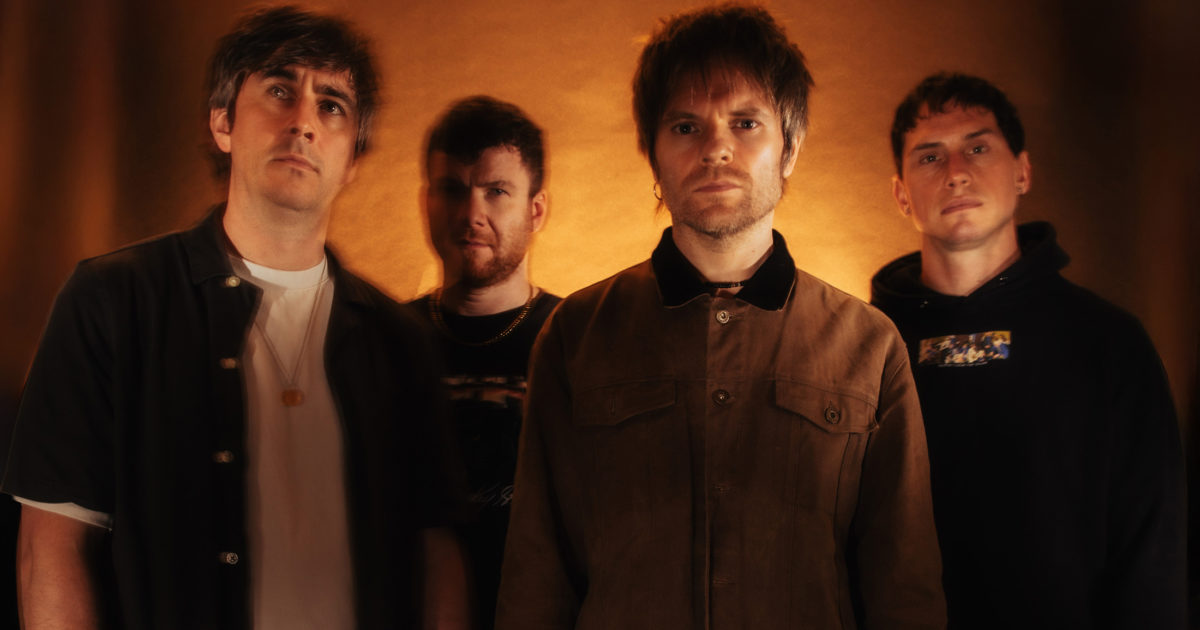
That progressive, ambitious, interstellar sound of Enter Shikari comes to a grand crescendo in the trifecta of movements that close the album, harnessing Rou’s love of classical music, under the umbrella of Spaceship Earth. A term coined by British economist Barbara Ward in her 1966 book of the same name, it’s a thought experiment that positions the planet as a spaceship with finite resources, forcing the crew (humanity) to think differently about consumption and production.
“You start to think about things in a kind of rational way,” Rou picks up. “Like, how much fuel do we have in this spaceship? Where are we heading? What are the protocols? Is everyone chipping in to keep this spaceship a safe place? There’s the vacuum of space out there, we need to be prudent and frugal.
“I think it’s a beautiful thing to explore creatively. From Spaceship Earth (I. Avec Abandon) I’m acting as this character who is welcoming people aboard and has his foot on the pedal to the metal, this joyride through space, which is what it feels like we’re doing at the moment. And then as we go on to other movements, we put forward different perspectives.”
But what is the conclusion of the experiment? Rou admits that the last verse of Spaceship Earth (III. Maestoso) “is probably the most trite I’ve allowed our lyrics to be”, as it closes with the yearning, ‘Hold on, hold on, a change is going to come…’
Change, of course, can come in many forms. So what specifically does Rou want to see?
“Everything. Everything. Absolutely everything,” he says bluntly. “It’s hard to think of things that don’t need to be updated or need complete overhauls at the moment. You speak to any person in any industry or walk of life and they’ll gladly sit you down and speak about all the problems in their area, but as I’ve always said, usually you follow those problems to their core and there lies the problem – which is the structure. The idea that we must exploit each other and the natural world, and that is the natural order of things, when it is absolutely false.”
Even if the message is a trite one, however, at least the prospect of change offers hope. And sometimes hope is all we have.
“You have to hold onto it. If you don’t have hope you’re not going to act. It’s the structural foundation that every kind of progress builds from.”