
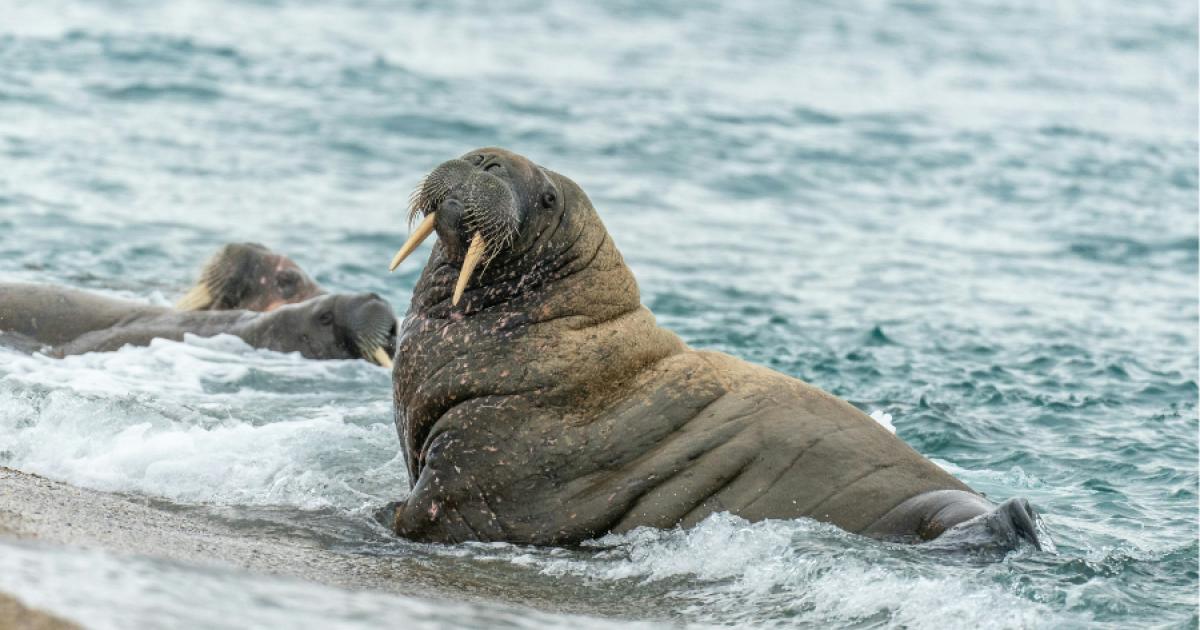
A walrus has caused quite the stir amongst locals after it appeared on the shore of Stronsay, known as Orkney’s Island of Bays, on Thursday in what experts have described as “something quite special”.
The last walrus to visit Orkney was in March 2018, when an animal briefly stopped at North Ronaldsay before making its way to Sanday, according to the Orkney Marine Mammal Research Initiative (OMMRI).
The charity said the walrus’s visit had caused “considerable excitement” among local schoolchildren and anyone else lucky enough to be in the right place. The last sighting prior to 2018 was back in 2013, also in North Ronaldsay.
READ MORE: UK Government responds to SNP vow to introduce price cap on essential food items
The OMMRI said in a statement that a cordon has been put in place around the animal as it appears to be wounded and that the British Divers Marine Life Rescue has been contacted for further guidance.
The charity added that despite some “concerns” being raised by locals about the walrus’s welfare, the organisation stressed that “in situations like this there is often little that can practically be done”.
“Nature generally takes its course and there are obviously difficulties in safely getting close to an animal of this size let alone treating it,” an OMMRI spokesperson said.
“What this does mean is that keeping your distance and allowing the animal to rest undisturbed is even more important than usual. Stress will not help its recovery.
“The best thing anyone can do for this walrus right now is leave it in peace.”
Walruses are specialist bottom feeders, diving to the seafloor to forage for benthic invertebrates.

Their primary diet is molluscs, which include clams, mussels and cockles, but they will also eat worms, gastropods, cephalopods, crustaceans and sea cucumbers and are able to locate their prey using their highly sensitive vibrissae, their whiskers, and extract the soft parts using powerful suction, essentially hoovering the flesh straight out of the shell.
A OMMRI spokesperson explained that although walruses are Arctic animals, native to the sea ice and subarctic waters of the northern hemisphere, individuals that turn up on Orkney’s shores are typically young roving animals.
They added that the adolescents may stray from their usual waters to possibly follow food or could be exploring, likely due to climate change.
“We’ve seen a handful of wandering walruses around northern Europe in recent years, and sightings do seem to be becoming less unusual, though whether that reflects a genuine increase or simply better recording is hard to say,” the OMMRI spokesperson added.
READ MORE: Bus fares across Scotland could be capped at £2 per journey, SNP manifesto says
“Closer to home, a walrus was recorded near Elie on the Fife coast in January this year, and just last month one was photographed resting on a beach on Iceland’s Reykjanes Peninsula.
“Today’s visitor in Stronsay suggests they may be on the move again.”
They added: “The best wildlife encounters always happen when the animal doesn’t know you’re there.
“Enjoy what is, let’s be honest, an extraordinary morning on Stronsay, and do it in a way that gives this animal the best possible chance of recovering and continuing its journey in good health.”
People have been urged to keep their distance from the walrus and strictly not to position themselves between the animal and the water.
They have also been asked to keep dogs on a lead, to keep well away from the animal and not to use drones.