
Senior ministers have described the current energy crisis as the worst the world has ever seen.
Experts say that depends on how it’s measured – with supply disruption at unprecedented levels, while prices and economic impacts have yet to surpass past shocks.
Speaking at the Easter Rising commemoration in Dublin on 5 April, Tánaiste Simon Harris said it was “hard to overstate the significance of the energy crisis that we’re living through now, which is the worst the world has ever seen.”
Four days later, Minister for Agriculture Martin Heydon told RTÉ’s Morning Ireland that the situation was “the biggest energy shock there has been in the history of the world”.
The comments come amid rising fuel prices, disruption to global supply routes, and protests in Ireland that temporarily affected access to fuel infrastructure.
The comments echo those of the International Energy Agency’s Executive Director, Dr Fatih Birol, who has described the current crisis as “the greatest threat to global energy security in history.”
But what does that actually mean?
To understand how the current crisis compares with previous global shocks, RTÉ Clarity examined available data and spoke to energy experts.
What’s driving the energy crisis?
There is no single way to define an ‘energy crisis.’
Assessing such crises involves multiple factors, including supply disruption, price increases and economic impact.
The current crisis has been driven by escalating conflict in the Middle East, where disruption to energy infrastructure and key shipping routes – particularly the Strait of Hormuz – has put pressure on global supply.
The Strait of Hormuz is a narrow chokepoint through which a significant share of the world’s oil passes.
The conflict has caused significant casualties, with most deaths reported in Iran, alongside smaller numbers in Israel and among US forces.
Thousands more have been injured, and key systems like power and oil infrastructure have been disrupted.
The International Energy Agency (IEA) has described the current situation as exceptional in scale.
Speaking in March, IEA Executive Director Fatih Birol said the disruption amounted to “two oil crises and one gas crisis” occurring simultaneously.
How does it compare historically?
In some respects, experts say the current crisis is unprecedented.
Prof Brian Ó Gallachóir, an energy systems expert at University College Cork (UCC) who advises on Irish and EU energy policy, said it represents the largest disruption to energy supply on record when measured by volume.
“It’s the worst in terms of the scale of disruption of supplies and that is why the IEA have characterised it in that way,” he said.

Prof. Brian Ó Gallachóir is Director of MaREI and Associate Vice-President of Sustainability at UCC
He pointed to the volume of oil and oil products affected by disruption in the Strait of Hormuz, estimated at around 20 million barrels per day, compared with roughly 4.5 million barrels per day during the 1970s oil crisis – a period that included the 1973 oil embargo and the 1979 disruption following the Iranian Revolution.
While that suggests the current shock is more than four times larger, today’s energy system is also far bigger in absolute terms.
Global oil demand has risen from roughly 50–60 million barrels per day in the 1970s to more than 100 million today, meaning disruptions now affect a much larger volume of supply.
“That is the biggest we’ve ever seen,” he said.
However, Prof Ó Gallachóir said this is only one way of measuring the severity of an energy crisis, with price shocks and economic impact also key factors that may emerge over time.
He noted that global energy systems have also changed significantly since earlier crises, with the introduction of strategic oil reserves helping to cushion the impact of supply disruptions.
“Member countries of the IEA sign up to having about 90 days’ supply of oil available to them in reserves and at different times when there’s a crisis the IEA would agree with member countries to release some of those strategic oil reserves into the market,” he said.
“This is to dampen any impacts of any restriction in production or any in this case restriction in supply, so it was a momentous decision by the IEA to release 400 million barrels of oil for this crisis disrupting the Strait of Hormuz.
“This is the largest amount of strategic oil reserves that have ever been released,” he added.
What do oil prices tell us?
Looking at energy prices provides a different perspective.
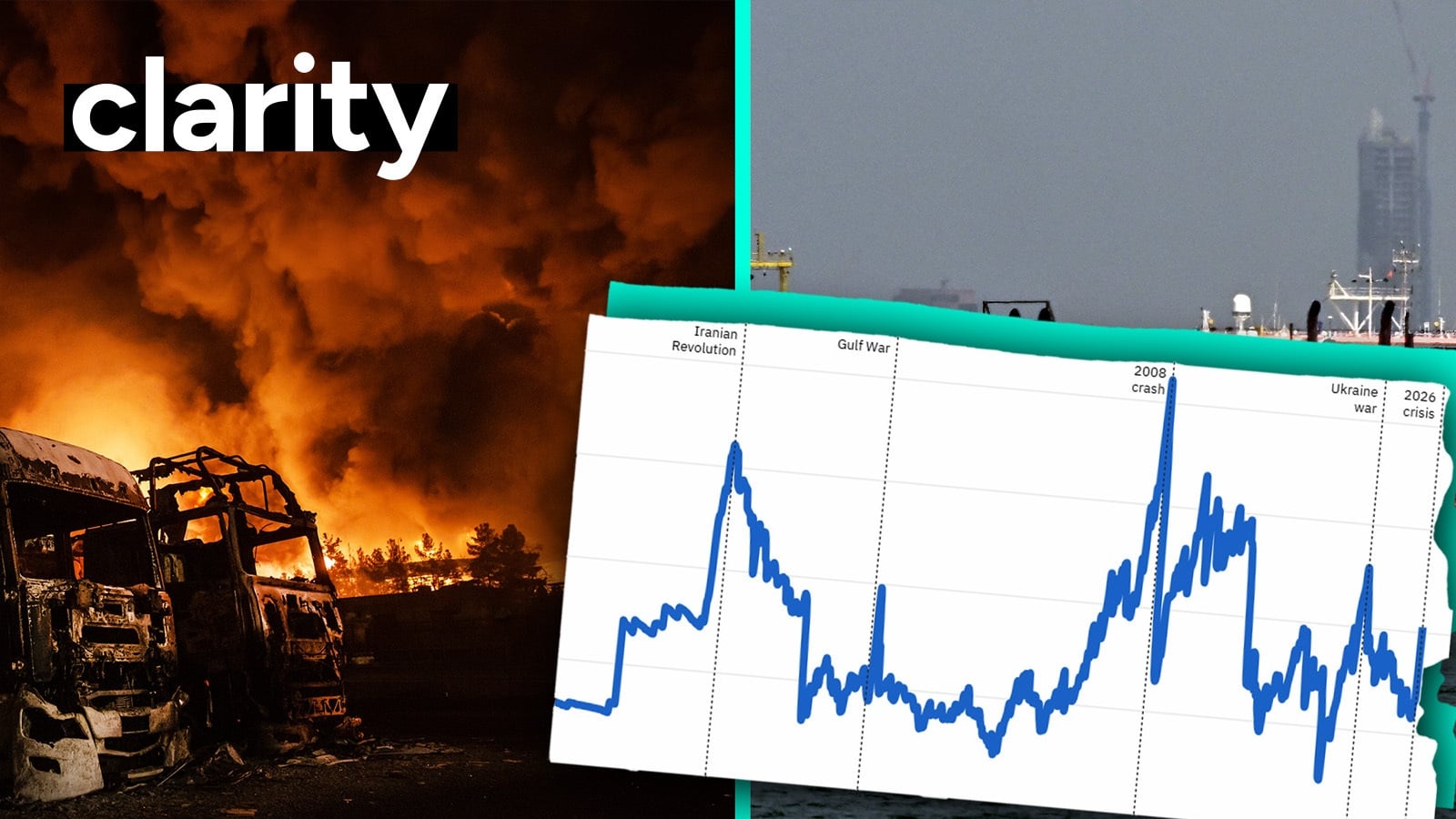
Analysis of Brent crude prices shows that while oil prices have risen sharply during the current crisis, similar – and in some cases higher – spikes occurred during earlier global shocks, particularly around the 2008 economic crash and following Russia’s invasion of Ukraine in 2022.
We need your consent to load this flourish contentWe use flourish to manage extra content that can set cookies on your device and collect data about your activity. Please review their details and accept them to load the content.Manage Preferences
Sean Casey, EY’s UK and Ireland energy and infrastructure lead and a former chief executive of Ervia which is now a part of Gas Networks Ireland, said the severity of the crisis depends on how it is assessed.
“It depends what lens you look at it through,” he said.
“In terms of prices, we’re seeing oil over $100 a barrel – that’s high, but it’s similar to what we saw in 2022.
“However, gas prices are not at the levels we saw then, when they increased by about ten times in 2022, we’re looking at maybe one or two times now.”

Sean Casey leads the Energy & Infrastructure practice of EY UK and Ireland
Mr Casey also noted that price increases have not yet fully fed through to consumers.
“We haven’t seen that effect flow through in terms of consumer prices yet,” he said.
This reflects a key difference between the current crisis and previous ones. While supply disruption is significant, the economic impact – particularly in terms of household energy costs – may take time to emerge.
That delay is partly due to how energy markets operate, with suppliers often hedging prices in advance.
Hedging is the practice of agreeing prices in advance to protect against sudden changes.
However, Mr Casey said the current situation is distinct in another way.
“What’s different is that this is multi-fuel and global,” he said.
“If you look back, the 1970s were oil shocks, in 2022 it was gas and what we have now is both.”
What does it mean for Ireland?
Both experts said Ireland remains particularly exposed to global energy shocks.
The country relies heavily on imported fossil fuels, leaving us vulnerable to international price movements.
Prof Ó Gallachóir said Ireland is largely insulated from physical supply shortages but not from price increases.
“So far, we’ve been sheltered from oil supply risks this time around, apart from the disruption from the fuel protests but the price effects are very significant here and we’re very exposed,” he said.
He noted that around 80% of Ireland’s energy is imported, primarily in the form of oil and gas.
Mr Casey gave a similar assessment, pointing out that Ireland imports more than 80% of its gas, which accounts for roughly half of electricity generation.
“As a country, we are at the end of a pipe when it comes to gas supply,” he said.
Both experts said the current crisis highlights the risks associated with that reliance and reinforces the long-term case for reducing dependence on fossil fuels through increased use of renewable energy and greater energy efficiency.
So, is this the “worst ever” energy shock the world has ever seen?
In terms of supply disruption, the current crisis appears to be the largest on record.
But other measures tell a different story. Price spikes and economic impacts do not clearly exceed those seen during earlier crises, particularly in 2008 and the 1970s.
However, experts say that could still change.
Prof Ó Gallachóir said that while the current crisis is already the largest in terms of disrupted supply, “it could also be the worst in terms of price effect,” noting that the full impact has yet to feed through due to delays in energy markets.
“It’s likely to get worse because the Strait of Hormuz still hasn’t reopened and it’s not clear when it will,” he said.
Much of the language around this being the ‘worst ever’ reflects how the crisis is being measured but if disruptions continue, the distinction between supply and price may not hold for long.