
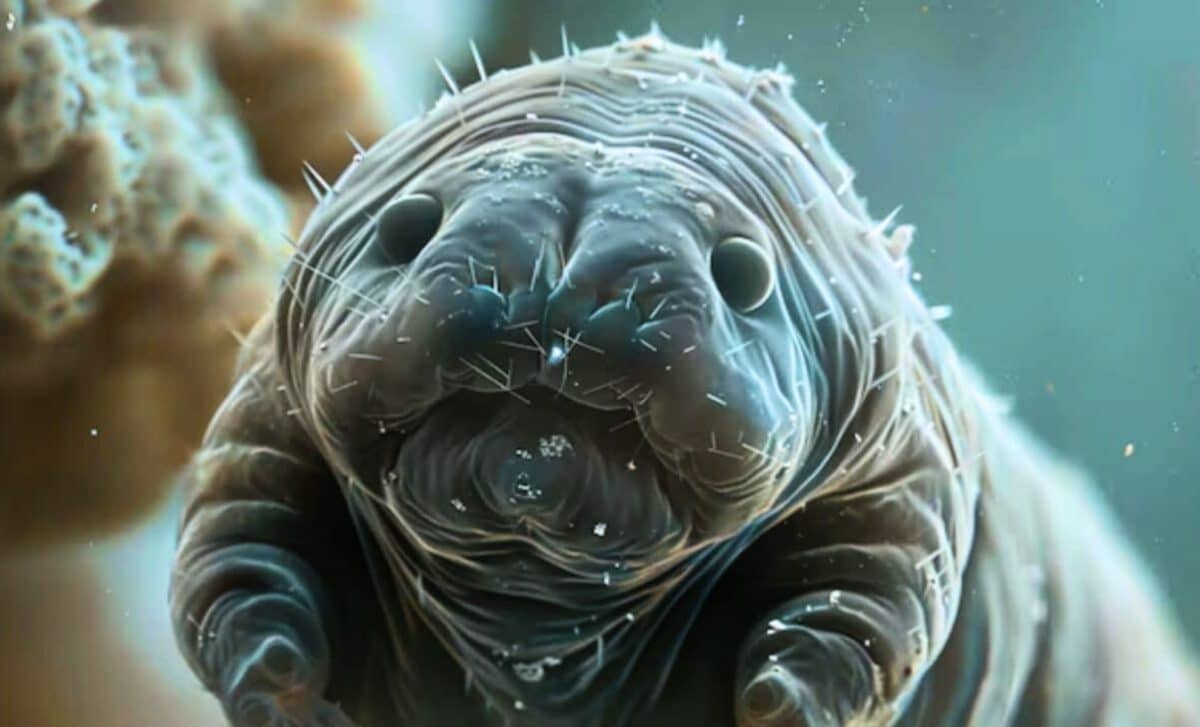
Forget the cockroach inheriting the Earth after a nuclear holocaust. When scientists at Oxford and Harvard universities set out to determine which creature would be the final holdout after a planet-sterilizing catastrophe, they bypassed urban pests entirely and focused on a microscopic, eight-legged animal that barely reaches half a millimeter in length. The tardigrade, also called the water bear, emerged as the definitive baseline for animal survival against the most violent forces the cosmos can unleash.
The research team, led by Dr. David Sloan and Dr. Rafael Alves Batista of the University of Oxford, published their analysis in the journal Scientific Reports. Their work calculated the precise astrophysical thresholds required to wipe out not just human civilization or surface ecosystems, but every last tardigrade on the planet. The conclusion was stark: the events capable of achieving complete sterilization of Earth remain so rare that the probability sits below one in ten million per billion years.
Why Ocean Boiling Became the Only Metric That Mattered
The study’s methodology abandoned the conventional focus on land-based extinction events. An asteroid impact that darkens the skies and collapses food chains would certainly end human life, but it would not touch the tardigrade populations living in deep-sea sediments. The researchers argued that to truly sterilize an Earth-like planet of its most resilient animals, you must eliminate the final refuge: the global ocean.
Tardigrades possess a near-legendary ability to enter cryptobiosis, a dormant state in which their metabolism slows to near zero. In this condition, the creatures can withstand temperatures as high as 150 degrees Celsius for minutes and endure decades frozen at minus 20 degrees Celsius. Radiation doses exceeding 5,000 Gy, instantly fatal to humans, leave them unharmed.
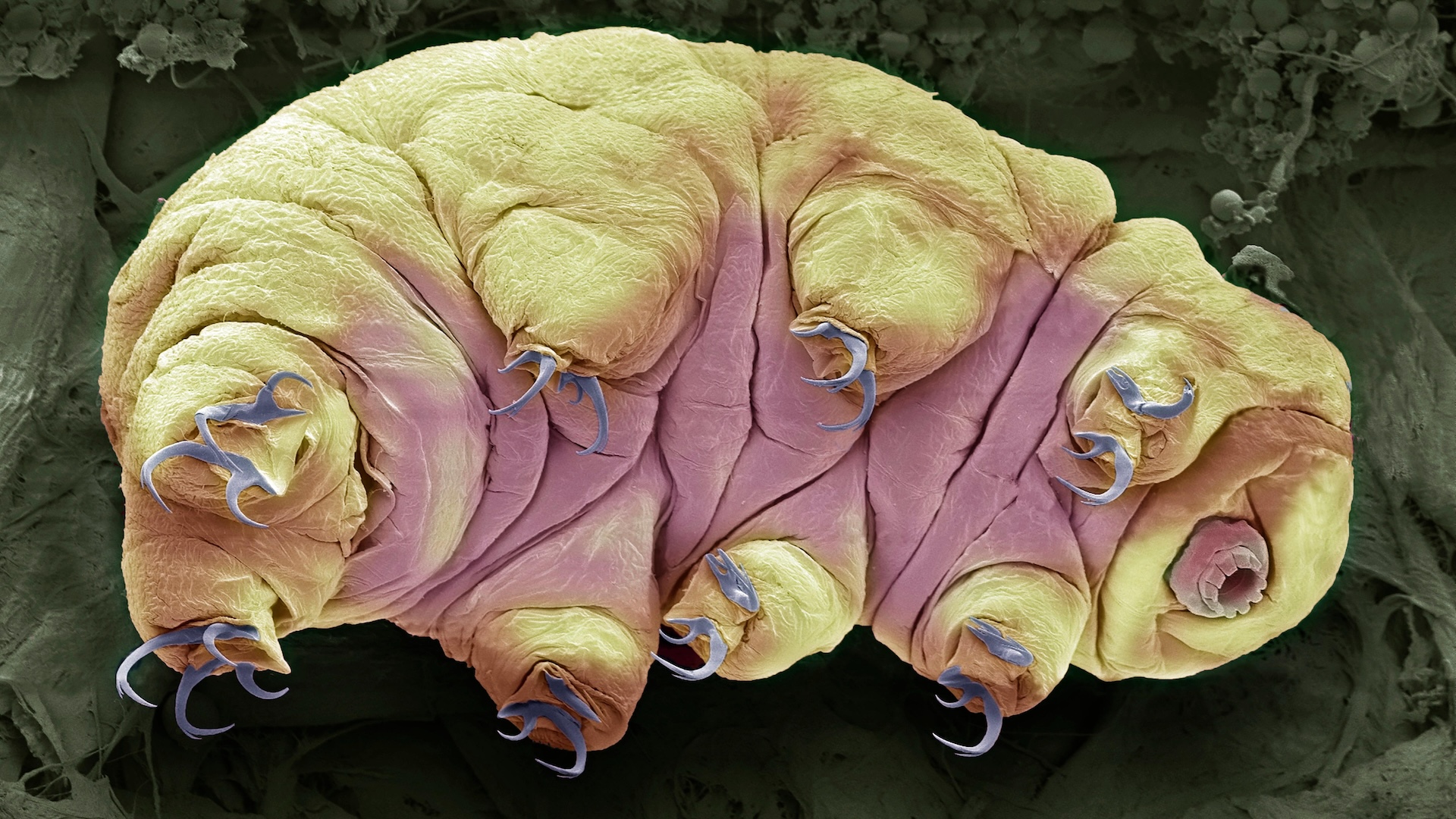 Tardigrades are creatures known for being able to withstand some of the most extreme conditions on Earth. Image Credit: Science Photo Library / Alamy Stock Photo
The ocean’s immense volume provides both thermal buffering and radiation shielding, meaning the energy required to kill a tardigrade at depth exceeds the energy required to boil the water above it. According to the original research published in Scientific Reports, the sterilization bar therefore became the total thermal energy needed to raise all of Earth’s oceans to boiling point.
The Asteroid Threat Requires a Mass Beyond All Reasonable Risk
Applying this ocean-boiling threshold to asteroid impacts produced numbers that dwarf the object responsible for the dinosaurs’ demise. The researchers calculated that an asteroid would need a mass of approximately 1.7 quintillion kilograms to deliver the thermal energy required to boil the oceans. This represents a different class of object entirely from the typical near-Earth threats tracked by planetary defense systems.
To put that figure in perspective, the study noted that only about a dozen known bodies in the entire solar system possess sufficient mass to theoretically meet this requirement. These include the asteroid Vesta and the dwarf planets Pluto and Eris. As reported by The Daily Galaxy in a 2026 summary of the findings, the research added a detail that severely constrains this scenario: none of these massive objects are on trajectories that intersect Earth’s orbit.
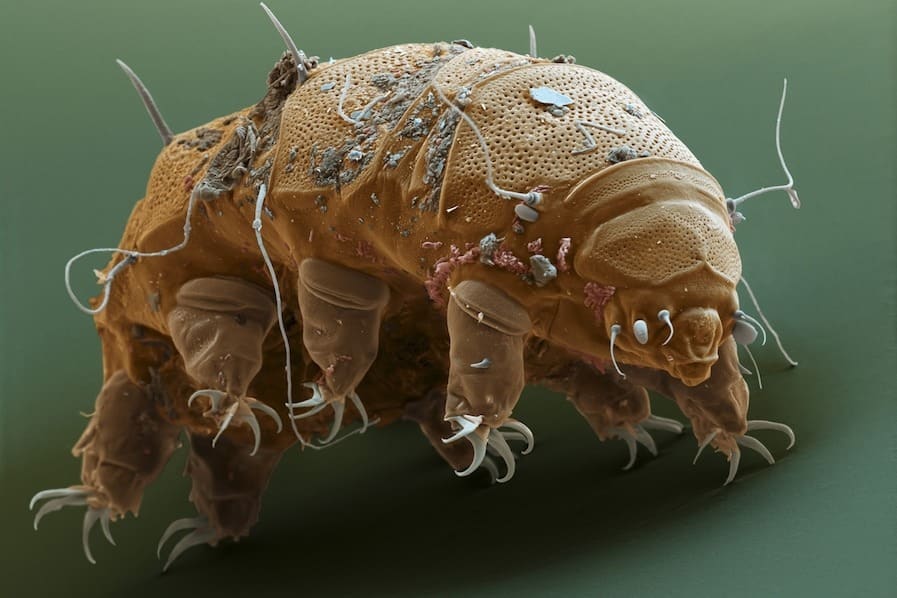 Around 1,300 species of tardigrades are found worldwide. Image Credit: Eye of Science
The rate of a sterilizing asteroid impact, based on extrapolated impact models, remains below one occurrence per hundred thousand billion years. Smaller but still devastating impacts would reset surface life while leaving deep-ocean refuges intact.
Supernovae and Gamma-Ray Bursts Face a Distance Problem
The same energy accounting applies to stellar explosions. The Oxford team determined that a supernova would need to occur within roughly 0.13 light-years of Earth to boil the oceans. This distance is astronomically small. The closest star system to Earth, Proxima Centauri, sits approximately four light-years away. None of the stars in the Alpha Centauri system are massive enough to go supernova, and the nearest potential candidate, the IK Pegasi system, lies 45 parsecs away, well outside the danger zone.
The researchers modeled the probability of a sterilizing supernova across different regions of the Milky Way. Even near the densely packed galactic center, where stellar traffic is thickest, the odds of a planet experiencing an ocean-boiling blast within a billion-year window hover around one percent. For gamma-ray bursts, which focus their energy into narrow jets, the probability dropped to roughly three in ten billion per billion years.
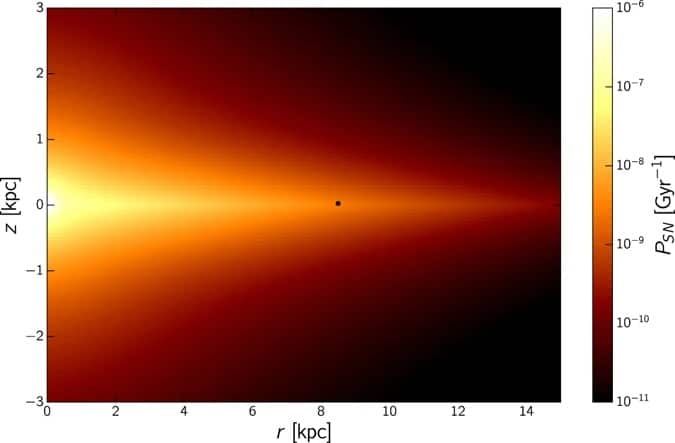 The expected number of supernovae within the sterilisation sphere of radius 0.04 pc per Gyr as a function of galactic position. The black circle indicates the position of the Solar System.
Alves Batista summarized the broader implication in the study: “Without our technology protecting us, humans are a very sensitive species. Subtle changes in our environment impact us dramatically. There are many more resilient species on earth. Life on this planet can continue long after humans are gone.”
The Fine Print on What Survival Actually Means
The Scientific Reports paper does contain important caveats that refine its conclusions. The analysis considered only direct effects such as the immediate boiling of ocean water from deposited energy. It does not fully model secondary climate feedback loops like a runaway greenhouse effect, which could potentially evaporate the oceans with a lower initial energy input. More significantly, the study’s definition of life is deliberately narrow. It uses tardigrades as a proxy for complex animal life, not for life itself.
As noted in public comments on the paper, prokaryotic organisms such as bacteria and archaea are far more resilient than tardigrades. Chemolithotrophic microbes living kilometers deep within the Earth’s crust would likely survive events that kill every animal on the planet.
Additionally, tardigrades require food. Even if individuals survive the initial catastrophe in a dormant state, the complete collapse of trophic relationships and the destruction of photosynthetic or chemosynthetic food webs could ultimately lead to their extinction. The study’s authors acknowledged this by focusing on the physical energy of sterilization rather than ecological continuity.
The rogue planet scenario presents another edge case. If a passing star ejected Earth from the solar system, life around deep-sea volcanic vents could theoretically persist for billions of years on internal heat, long after the surface froze solid. The researchers calculated the rate of such stellar disruptions at roughly three in a hundred million per billion years in our stellar neighborhood, an event so rare as to be negligible.