

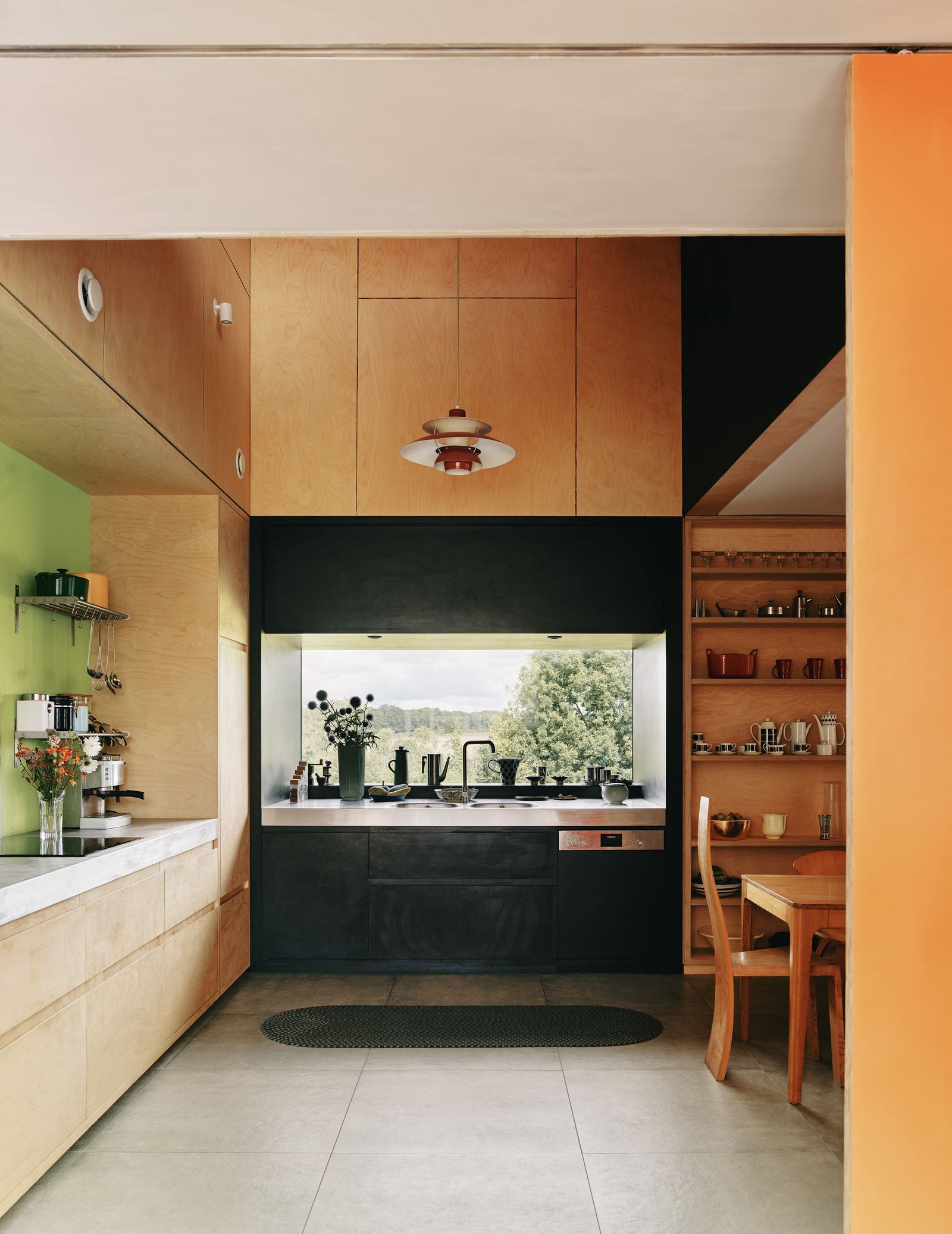
The birch ply and stainless steel kitchen in this newbuild house in Somerset embraces the industrial aesthetic and material-focused simplicity of the 1990s.
Michael Sinclair
Style director Ruth Sleightholme has also embraced this marked move to tempering decoration. ‘It’s a prompt to pull in simple design pieces to help achieve a balanced, sophisticated end result. It’s nice to have a flourish, a scallop, a wave but it had got to the point where unnecessary additions were disguising bad proportions.’ George Morgan’s debut furniture collection, which comprises 11 pieces, was a recent standout for Ruth and was created to a manifesto born from the wish to populate his projects with furniture that didn’t fight for attention. ‘There is a trend to make things which are whimsical or statementy,’ says George. ‘What I’ve created is an antidote to that. It’s about being well made, being quiet. I wanted my “Standard” chair to have not too much of an opinion.’ ‘He was very intentional about that,’ adds Ruth.
Tom Dixon, creative director at Habitat during the 1990s and responsible for introducing collaborations with Achille Castiglioni and Ingvar Kamprad, has always embraced harder materials such as cooper, steel and cast iron. He thinks it can be difficult to be radical in today’s environment with everything up on Pinterest but, in what he described as the ‘massive soup of possibilities’, the more you pick out a couple of extremities and use them together, the better the end result. ‘It’s not about being in the middle but using both extremes,’ he adds. ‘So if I’m working with a textile, it’s the fattest, thickest fabric for upholstery in really saturated colours.’
So what is it about the late 1990s that has been resonating in recent years? Richard Benson, editor of The Face between 1995 and 1998, thinks what people express in terms of admiration for that time is that there was a lack of self-consciousness, a ‘not overthinking’ of anything. ‘You can sense a lot of human connection in those pictures,’ he says of the many visual references provided by the era. Understandable given that, as Lucinda points out, you only had one shot at something: ‘There was no altering it in post-production.’ And naturally that always created ‘a kind of nervousness, a tenseness and sense of anticipation which was actually really fantastic’. Laura Craik, fashion editor at The Face in the 1990s (as well as the Guardian and Evening Standard) remembers that stylists and photographers could shoot what they wanted: ‘There was no edict from above, no having to shoot full designer looks from one brand, which can so often look sterile.’