

The Model, a Eurovision Song Contest prediction tool, continues to project Finland as the winner of Eurovision 2026 if the contest was held today.
After a week where the London Eurovision Party brought fans in the UK capital out to see many of this year’s acts perform, ‘Liekinheitin’ by Linda Lampenius and Pete Parkkonen has increased its lead, with The Model now forecasting it to score 397 points in the final in Vienna.
That gives Finland a 43 point lead over France, with Denmark rising back into third as Israel falls to fourth after changes to the way the country’s points are calculated.
This week’s update takes into account the London Eurovision Party, another pre-party I attended in person. I’ll bring you some of my thoughts on the performances I hadn’t seen in Amsterdam, as well as how some of the acts fared in the UK compared to the Netherlands.
Coming up in this update:
Which country has had the biggest crowd reaction at this year’s pre-parties?
Have the qualification races become easier to predict?
Why has there been less movement in The Model than in previous years?
What Is The Model?
The Model was built to answer a simple question: “if the Eurovision Song Contest was held today, who would win?” To do that, The Model turns opinion into data in the lead-up to the Contest to create weekly updates on how the race to Vienna is shaping up. The tool has frequently been more successful in predicting the Contest than betting odds, fan polls, or any other indicator.
This year, The Model is bigger than ever before, with new updates released every Monday (except this week, with LEP shifting it to Tuesday!) from now until Eurovision 2026 on the ESC Insight website, where the results will change and evolve as this year’s Contest comes closer.
A new companion podcast, ‘Inside The Model’, is also launching on the ESC Insight feed, providing weekly prediction updates, unique song analysis, and special guest appearances from the world of the Contest. This week, the show takes a short break, but there are plenty of episodes already out! You could listen to Krista Siegfrids chat about her favourites for the year, learn more about this year’s rule changes from ESC Insight’s Ben Robertson, or listen to an hour-long preview of Eurovision 2026 filmed in Amsterdam last week.
Under the Hood
The toughest thing to predict in the Eurovision Song Contest is what I call ‘non-musical factors’.
These are things that exist outside of the control of anyone involved in the entry. For example, the biggest differentiator between a song’s expectations and reality is the lead vocal. However, that’s in the gift of the lead singer to get right. Non-musical factors go far beyond the power of the act.
The biggest non-musical factor, especially today, is politically motivated voting. Two countries have been most affected by this: Ukraine, who have been in a state of war with Russia for four years now, and Israel, which has been in various active conflicts since 2023.
We know that those circumstances have affected the Eurovision performance of both countries. In 2022, less than three months after Russia’s invasion, Ukraine won the Eurovision Song Contest with a record-breaking televote score unlikely to be surpassed for decades. And, in the last two years, Israel’s televote totals have been similarly high. In fact, these factors affect jury voting as well, reducing votes for Israel in their case.
These performances have often defied the bookmakers, with public vote points coming in much higher than anticipated. Because of this, the way I model Ukraine and Israel is unique, and with far less data to go off. For Israel specifically, the voting phenomenon around them has only existed for two years, and the way both acts were treated by bookmakers was very different. This creates an unclear picture of future performance and means, in short, it’s much harder to gauge.
This week, I’ve made further tweaks to how The Model forecasts both countries’ entries against these non-musical factors. I’ve introduced a sliding-scale variable that tries to balance the expectations of bookmakers against how these countries often outperform them – the difference left should be attributable to ‘non-musical factors’.
For Israel in particular, this also affects jury voting, with a higher place in the odds being offset by a reduction in the jury voting the shorter the odds get. The reason I’ve created this is to try and accurately replicate the behaviour of juries around the previous two entries, while also taking their quality and competitive potential into account fairly.
It’s a tough balance to find and, honestly, quite difficult to land on. As a result, I’m letting you know honestly that those scores will fluctuate more than for other entries, and I can’t promise they’ll ever be right. With everything else, I’m confident in how those scores appear – with Ukraine and Israel, there are more factors at play than can be truly mapped.
And with that, this is what The Model forecasts would happen if the Eurovision Song Contest was held today, 21 April 2026.
Semi-Final One
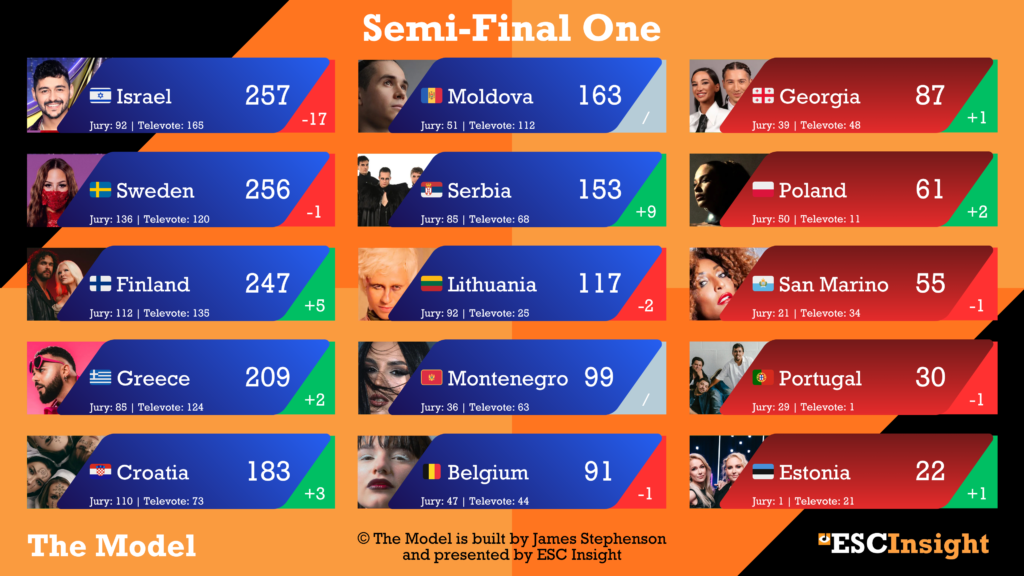
Semi-Final One from The Model – 21/04/2026 (James Stephenson)
Although we’ve had two pre-parties come and go, the surprise is that The Model’s projections haven’t changed that much in Semi-Final One. Bar a slight fall for Israel (explained above to some extent) and a healthy gain for Serbia’s ‘Kraj mene’, each country is only a handful of points away from where they were last week.
That means the ten qualifiers from this semi-final are the same, although the gaps between the major contenders and the countries seen as on the bubble are increasing. Belgium’s mark of 91 points is the lowest number a song has had which has made it through in any projection this season – and only four clear of Georgia.
At the London Eurovision Party, there was a chance to see many of these entries in action. The only entry I hadn’t seen live before was Estonia’s, and Vanilla Ninja’s rock-pop track ‘Too Epic to be True’ was perfectly fine to listen to, but didn’t get a rapturous response from the UK crowd. Sweden drew a big noise, with the harsh baseline of ‘My System’ getting a reaction, and favourites Finland also got a good response – better than in Amsterdam, I thought.
Another song which technically had a debut was San Marino. Boy George, who is controversially involved in the entry, came on stage to perform with Senhit while also following up with the ubiquitous ‘Karma Chameleon’. While he’s a genuinely big name who in theory adds star power to San Marino’s entry, the decidedly mixed response in the hall to his appearance shows to me that his involvement could have the opposite effect on their score.
The biggest reaction, though? Moldova could go big in Vienna. Satoshi is one of the most energetic performers in this line-up, and with him opening this semi-final, the sky feels like the limit. And while his song ‘Viva, Moldova!’ is modelled as one of the least jury-friendly songs in the field, it doesn’t feel like jurors will ignore it en masse. It’s a young, fresh song, and with younger jurors, could find support to become a genuine contender.
Semi-Final Two
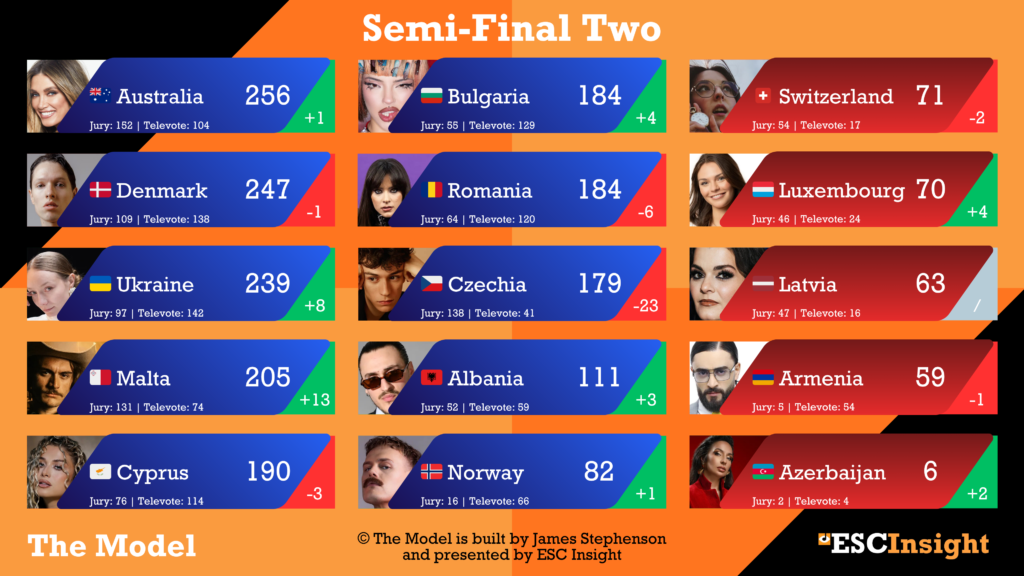
Semi-Final Two from The Model – 21/04/2026 (James Stephenson)
Onto Semi-Final Two, where the story is the same. Once again, it’s the same top ten songs making it to the Grand Final and, once again, the contenders’ points totals are beginning to edge further away.
Australia is still in pole position to win this semi-final, with ‘Eclipse’ increasing its lead with The Model by a hair, and Denmark and Ukraine seem to be in close pursuit. Ukraine won its semi-final in 2025 with ‘Bird of Pray’, and there’s every chance ‘Ridnym’ could do the same: for me, Leleka has one of the best vocals at this contest, and it wouldn’t be surprising to see her earn a lot of jury points in Vienna to go along with an expected high televote. She’s also the first guest on our Eurovision Uncovered Interviews this year.
There is more movement in this semi-final, though, with positions switching and shifting throughout the midfield. Malta and Czechia are two countries with jury-friendly ballads in ‘Bella’ and ‘Crossroads’, and they’ve found themselves dipping and diving around each other in each projection. This week, it’s Malta’s turn to rise by double digit points, while Czechia’s major increase last week almost entirely reverses – they’re down to eighth place. ‘Bangaranga’, which I saw for the first time in London, is also up by two places.
The race for the final spots has been tight every week, and that isn’t changing. Albania, though, appear to be getting free, with another increase for Alis taking him 40 points ahead of 11th place. Norway still holds tenth, with Jonas Lovv delivering an impressive live performance amidst the crowd on the floor – despite claiming that his voice was completely shot. Behind, Switzerland, Luxembourg, Latvia and Armenia are all definitely still in what could be a very tight race for that final position.
‘Alice’ by Veronica Fusaro also debuted live in London, and I thought it was a cool, relaxed performance with a great live vocal – there is definitely jury appeal for Switzerland. Beyond that, the most impressive responses in the venue were for Ukraine, Malta and Denmark, who all drew a lot of support. For me, though, I think Albania is delivering the best live – there is a huge drama and power to Alis’s performance that I think gives it a great chance of scoring high in May.
Grand Final
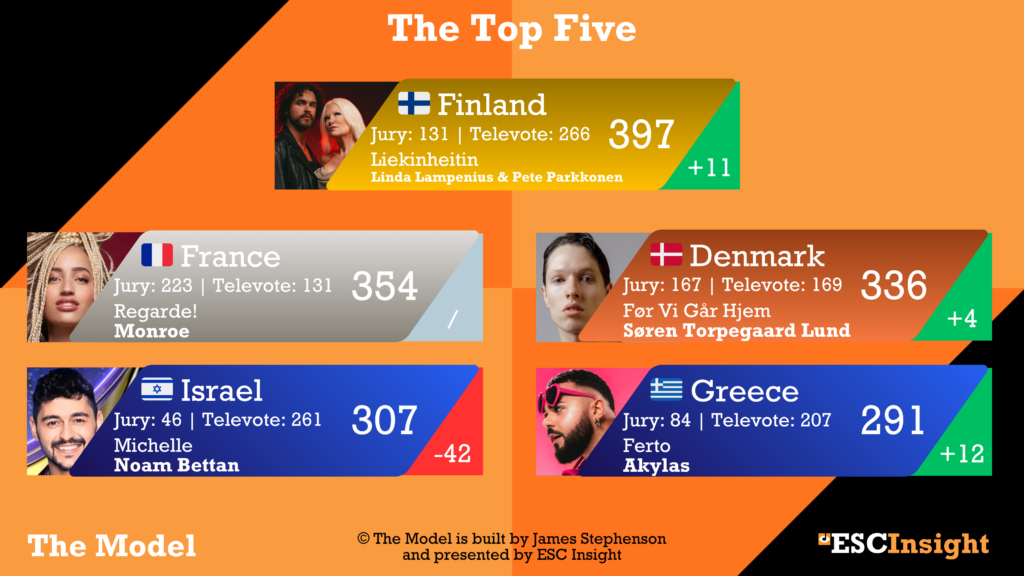
The Top Five from The Model – 21/04/26 (James Stephenson)
This week’s Top Five, then, returns to what we’ve had in previous updates thanks to Israel’s next re-model. The Model is now more confident about Finland than it has ever been: 397 points is the biggest projected total its had all season, and its 43 point lead over France is Finland’s biggest as well.
In my view, Finland’s performance went down better in London than Amsterdam, although it still didn’t bring the house down as I may have expected from a runaway favourite. But the data doesn’t lie – ‘Liekinheitin’ has had a commanding lead in the betting odds since Linda and Pete won UMK. Finland also has one of the highest percentages in the Eurovision World poll ever. Make no mistake, this is by all accounts a major fan favourite.
They benefit from Israel’s televote power being slightly reduced in this simulation, with Finland now projected to win the public vote by 5 points. Another beneficiary is Greece, which has kept its place in the top valiantly despite Australia breathing down its neck. Further down, Ukraine (also re-modelled), Sweden, Romania and Czechia make up the current top ten, but the point margins are so tight in the midfield that there’s no doubt this will all move about in Austria.
What’s been fascinating about going to the pre-parties through this lens is trying to match the data with what I see in front of me. And, in a few places, those things don’t feel connected. I mentioned Sal Da Vinci last week, and the point remains: ‘Per Sempre Si’ is drawing a huge reaction everywhere it goes, but the betting odds still don’t seem to be waking up to it. ‘Viva, Moldova!’ is going through the same kind of story.
Why is that? One reason could be a reduction in interest. While they don’t feature in The Model, streaming numbers for the Eurovision 2026 are notably down on previous years, and that lack of engagement may also be affecting the data. With less people potentially engaged, you get less diversity of thought – and, as a result, more locked in data that isn’t as dynamic in the lead-up to the Contest.
However, there is a simple solution for that, which is the Contest itself. Throughout these past few weeks, we’ve heard the songs at length and heard them live, but nothing replicates the performance when you see it. I often talk about the disconnect between what engaged fans see and what people who just watch Eurovision on a Saturday night see. They see that performance blind – that impression is what truly matters.
Once we see the staging, in the bright spotlights of the Wiener Stadthalle, we’ll see what this Eurovision Song Contest really looks like. And, when we do, you’ll see everyone adjust their expectations, and The Model will begin to hone in on this year’s result. For now, though, the lay of the land appears clear – and when it comes to this year, Finland is still the target everyone else is aiming for.
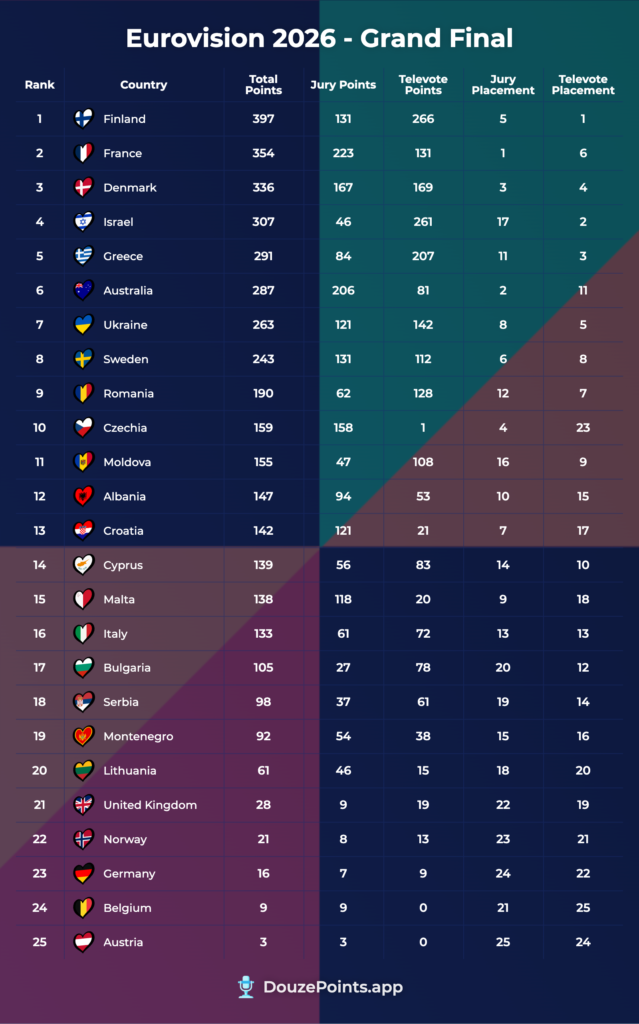
Full Split Results from The Model – 21/04/26 (James Stephenson / DouzePoints.app)
With The Model’s latest update, Finland remains in front – but that is set to keep changing. Next week, we’ll have our final update of April before the Eurovision calendar almost reaches game time. It’ll also be the final update before each of the 35 acts head to Austria to begin rehearsing for Eurovision 2026 – and we get more information about how each of the performances is shaping up.
Remember, The Model will make weekly projections from now until the contest, updating with new information throughout. If you don’t want to miss any regular weekly update, read The Model on ESC Insight every Monday from now until the Eurovision Song Contest 2026.
Finland’s in front – but could someone catch them next week? See you then for the next update from The Model.