
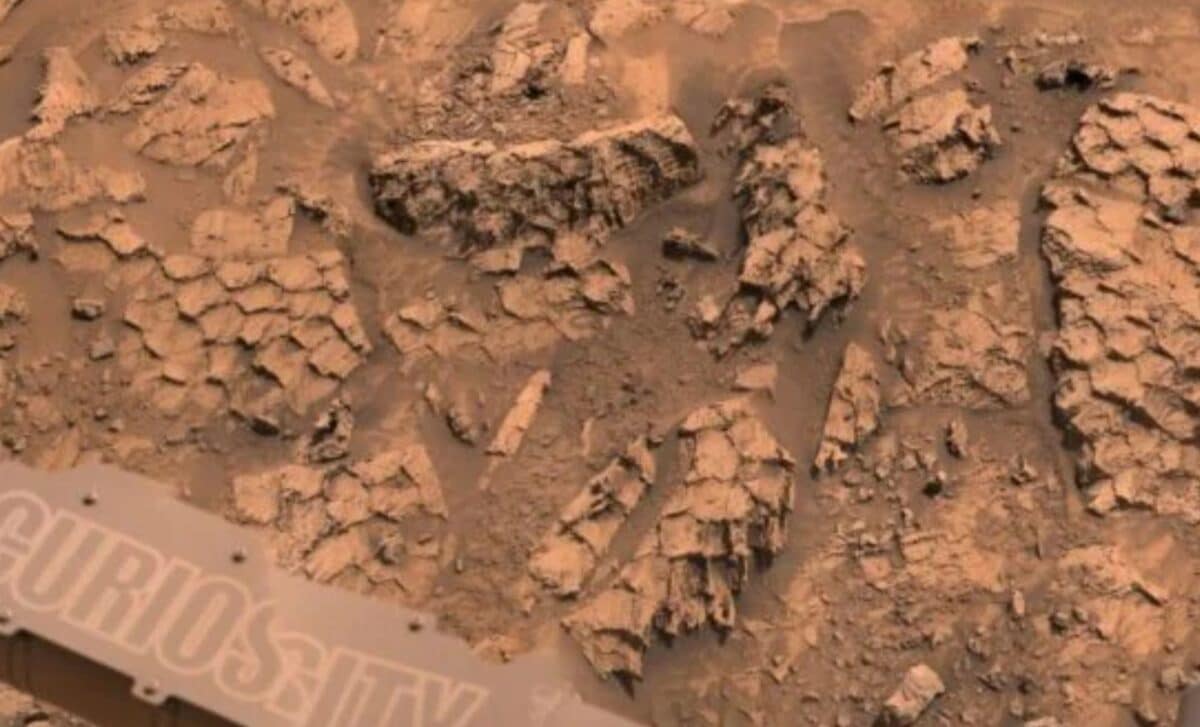
A strange, scale-like rock pattern spotted by NASA’s Curiosity rover is catching scientists’ attention on Mars.
The images were taken on April 13, 2026 (Sol 4865) as the rover moved toward the Antofagasta crater, which takes its name from a Chilean port city and the surrounding region located on the edge of the Atacama, in Gale Crater. They show thousands of repeating, honeycomb-like polygons, far more widespread than anything similar seen there before.
These formations matter because patterns like this are often linked to water-related processes. Their presence adds to ongoing efforts to understand how long liquid water may have existed on Mars.
A Pattern That Stands Out
As Curiosity rolled forward, its Mastcam revealed wide mosaics of a surface covered in honeycomb-shaped polygons. In the days leading up to the discovery, mission updates reported that the rover was heading toward a small crater about 10 meters (32 feet) in diameter.
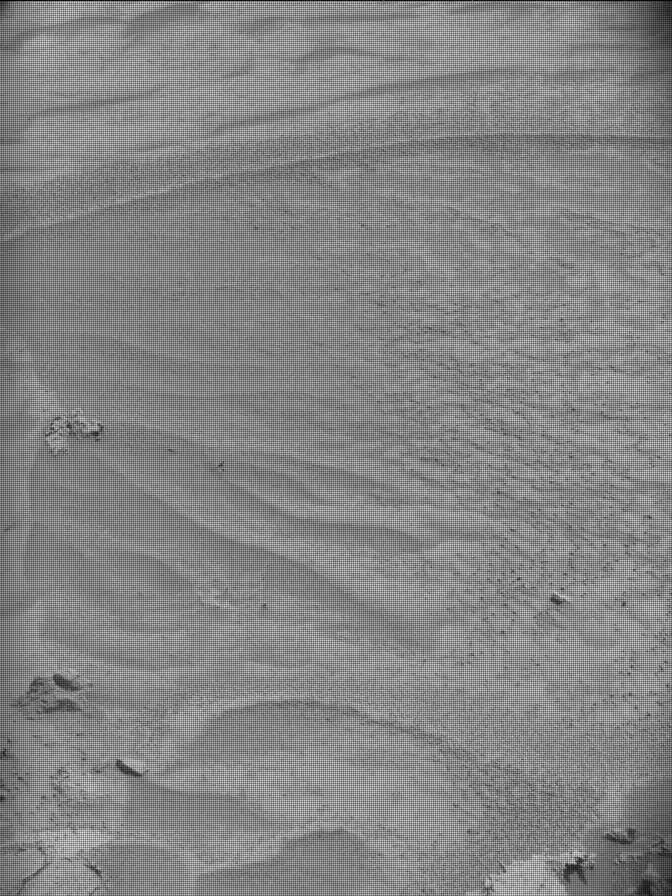 Captured by Mastcam on Curiosity as part of Sol 4865 operations on Mars. Credit: NASA/JPL-Caltech/MSSS
According to Abigail Fraeman from NASA’s Jet Propulsion Laboratory, scientists have seen this kind of pattern before, but not at this scale. She pointed out that:
“We’ve seen polygon-patterned rocks like these before,” she said in a NASA statement, “but they didn’t seem quite this dramatically abundant, stretching across the ground for meters and meters in our Mastcam mosaics.”
The look of the terrain has sparked comparisons to reptile skin, even if the science behind it is strictly geological. The sheer number of these shapes suggests something that happened again and again over time, not just a one-off event.
Evidence of Cyclical Wet and Dry Phases
On Earth, cracks like these usually form when wet mud dries out and shrinks. As stated by the source material, when that process repeats over and over, the cracks can evolve into more organized hexagonal shapes.
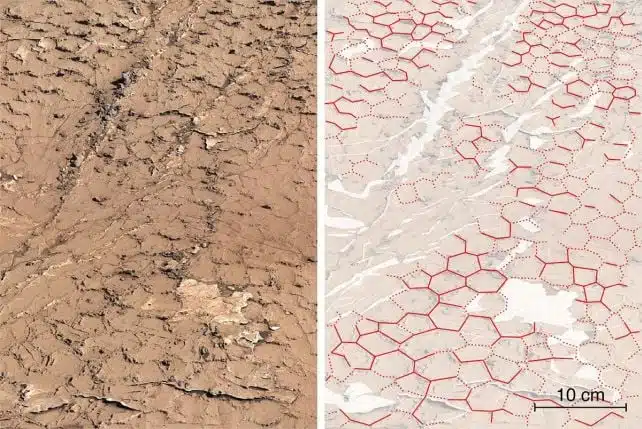 The well-preserved polygonal network at Pontours. Credit: Nature
A similar case was identified in 2023 at Pontours on Mars. As reported in a study published in the Journal of Statistical Physics, the hexagonal patterns observed there developed through multiple wet-dry cycles rather than a single drying event. The research indicates that cracks evolved from T-shaped intersections into Y-shaped junctions.
That kind of structure points to repeating conditions, possibly seasonal changes. If the same thing happened at Antofagasta, it would suggest Mars once had ongoing cycles involving liquid water.
Small Details That Could Change The Picture
Even with the similarities to Pontours, the new site has its own quirks. The edges of the polygons are raised, forming ridges that stand out from the rest of the rock. As explained by Fraeman, this can happen when minerals fill in the cracks and later resist erosion better than the surrounding material. Over time, that leaves behind these raised lines tracing the original pattern.
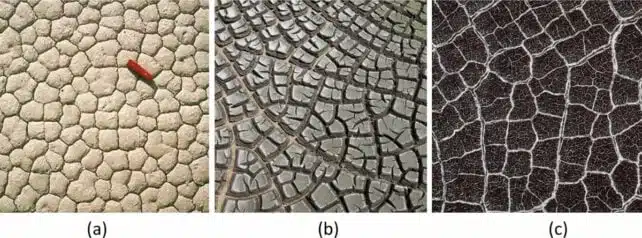 Surface crack geometries: (a)–(b) desiccation-induced mud patterns; (c) polygonal terrain on Mars. Credit: Journal of Statistical Physics
The rover has already 8collected images andchemical data from the area. Based on the mission team’s analysis, studying those details should help figure out whether minerals like salts, which were found at Pontours, are also present here. She added:
“We continued to collect lots of images and chemical data that will help us distinguish between different hypotheses for how the honeycomb textures formed.”
These observations add to growing evidence that Mars once had a more complex and active relationship with water than its surface suggests today.