

US consumer sentiment showed some improvement amid a two-week ceasefire between the US and Iran, but it’s still at record lows, according to new data from the University of Michigan.
The Index of Consumer Sentiment showed consumer sentiment ended April with a final reading of 49.8, above the 48.5 reading economists expected but marking the lowest level on record — below readings taken during the financial crisis, the COVID-19 pandemic, and when inflation spiked following Russia’s invasion of Ukraine.
Overall, consumer sentiment fell 6.6% from last month and 4.6% from a year ago.
Read more: What is consumer confidence, and why does it matter?
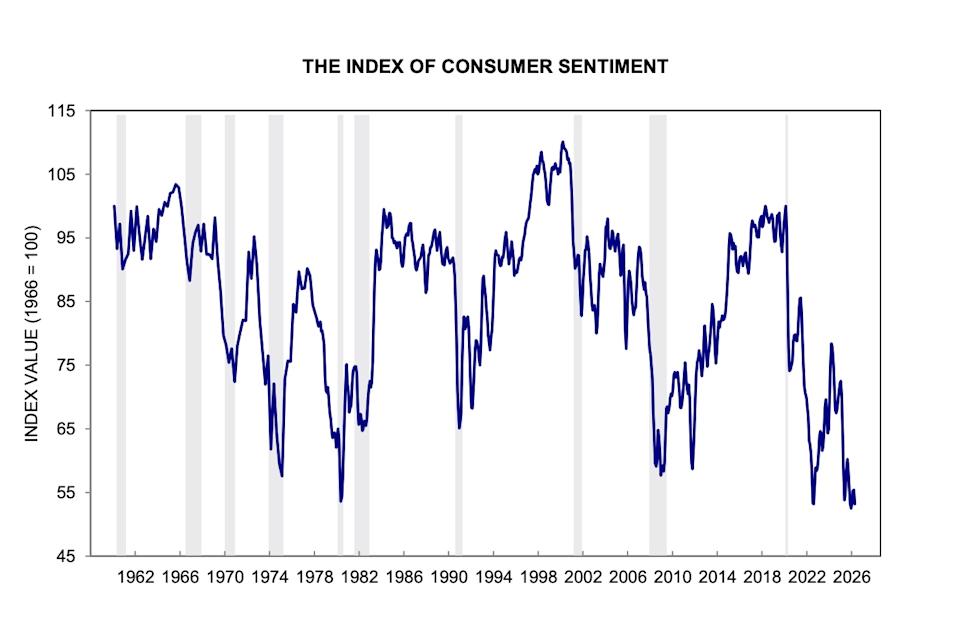 (Chart: University of Michigan)
The ceasefire in the Middle East made Americans feel a bit better about the shock to gas prices and other prices, Joanne Hsu, the survey’s director, said in the release. The record low in sentiment also comes as stock have hit record highs this week.
“In contrast, military and diplomatic developments that do not lift supply constraints or lower energy prices are unlikely to buoy consumers,” she added.
Gas prices have increased by more than $1 on average since the beginning of the war, according to AAA.
 Gas prices are displayed at a station in Brooklyn on April 21, 2026, in New York City. (Spencer Platt/Getty Images) · Spencer Platt via Getty Images
Friday’s reading from the University of Michigan also showed year-ahead inflation forecasts rising to 4.7% in April from 3.8% in March. That was the largest one-month increase since April 2025, when President Trump announced sweeping global tariffs that shocked markets.
Current inflation expectations also remain well above the 2.3% to 3% range seen in the two years before the pandemic.
Long-term inflation expectations climbed to 3.5% in April, the highest level since last October, as Americans expected inflation to stick around. That was higher than the 3.2% to 3.3% range inflation expectations have hovered around for the past four months. In 2019 and 2020, it was consistently below 2.8%.
Consumer sentiment fell across all ages, incomes, education levels, and political parties, Hsu said in the release.
Brooke DiPalma is a reporter for Yahoo Finance. Follow her on X at @BrookeDiPalma or email her at bdipalma@yahoofinance.com.
Click here for the latest economic news and indicators to help inform your investing decisions
Read the latest financial and business news from Yahoo Finance